Product Design, Manufacturing & Innovation Resources
Home » Customer-to-Customer (C2C) E-commerce Model

Customer-to-Customer (C2C) E-commerce Model

1995
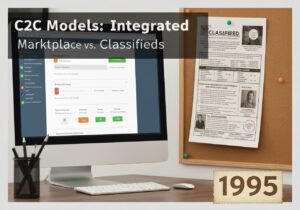
Customer-to-customer transactions in a vibrant online marketplace setting.

(generated image for illustration only)

Customer-to-customer (C2C) is a business model where consumers trade directly with each other, typically facilitated by a third-party online platform. This model contrasts with business-to-consumer (B2C) and business-to-business (B2B) models. The platform provider is not the seller but an intermediary that enables the transaction, creating a market for second-hand goods, handmade items, or collectibles.


The C2C model fundamentally democratizes commerce by removing traditional intermediaries like retailers and wholesalers. In this framework, an individual can act as both a buyer and a seller. The enabling third-party platform provides the necessary infrastructure, including user profiles, search functionality, messaging systems, and often payment processing. The success of a C2C platform hinges on its ability to attract a critical mass of both buyers and sellers, a network effect where the value of the service increases as more people use it.

Historically, C2C transactions existed in forms like garage sales, flea markets, and classified ads in newspapers. The internet revolutionized this by removing geographical barriers and drastically reducing transaction costs. Early platforms like eBay, founded in 1995, demonstrated the immense potential of this model by creating a global marketplace for virtually any item. The platform’s role is crucial; it must establish rules, handle disputes, and, most importantly, foster a sense of trust among strangers to encourage transactions.

UNESCO Nomenclature: 5312
– Business Administration

Type

Abstract System

Disruption

Revolutionary

Usage

Widespread Use

Precursors

  • newspaper classified advertisements
  • flea markets and swap meets
  • garage sales
  • the invention of the world wide web
  • development of secure online payment systems

Applications

  • online auction sites like ebay
  • peer-to-peer marketplaces like etsy
  • classified advertising websites like craigslist
  • social commerce on platforms like facebook marketplace
  • the sharing economy (e.g., airbnb, turo)

Patents:

NA

Potential Innovations Ideas

  • hyper-local c2c platforms for neighborhood skill-swapping
  • ai-powered c2c matching for rare collectibles based on image recognition
  • blockchain-based c2c platforms with smart contracts for automated, trustless transactions
  • subscription box services for curated second-hand goods
  • c2c platforms for trading digital assets and in-game items
  • augmented reality try-on features for second-hand clothing marketplaces
  • c2c rental platforms for specialized equipment (e.g., film gear, scientific instruments)
  • gamified c2c apps that reward users for successful transactions and positive reviews
Related to: c2c, e-commerce, business model, peer-to-peer, online marketplace, consumer, transaction, intermediary.

Historical Context

Customer-to-Customer (C2C) E-commerce Model

1986
1990
1992
1995
1995
2000
2008
1983
1990
1992
1994
1995
2000
2002-05-01
2010

(if date is unknown or not relevant, e.g. "fluid mechanics", a rounded estimation of its notable emergence is provided)

10th year anniversary

Full size images and downloads are only available, 100% free, for registered members.

> Login <