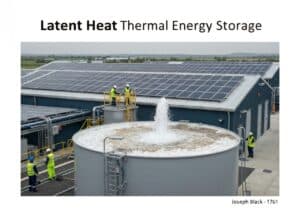
Thermal Energy Storage (TES) captures heat or cold across three fundamental mechanisms — sensible storage in materials such as water, rock, or molten salt; latent storage through phase transitions in PCMs; and thermochemical storage via reversible reactions in metal hydrides, zeolites, or calcium looping systems. Storage capacity, charge-discharge cycling efficiency, exergy retention, and thermal loss management define system performance across timescales ranging from diurnal buffering to interseasonal storage.
Integration contexts span concentrated solar power with molten salt two-tank configurations, district heating networks, industrial waste heat recovery, and absorption cooling. Packed bed regenerators, thermocline tanks, aquifer and borehole systems extend the design space further.
This page aggregates the latest peer-reviewed publications and granted patents across the full TES technical spectrum:
This is our latest selection of worldwide publications and patents in english on Thermal Energy Storage (TES), between many scientific online journals, classified and focused on Sensible heat storage, latent heat storage, thermochemical storage, stratified thermal storage, packed bed regenerator, molten salt storage, two-tank molten salt, single-tank thermocline, rock bed storage, aquifer thermal energy storage, borehole thermal energy storage, seasonal thermal storage, district heating integration, heat transfer fluid, charging and discharging cycle, thermal stratification, exergy efficiency, storage capacity density, thermal losse, insulation performance, solar thermal integration, Rankine cycle coupling, absorption chiller coupling, reversible thermochemical reaction, metal hydride storage, zeolite sorption storage, calcium looping, encapsulated PCM bed, heat exchanger effectiveness, thermal ratcheting and thermal energy stor.
Alkaline secondary battery and manufacturing method therefor
Patent published on the 2026-07-02 in WO under Ref WO2026141344 by MAXELL LTD [JP] (Inoue Yusuke [jp])
Abstract: The present invention provides an alkaline secondary battery that contains zinc metal, a zinc alloy, or a zinc compound as a negative electrode active material and exhibits excellent charging and discharging cycle characteristics, and a method for manufacturing the alkaline secondary battery. The alkaline secondary battery according to the present invention is characterized by containing: a negative electrode that is provided with a negative electrode active material layer containing zinc meta[...]
Our summary: The invention presents an alkaline secondary battery utilizing zinc-based materials for the negative electrode. It features a zinc oxide-containing layer between the negative electrode and separator. The manufacturing method includes specific mass ratios for optimal performance.
Alkaline battery, Zinc electrode, Battery manufacturing, Cycle characteristics
Patent
A system for deposition of dry ice for maintaining vacuum during desorption in direct air capture applications
Patent published on the 2026-06-24 in EP under Ref EP4763310 by SIEMENS ENERGY GLOBAL GMBH & CO KG [DE] (Hjalmarsson Christer [se], Jaksch Peter [se])
Abstract: A method of capturing carbon dioxide for use with a sorbent media includes the steps of configuring the sorbent media to receive a flow of a carbon dioxide containing gas within a pressure vessel, absorbing carbon dioxide from the carbon dioxide containing gas within the sorbent media during an absorption cycle, configuring the pressure vessel to be sealed with at least one lid, configuring the at least one lid to include at least one cryogenic heat exchanger, releasing an amount of carbon dioxi[...]
Our summary: The system captures carbon dioxide using sorbent media in a pressure vessel. It employs a cryogenic heat exchanger to freeze and isolate carbon dioxide during desorption. The process involves circulating a heat transfer fluid to maintain optimal temperature and pressure conditions.
carbon capture, sorbent media, cryogenic heat exchanger, desorption cycle
Patent
Method and system for optimizing hvac operation
Patent published on the 2026-06-24 in EP under Ref EP4764337 by MITSUBISHI ELECTRIC CORP [JP] (Olkis Christopher [gb])
Abstract: Embodiments of this application provide a method and system for operating an HVAC system, particularly in systems comprising heat pumps and thermal energy storage (TES) devices. The method includes: dividing an operational period into a number of sub-periods, where each sub-period represents a distinct portion of the operational period; obtaining information for operating the heat pump for at least some of the sub-periods, where the information may include factors such as energy demand, weather [...]
Our summary: The method optimizes HVAC operation by dividing the operational period into sub-periods. It gathers information on energy demand, weather conditions, and grid stability for each sub-period. The heat pump is controlled based on the determined operational state to ensure efficiency.
HVAC, heat pump, thermal energy storage, optimization
Patent
Cryostat microtome
Patent published on the 2026-06-24 in EP under Ref EP4764448 by LEICA BIOSYSTEMS NUSSLOCH GMBH [DE] (Kuffner Benedikt [de], Bayer Oliver [de], Thiem Stefan [de])
Abstract: [0001] A cryostat microtome (100, 500) comprises a cryostat chamber, a sample holder arranged inside the cryostat chamber and having an object head (108, 400) configured to hold a sample, a sectioning unit arranged inside the cryostat chamber and configured to section the sample, and a cooling system having a first circuit for cooling the cryostat chamber and a second circuit connecting the first circuit with the object head (108, 400) for cooling the object head (108, 400). The first circuit co[...]
Our summary: A cryostat microtome includes a cryostat chamber and a sample holder for sectioning samples. It features a cooling system with two circuits for efficient temperature management. The design incorporates a compressor and evaporators to maintain optimal conditions for sample preparation.
Cryostat, Microtome, Cooling System, Sectioning Unit
Patent
Captured carbon liquefication cooling using fuel cell heat recovery
Patent published on the 2026-06-24 in EP under Ref EP4764377 by TECHNIP ENERGIES FRANCE [FR] (Pawar Dhairyasheel [fr])
Abstract: [0001] A system and method of generating electrical energy using a fuel cell while decarbonizing an exhaust gas generated by the fuel cell is disclosed. Heat generated by an electrochemical reaction within the fuel cell can be recovered at both an anode side and a cathode side of the fuel cell, and at least some of the recovered heat can be used to preheat each of a fuel feed and an oxidant supplied to the fuel cell. A carbon capture system may be included and used to capture and liquefy carbon [...]
Our summary: A system generates electrical energy using a fuel cell while decarbonizing exhaust gases. Heat from the fuel cell s electrochemical reaction is recovered for preheating fuel and oxidant. A carbon capture system liquefies carbon dioxide from the anodic exhaust gas using cooled refrigerant.
carbon capture, fuel cell, heat recovery, liquefaction
Patent
Isothermal membrane-type tank
Patent published on the 2026-06-18 in WO under Ref WO2026127781 by LIMITED LIABILITY CO GTI [RU] (Spirin Artem Andreevich [ru], Serpova Mariya Aleksandrovna [ru])
Abstract: The invention relates to devices for storing and/or transporting low-temperature fluid media. Disclosed are an insulating joining panel, a hermetically sealed isothermal membrane-type tank with a wall comprising said insulating joining panel, and a method for manufacturing such a tank. The joining panel comprises a thermally insulating layer with a plywood sheet glued thereto, said plywood sheet forming the upper surface of the joining panel, and further comprises a sealing sheet made of a compo[...]
Our summary: The invention describes an isothermal membrane-type tank designed for low-temperature fluid storage. It features a unique insulating joining panel with a thermally insulating layer and a composite sealing sheet. This design simplifies manufacturing while ensuring effective insulation and hermetic sealing.
Isothermal tank, low-temperature storage, insulating panel, hermetic sealing
Patent
Performance analysis of a coal mine air supply system based on a multienergy complementary energy supply system
Published on 2026-06-03 by @OXFORD
Abstract: AbstractMine ventilation air heating in severely cold regions is commonly supplied by coal-fired boilers, leading to high energy use and environmental impacts. This study proposes a multienergy complementary energy supply system integrating air-source heat pumps (ASHPs), a cascade water-source heat pump, and thermal energy storage to ensure reliable shaft anti-freezing (3°C) and flexible operation under time-of-use electricity pricing. A dynamic TRNSYS model was developed for a coal mine in Wuh[...]
Our summary: This study presents a multienergy complementary energy supply system for mine ventilation heating in cold regions. A dynamic TRNSYS model was validated, showing a 7.57% error margin. The proposed system enhances performance in extreme cold, reducing costs and emissions significantly.
multienergy system, air-source heat pumps, thermal energy storage, coal mine ventilation
Publication
Development and Evaluation of an Integrated Phase Change Material Oriented Strand Board for Thermal Energy Storage in Building Walls
Published on 2026-02-02 by Layla Muhsan Hasan, Sanjeev Khanna @MDPI
Abstract: In this study, a phase change material (PCM) in the form of technical-grade octadecane and oriented strand boards (OSBs), which are boards made from wood strands, are used to develop a latent heat storage board with the aim of utilizing this material in building construction while lowering energy consumption. The incorporation of PCM into buildings is difficult for several reasons, including the organic phase material’s flammability and leakage during phase change. These obstacles [...]
Our summary: This study develops a shape-stabilized phase change material oriented strand board (SSPCM-OSB) for thermal energy storage in building walls. The integration of PCM into OSBs addresses challenges such as flammability and leakage. Extensive testing shows that SSPCM-OSB has lower heat flux and comparable flammability to conventional OSB.
Phase Change Material, Oriented Strand Board, Thermal Energy Storage, Building Construction
Publication