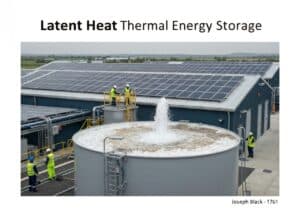
热能储存(TES)通过三种基本机制捕获热量或冷量:显热储存,例如储存在水、岩石或熔盐等材料中;潜热储存,例如通过相变材料(PCM)中的相变;以及热化学储存,例如通过金属氢化物、沸石或钙循环系统中的可逆反应。储存容量、充放电循环效率、火用保持和热损失管理决定了系统在从日间缓冲到跨季节储存等不同时间尺度上的性能。
集成背景涵盖 聚光太阳能 熔盐双罐式储能系统、区域供热网络、工业余热回收和吸收式制冷等应用,以及填充床再生器、温跃层储罐、含水层和钻孔系统等,进一步拓展了设计空间。
本页面汇总了TES技术领域最新的同行评审出版物和已授予的专利:
这是我们最新精选的全球英文版热能存储(TES)相关出版物和专利,涵盖众多科学在线期刊,并按显热存储、潜热存储、热化学存储、分层热存储、填充床再生器、熔盐存储、双罐熔盐存储、单罐温跃层存储、岩床存储、含水层热能存储、钻孔热能存储、季节性热存储、区域供热集成、传热流体、充放电循环、热分层、火用效率、存储容量密度、热损失、绝缘性能、太阳能热集成、朗肯循环耦合、吸收式制冷机耦合、可逆热化学反应、金属氢化物存储、沸石吸附存储、钙循环、封装相变材料床、换热器效率、热棘轮效应和热能存储等领域进行分类和重点介绍。
Heat pump and fan coil unit with thermal energy storage and thermal expansion valve in flow conduits extending therebetween
Patent published on the 2026-06-18 in US under Ref US20260168707 by CARRIER CORP [US] (Leman Derek [us], Troxler Casey [us])
Abstract: An air conditioning system, having: a heat pump having a heat pump coil, a fan coil unit (an FCU) having an FCU coil, a first conduit and a second conduit connecting the heat pump to the FCU coil, wherein the first conduit, the second conduit, the heat pump coil and the FCU coil define a loop; a working fluid in the loop; and a thermal energy storage unit (a TES unit) coupled to the first conduit; a thermal expansion valve (a TXV) including a TXV body coupled to the second conduit, and a bulb co[...]
Our summary: The system consists of a heat pump and a fan coil unit connected by conduits. It includes a thermal energy storage unit and a thermal expansion valve. A working fluid circulates within the defined loop.
Heat pump, fan coil unit, thermal energy storage, thermal expansion valve
Patent
Isothermal membrane-type tank
Patent published on the 2026-06-18 in WO under Ref WO2026127781 by LIMITED LIABILITY CO GTI [RU] (Spirin Artem Andreevich [ru], Serpova Mariya Aleksandrovna [ru])
Abstract: The invention relates to devices for storing and/or transporting low-temperature fluid media. Disclosed are an insulating joining panel, a hermetically sealed isothermal membrane-type tank with a wall comprising said insulating joining panel, and a method for manufacturing such a tank. The joining panel comprises a thermally insulating layer with a plywood sheet glued thereto, said plywood sheet forming the upper surface of the joining panel, and further comprises a sealing sheet made of a compo[...]
Our summary: The invention describes an isothermal membrane-type tank designed for low-temperature fluid storage. It features a unique insulating joining panel with a thermally insulating layer and a composite sealing sheet. This design simplifies manufacturing while ensuring effective insulation and hermetic sealing.
Isothermal tank, low-temperature storage, insulating panel, hermetic sealing
Patent
Temperature controlled storage and retrieval system
Patent published on the 2026-06-17 in GB under Ref GB2702484 by OCADO INNOVATION LTD [GB] (Paul Bird [gb])
Abstract: A temperature controlled automated storage and retrieval system comprising a tracked 46 and grided arrangement on which at least one robotic load handling device 30 operates, comprises container storage area 60. Cooling system 62 comprising at least one cooling unit 76 and a closed network of tubing 70 in fluid communication with unit 76, to circulate a heat transfer fluid from unit 76 to the closed network of tubing via a common feed inlet 84. Fluid is fed back to cooling unit 76 via common ret[...]
Our summary: The system features an automated storage and retrieval mechanism with robotic load handling. It includes a cooling system that circulates a heat transfer fluid through a closed network of tubing. A controller manages the temperature based on ice thickness, ensuring optimal conditions for stored items.
automated storage, temperature control, robotic handling, cooling system
Patent
Thermal energy generation and storage device
Patent published on the 2026-06-17 in EP under Ref EP4760192 by CLIVET S P A [IT] (Gu Zongmin [cn])
Abstract: A thermal energy generation and storage device is provided comprising: a thermal energy generation system; a thermal energy storage system including a plurality of modules; a first heat exchanger operatively connected to the modules and to the generation system and capable of transferring thermal energy from the generation system to the modules through a first transfer fluid; and wherein the modules comprise: a first module (30a) including a first phase change material defining a first phase cha[...]
Our summary: The device includes a thermal energy generation system and a thermal energy storage system with multiple modules. It features a first heat exchanger for transferring thermal energy between the generation system and the storage modules. Additionally, a second heat exchanger connects the storage system to an external utility for thermal energy transfer.
thermal energy, storage system, heat exchanger, phase change material
Patent
Method for determining the thickness of scale on the inner surface of pipes in a water-heating boiler system
Patent published on the 2026-06-17 in UA under Ref UA163361U by UKRAINIAN STATE UNIV OF SCIENCE AND TECHNOLOGIES [UA] (Dolzhanskyi Anatolii Mykhailovych [ua], Brahynskyi Oleh Borysovych [ua], Bondarenko Oksana Anatoliivna [ua])
Abstract: Method for determining the thickness of scale on the inner surface of pipes in a water-heating boiler system involves measuring the ambient temperature and the temperature of the pipe’s outer surface, as well as the temperature of the heat transfer fluid at the pipe’s inlet and outlet, the pipe wall thickness, and the pipe’s inner diameter. The temperature of the pipe surface is measured along the length of the system after it has stabilized during the supply of coolant, preheated to the s[...]
Our summary: The method determines scale thickness on pipes in water-heating boilers. It involves measuring ambient and surface temperatures, as well as pipe dimensions. Scale thickness is calculated using a heat balance equation.
scale thickness, pipe measurement, heat transfer, boiler system
Patent
Hydrate materials for thermal energy storage and methods for using
Patent published on the 2026-06-11 in US under Ref US20260159739 by BATTELLE MEMORIAL INST [US] (Murugesan Vijayakumar [us], Karakoti Ajay S [us], Thangaraj Kavin Chakravarthy [us])
Abstract: [0000] Embodiments provide thermochemical energy storage materials, methods and systems. Materials include organic or organometal material hydrates and corresponding anhydrates including isolate site hydrates like alendronate sodium trihydrate, channel associated hydrates like cromolyn sodium, and ion associated hydrates like ibuprofen sodium dihydrate, and nedocromil sodium. Preferred hydrates have hydrophobic backbones and hydrophilic sites or channels.[...]
Our summary: The content discusses thermochemical energy storage materials and methods. It highlights various hydrate materials, including organic and organometal hydrates. Preferred materials feature hydrophobic backbones with hydrophilic sites or channels.
thermochemical energy storage, hydrate materials, thermal energy storage, hydrophobic backbones
Patent
Performance analysis of a coal mine air supply system based on a multienergy complementary energy supply system
Published on 2026-06-03 by @OXFORD
Abstract: AbstractMine ventilation air heating in severely cold regions is commonly supplied by coal-fired boilers, leading to high energy use and environmental impacts. This study proposes a multienergy complementary energy supply system integrating air-source heat pumps (ASHPs), a cascade water-source heat pump, and thermal energy storage to ensure reliable shaft anti-freezing (3°C) and flexible operation under time-of-use electricity pricing. A dynamic TRNSYS model was developed for a coal mine in Wuh[...]
Our summary: This study presents a multienergy complementary energy supply system for mine ventilation heating in cold regions. A dynamic TRNSYS model was validated, showing a 7.57% error margin. The proposed system enhances performance in extreme cold, reducing costs and emissions significantly.
multienergy system, air-source heat pumps, thermal energy storage, coal mine ventilation
Publication
Development and Evaluation of an Integrated Phase Change Material Oriented Strand Board for Thermal Energy Storage in Building Walls
Published on 2026-02-02 by Layla Muhsan Hasan, Sanjeev Khanna @MDPI
Abstract: In this study, a phase change material (PCM) in the form of technical-grade octadecane and oriented strand boards (OSBs), which are boards made from wood strands, are used to develop a latent heat storage board with the aim of utilizing this material in building construction while lowering energy consumption. The incorporation of PCM into buildings is difficult for several reasons, including the organic phase material’s flammability and leakage during phase change. These obstacles [...]
Our summary: This study develops a shape-stabilized phase change material oriented strand board (SSPCM-OSB) for thermal energy storage in building walls. The integration of PCM into OSBs addresses challenges such as flammability and leakage. Extensive testing shows that SSPCM-OSB has lower heat flux and comparable flammability to conventional OSB.
Phase Change Material, Oriented Strand Board, Thermal Energy Storage, Building Construction
Publication