Product Design, Manufacturing & Innovation Resources
家 » Heterogeneous Catalysis

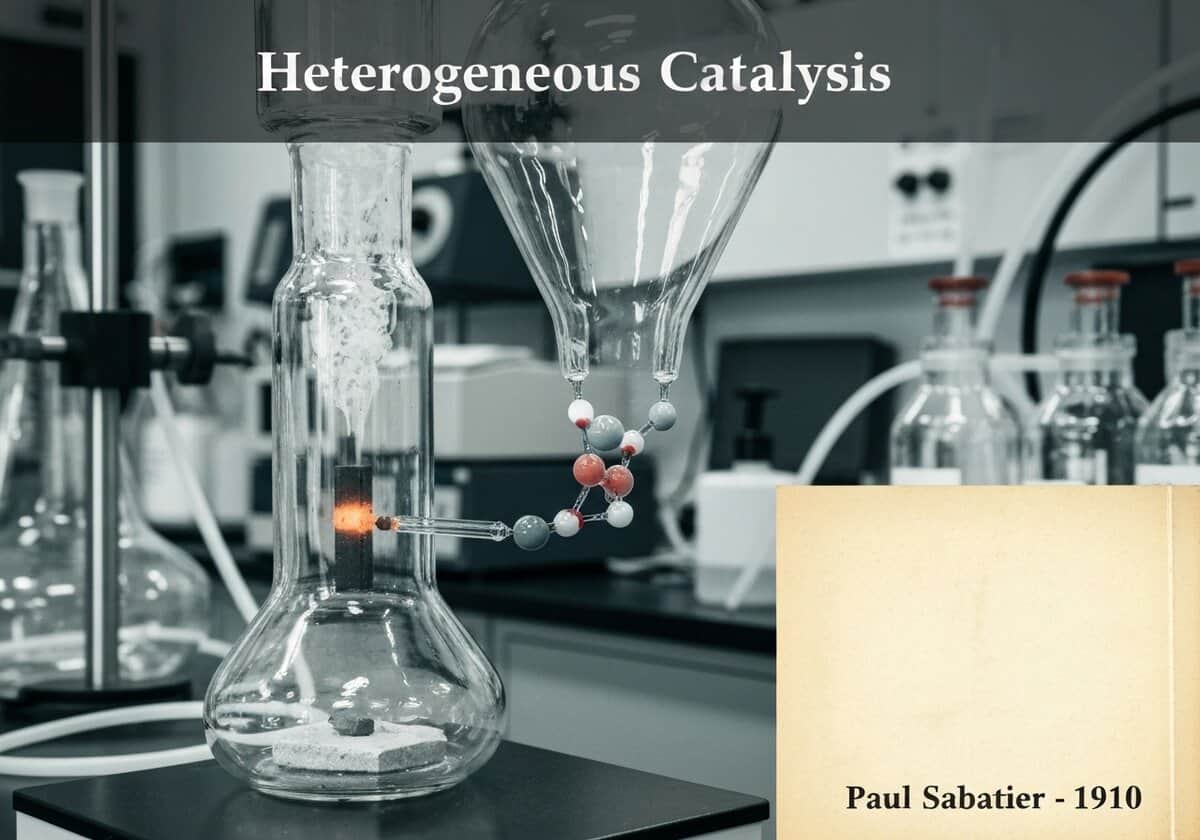
Heterogeneous Catalysis

1910
  • Paul Sabatier
物理化学における不均一触媒作用を示す反応器内の固体触媒。

(画像はイメージです)

In heterogeneous 触媒作用、 触媒 is in a different phase from the reactants. Typically, a solid catalyst is used with gaseous or liquid reactants. The process involves several steps: diffusion of reactants to the catalyst surface, adsorption onto active sites, chemical reaction on the surface, desorption of products, and diffusion of products away from the surface.

Heterogeneous catalysis is the cornerstone of the modern chemical industry, accounting for the vast majority of large-scale industrial processes. The key advantage is the ease of separating the catalyst from the product stream, which simplifies purification and allows for continuous operation. The catalyst is often a porous solid with a high surface area, maximizing the number of available active sites. These 触媒 can be unsupported (e.g., platinum gauze) or, more commonly, supported, where catalytically active metal nanoparticles are dispersed on a high-surface-area support material like alumina ([latex]Al_2O_3[/latex]), silica ([latex]SiO_2[/latex]), or activated carbon.

The mechanism, often described by the Langmuir–Hinshelwood model, involves the adsorption of reactant molecules onto the catalyst surface. This adsorption weakens the chemical bonds within the reactants, lowering the activation energy for the reaction. After the reaction occurs between adsorbed species, the product molecules desorb from the surface, freeing the active site for another catalytic cycle. The overall rate can be limited by any of these steps, from mass transport of reactants to the surface to the desorption of products. Catalyst deactivation through processes like poisoning (strong adsorption of impurities), coking (deposition of carbonaceous material), or sintering (loss of surface area at high temperatures) is a major practical challenge.

UNESCO Nomenclature: 2202
物理化学

タイプ

化学プロセス

混乱

革命的

使用法

広く普及している

前駆物質

  • discovery of 吸着 by Carl Wilhelm Scheele and Felice Fontana
  • マイケル・ファラデーによる白金の触媒特性に関する研究
  • ポール・サバティエによる有機化合物の触媒的水素化に関する研究
  • 表面科学技術の開発

アプリケーション

  • アンモニア合成のためのハーバー・ボッシュ法
  • 自動車の触媒コンバーター
  • 石油精製における流動接触分解(FCC)
  • 合成燃料のためのフィッシャー・トロプシュ法
  • 硫酸製造のための接触法

特許:

NA

潜在的なイノベーションのアイデア

  • single-atom catalysts for maximum efficiency and selectivity
  • 3D-printed catalyst structures for optimized flow and mass transfer
  • self-regenerating catalysts that can reverse poisoning effects
  • plasmonic catalysts that use light energy to drive reactions
  • metal-organic framework (mof) based catalysts with tunable porosity
  • catalytic membranes that combine reaction and separation in one step
  • nanoreactors with encapsulated catalysts for cascade reactions
  • catalysts for converting nitrogen directly into fertilizers at ambient conditions
  • magnetic catalysts for easy recovery from liquid-phase reactions
  • catalysts that operate efficiently at low temperatures to save energy
関連分野:不均一触媒、固体触媒、表面化学、吸着、活性部位、脱着、ラングミュア・ヒンシェルウッド、触媒担体、工業化学、物質輸送。

歴史的背景

Heterogeneous Catalysis

1904
1907
1909
1910
1912
1915
1915-11
1902
1907
1909
1910
1911-04-08
1913
1915
1916

(日付が不明または関連性がない場合、例えば「流体力学」などでは、その注目すべき出現時期の概算値が提示されます。)

10年目 周年

フルサイズの画像とダウンロードは、登録会員のみが100%無料で利用できます。