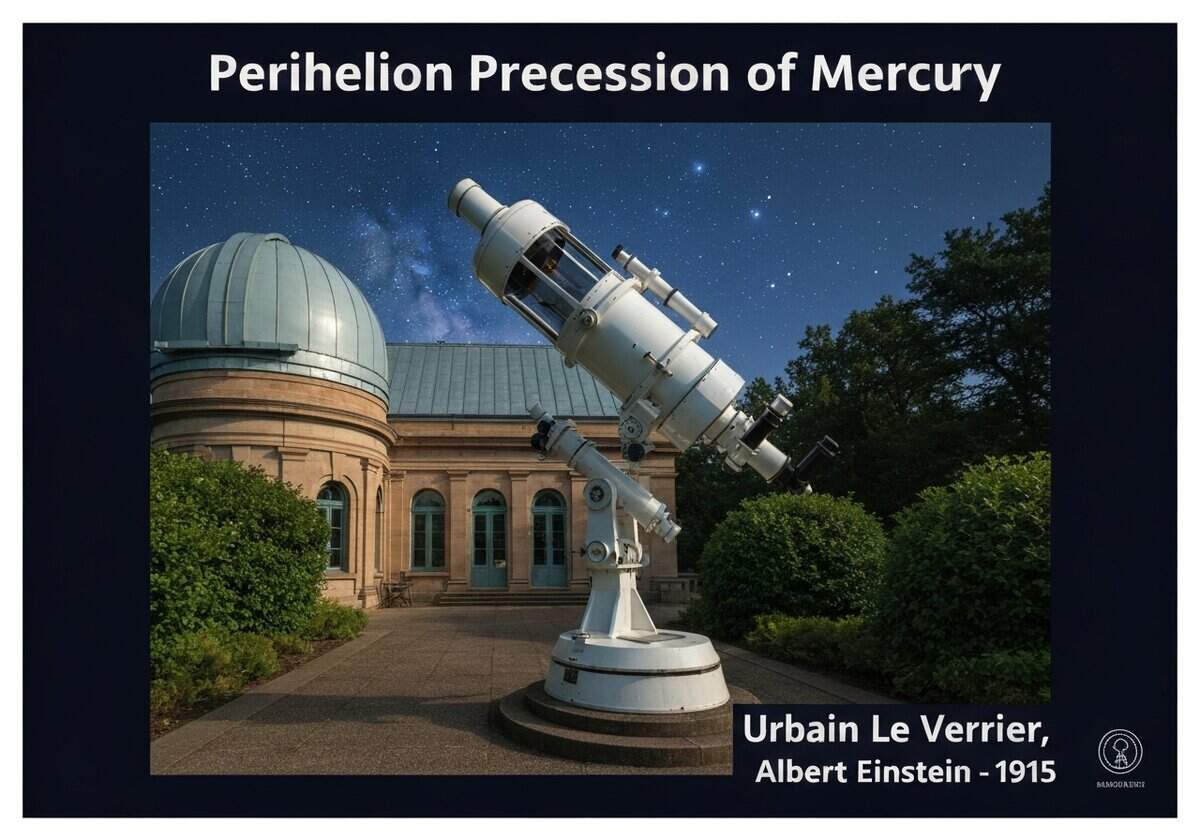
一般相対性理論は、水星の近日点における異常な歳差運動を初めて正確に説明した。ニュートン重力では、水星の楕円軌道の向きがゆっくりと徐々に変化していく現象を完全に説明することはできなかった。アインシュタインの理論は、1世紀あたり43秒角のずれを正しく予測し、それを太陽周辺の時空の曲率に起因するものとした。これは、この理論にとって初期の大きな成果であった。


(画像はイメージです)
一般相対性理論は、水星の近日点における異常な歳差運動を初めて正確に説明した。ニュートン重力では、水星の楕円軌道の向きがゆっくりと徐々に変化していく現象を完全に説明することはできなかった。アインシュタインの理論は、1世紀あたり43秒角のずれを正しく予測し、それを太陽周辺の時空の曲率に起因するものとした。これは、この理論にとって初期の大きな成果であった。
19世紀、天文学者たちは水星の楕円軌道が静止していないことを観測した。太陽に最も近づく点である近日点が、ゆっくりと前進、つまり歳差運動を起こしていたのだ。この歳差運動の大部分はニュートンの法則に従って他の惑星の重力によって説明できたが、1世紀あたり約43秒角というわずかなずれは説明がつかなかった。この異常は科学者たちを困惑させ、中には水星と太陽の間に未発見の惑星バルカンが存在すると提唱する者もいた。
In 1915, Albert Einstein applied his new theory of general relativity to the problem. His calculations showed that the curvature of spacetime caused by the Sun’s mass would introduce a correction to the Newtonian description of gravity. This correction perfectly accounted for the missing 43 arcseconds per century without any ad-hoc parameters. Unlike Newton’s theory, where orbits are closed ellipses (in a two-body system), general relativity predicts that orbits are not closed but trace a rosette pattern. This effect is most pronounced for objects in strong gravitational fields and with eccentric orbits, making Mercury the ideal candidate in our ソーラー system. The successful explanation of Mercury’s perihelion precession was one of the first strong pieces of evidence that general relativity was a more accurate description of gravity than Newton’s theory.
Perihelion Precession of Mercury
(日付が不明または関連性がない場合、例えば「流体力学」などでは、その注目すべき出現時期の概算値が提示されます。)

フルサイズの画像とダウンロードは、登録会員のみが100%無料で利用できます。
> ログイン <