Product Design, Manufacturing & Innovation Resources
家 » 触媒作用

触媒作用

1835
  • Jöns Jacob Berzelius
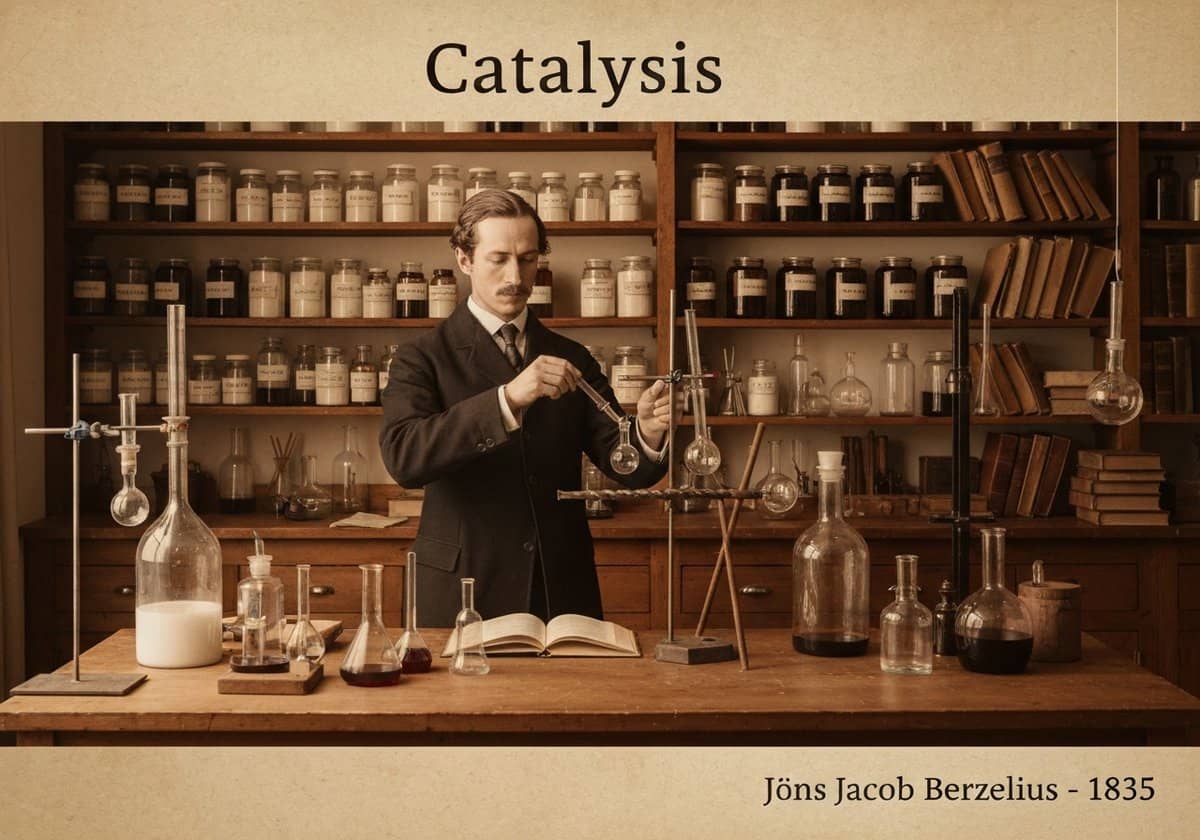
歴史的な実験室で触媒実験を行う化学者。.

(画像はイメージです)

Catalysis is the process of increasing the rate of a chemical reaction by adding a substance known as a 触媒. Catalysts are not consumed in the reaction and remain unchanged. They work by providing an alternative reaction pathway with a lower activation energy ([latex]E_a[/latex]), thereby accelerating both the forward and reverse reactions without altering the overall thermodynamics ([latex]\Delta H[/latex]).

The fundamental principle of catalysis lies in its ability to alter the kinetics of a chemical reaction without affecting its thermodynamics. A 触媒 introduces a new reaction mechanism, often involving one or more intermediate steps. For a reaction A + B → C, a catalyst C’ might participate as follows: A + C’ → AC’ and then AC’ + B → C + C’. The catalyst C’ is regenerated at the end of the process. This alternative pathway has a lower transition state energy compared to the uncatalyzed reaction. The Arrhenius equation, [latex]k = Ae^{-E_a/(RT)}[/latex], shows that a lower activation energy ([latex]E_a[/latex]) leads to an exponential increase in the reaction rate constant (k). Importantly, the catalyst does not change the Gibbs free energy change ([latex]\Delta G[/latex]) or the equilibrium constant ([latex]K_{eq}[/latex]) of the reaction. It only affects the speed at which equilibrium is reached. This concept was first formally described by Jöns Jacob Berzelius in 1835, who observed that certain substances could accelerate reactions without being consumed, coining the term “catalysis” from Greek words meaning “to dissolve” or “to break down”.

この原理は反応座標図を用いて視覚化され、触媒反応経路では非触媒反応経路よりも低いエネルギーピーク(遷移状態)が示されます。反応物と生成物の間の全体的なエネルギー差は同じままですが、乗り越えるべきエネルギー障壁は大幅に低下します。これにより、より多くの反応物分子が衝突時に反応するのに十分なエネルギーを持つようになり、一定の温度において反応速度が速くなります。

UNESCO Nomenclature: 2202
物理化学

タイプ

化学プロセス

混乱

基礎

使用法

広く普及している

前駆物質

  • 錬金術における賢者の石の概念
  • ルイ・パスツールによる発酵の観察
  • ハンフリー・デービーによる白金がガス燃焼に及ぼす影響に関する研究
  • カール・ヴィルヘルム・シェーレによる塩素の発見。これは後に触媒反応に利用されるようになった。

アプリケーション

  • 工業用化学合成(例:アンモニア、硫酸)
  • 石油精製
  • ポリマー製造
  • 汚染防止装置(触媒コンバーター)
  • 医薬品製造

特許:

NA

潜在的なイノベーションのアイデア

  • self-healing materials with embedded catalyst capsules
  • smart catalysts that activate only under specific light or ph conditions
  • catalytic systems for 直接大気回収 of co2
  • miniaturized catalytic reactors for on-demand chemical synthesis in space
  • catalysts designed by machine learning for breaking down persistent pollutants
  • biocompatible catalysts for in-vivo synthesis of therapeutic drugs
  • catalytic surfaces that prevent biofilm formation
  • catalysts for converting plastic waste directly into high-value chemicals
  • photo-responsive catalysts for solar-powered water splitting
  • catalytic nanoparticles for targeted cancer therapy
関連キーワード:触媒作用、触媒、活性化エネルギー、反応速度、化学反応速度論、熱力学、反応経路、イェンス・ヤコブ・ベルセリウス、平衡、遷移状態。

歴史的背景

触媒作用

1831
1832
1834
1835
1838
1841
1845
1831
1831
1833
1834
1836
1839-01-01
1842
1847

(日付が不明または関連性がない場合、例えば「流体力学」などでは、その注目すべき出現時期の概算値が提示されます。)

10年目 周年

フルサイズの画像とダウンロードは、登録会員のみが100%無料で利用できます。