Product Design, Manufacturing & Innovation Resources
家 » 酵素触媒(生体触媒)

酵素触媒(生体触媒)

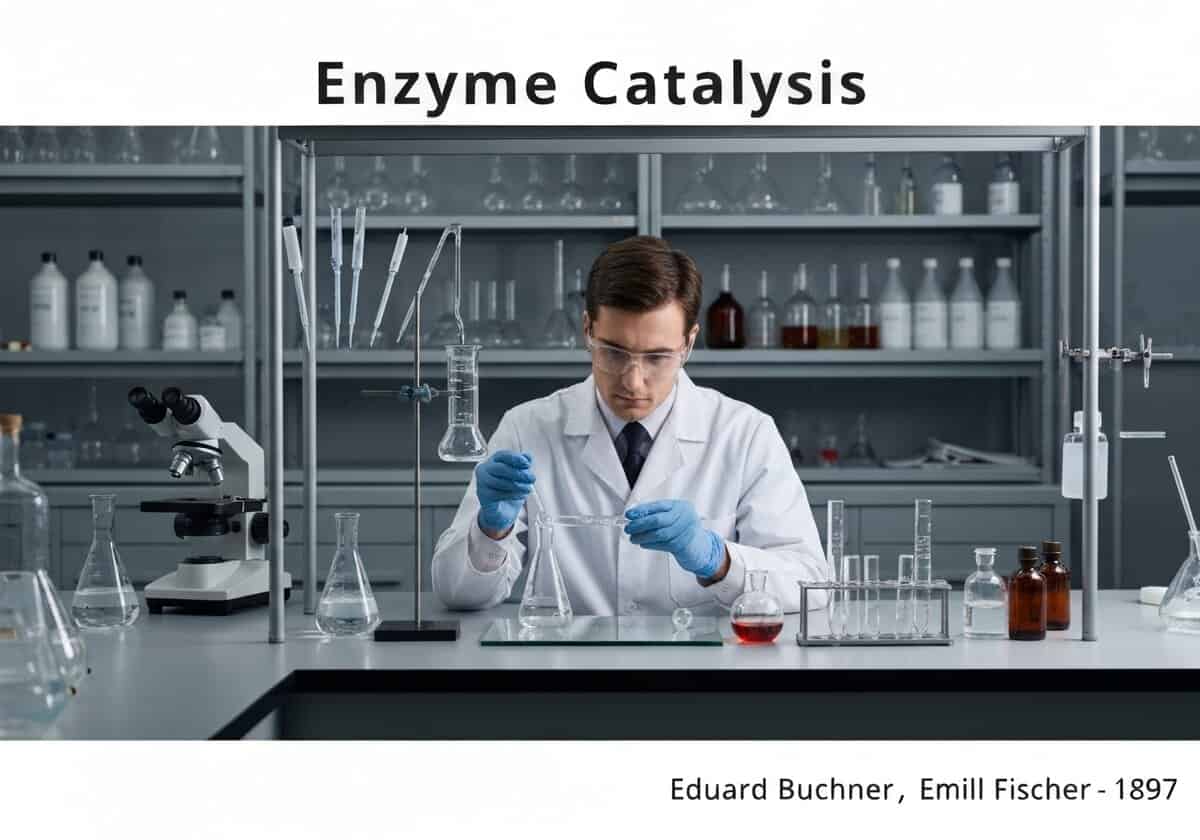
1897
  • Eduard Buchner
  • Emil Fischer
Biochemist conducting enzyme catalysis experiments in a laboratory.

(画像はイメージです)

Enzymes are proteins that act as biological 触媒 (biocatalysts). They exhibit remarkable specificity and efficiency, often accelerating reactions by factors of millions under mild physiological conditions (temperature, pH). The reaction occurs in a specific region of the enzyme called the active site, which binds the substrate through a lock-and-key or induced-fit mechanism.

Enzyme catalysis represents the pinnacle of catalytic efficiency and selectivity. These complex protein structures create a unique microenvironment within their active site that is perfectly tailored to stabilize the transition state of a specific reaction. This is achieved through a combination of factors: precise orientation of substrates, providing acidic or basic functional groups, straining substrate bonds, and providing an alternative covalent pathway. The kinetics of many enzyme-catalyzed reactions can be described by the Michaelis-Menten equation: [latex]v = \frac{V_{max}[S]}{K_M + [S]}[/latex], where [latex]v[/latex] is the reaction rate, [latex]V_{max}[/latex] is the maximum rate, [latex][S][/latex] is the substrate concentration, and [latex]K_M[/latex] (the Michaelis constant) is the substrate concentration at which the reaction rate is half of [latex]V_{max}[/latex].

Emil Fischer’s original ‘lock-and-key’ model proposed a rigid active site perfectly matching the substrate. This was later refined by Daniel Koshland’s ‘induced-fit’ model, which suggests that the active site is flexible and changes conformation upon substrate binding to achieve optimal catalytic orientation. This specificity is often stereospecific, meaning enzymes can distinguish between stereoisomers, a critical feature for producing enantiomerically pure drugs. While historically used in food production, modern biotechnology has expanded their use to industrial synthesis, diagnostics, and therapeutics through techniques like directed evolution, which allows scientists to engineer enzymes with novel properties.

UNESCO Nomenclature: 2302
生化学

タイプ

生物学的プロセス

混乱

革命的

使用法

広く普及している

前駆物質

  • Louis Pasteur’s work linking fermentation to living organisms
  • discovery and isolation of diastase (amylase) by Anselme Payen
  • Emil Fischer’s lock-and-key theory of enzyme specificity
  • Eduard Buchner’s discovery of cell-free fermentation

アプリケーション

  • production of high-fructose corn syrup
  • use of proteases in laundry detergents
  • synthesis of chiral pharmaceuticals
  • cheese and yogurt production
  • bioremediation to break down pollutants

特許:

NA

潜在的なイノベーションのアイデア

  • artificial enzymes (synzymes) created from non-biological scaffolds
  • enzymes engineered to degrade plastics like pet
  • immobilized enzymes in continuous flow reactors for industrial synthesis
  • enzyme-based biosensors for medical diagnostics and environmental monitoring
  • cascade reactions using multiple enzymes in a single pot to build complex molecules
  • enzymes that function in non-aqueous solvents for organic synthesis
  • thermostable enzymes from extremophiles for high-temperature industrial processes
  • light-activated enzymes (optozymes) for precise spatiotemporal control of reactions
  • enzymes designed to capture and convert carbon dioxide
  • in-vivo enzyme therapies to correct metabolic disorders
Related to: enzyme, biocatalysis, active site, Michaelis-Menten kinetics, specificity, induced fit, lock and key, substrate, protein, directed evolution.

歴史的背景

1880
1897
1970
1890
1955
1980

(日付が不明または関連性がない場合、例えば「流体力学」などでは、その注目すべき出現時期の概算値が提示されます。)

10年目 周年

フルサイズの画像とダウンロードは、登録会員のみが100%無料で利用できます。