Product Design, Manufacturing & Innovation Resources
家 » Gravitational Time Dilation

Gravitational Time Dilation

1915
  • Albert Einstein
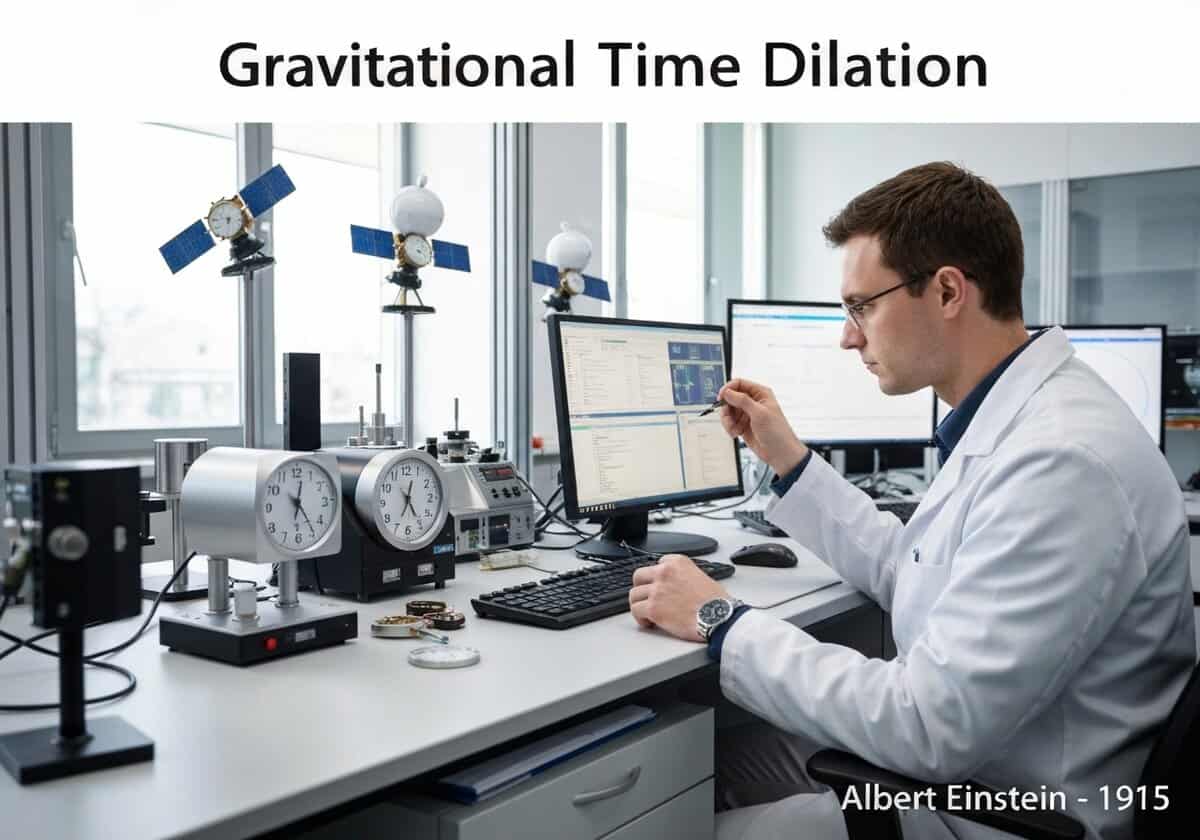
重力による時間の遅れの原理を実証する実験室での原子時計の校正。

(画像はイメージです)

A key prediction of general relativity is that time passes at different rates in different gravitational potentials. A clock in a stronger gravitational field (closer to a massive object) will tick slower than a clock in a weaker field. This effect, known as gravitational time dilation, has been experimentally verified and is a crucial factor in modern technology like GPS.


重力による時間の遅れは、時間の経過速度が時空の曲率によって影響を受けるという原理から生じます。重力が強い領域では、時間の「流れ」自体が重力が弱い領域に比べて遅くなります。これは時計に対する機械的な効果ではなく、時間の経過の実際の差です。たとえば、海面にある時計は、山の上にある同じ時計よりもわずかに遅く進みます。回転しない球対称の質量に対するこの効果の式は、[latex]t_f = t_0 sqrt{1 – frac{2GM}{rc^2}}[/latex]で、ここで[latex]t_f[/latex]は遠方の観測者の時間、[latex]t_0[/latex]は重力場内の時間です。

This effect was first confirmed experimentally by the Pound-Rebka experiment in 1959, which measured the gravitational redshift of photons (a related phenomenon). The most significant real-world application is the Global Positioning System (GPS). The atomic clocks on GPS satellites are in a weaker gravitational field than clocks on Earth’s surface, so they run faster by about 45 microseconds per day. They also experience special relativistic time dilation due to their high velocity, making them run slower by about 7 microseconds per day. The net effect is that GPS satellite clocks run faster by about 38 microseconds daily. Without correcting for this, GPS navigation errors would accumulate at about 10 kilometers per day, rendering the system useless.

UNESCO Nomenclature: 2211
相対性理論

タイプ

抽象システム

混乱

実質的な

使用法

広く普及している

前駆物質

  • 特殊相対性理論と速度による時間の遅れの概念
  • 等価原理
  • ミンコフスキー時空

アプリケーション

  • 全地球測位システム(GPS)衛星が正確に機能するためには、特殊相対性理論と一般相対性理論の両方の時間膨張に対する補正が必要となる。
  • 原子時計による正確な時刻計測
  • ブラックホールと中性子星の物理学を理解する
  • 重力赤方偏移の天文学的観測

特許:

NA

潜在的なイノベーションのアイデア

  • ultra-secure communication channels based on synchronized clocks in different gravitational potentials
  • ‘chronoscaping’ habitats in deep space to alter the perception of time for long-duration missions
  • gravitational potential sensors for mapping planetary interiors
  • a new generation of atomic clocks that use time dilation to measure gravity with unprecedented precision
  • time-stasis pods for medical procedures by placing patients in intense, temporary gravitational fields
  • advanced navigation systems for probes near black holes or neutron stars
  • a global time standard that dynamically accounts for local gravitational variations
  • energy generation by exploiting time dilation differentials
関連概念:時間の遅れ、一般相対性理論、重力、時空、GPS、原子時計、重力ポテンシャル、赤方偏移。

歴史的背景

Gravitational Time Dilation

1909
1910
1912
1915
1915-11
1916
1918
1909
1910
1911-04-08
1913
1915
1916
1917
1918

(日付が不明または関連性がない場合、例えば「流体力学」などでは、その注目すべき出現時期の概算値が提示されます。)

10年目 周年

フルサイズの画像とダウンロードは、登録会員のみが100%無料で利用できます。