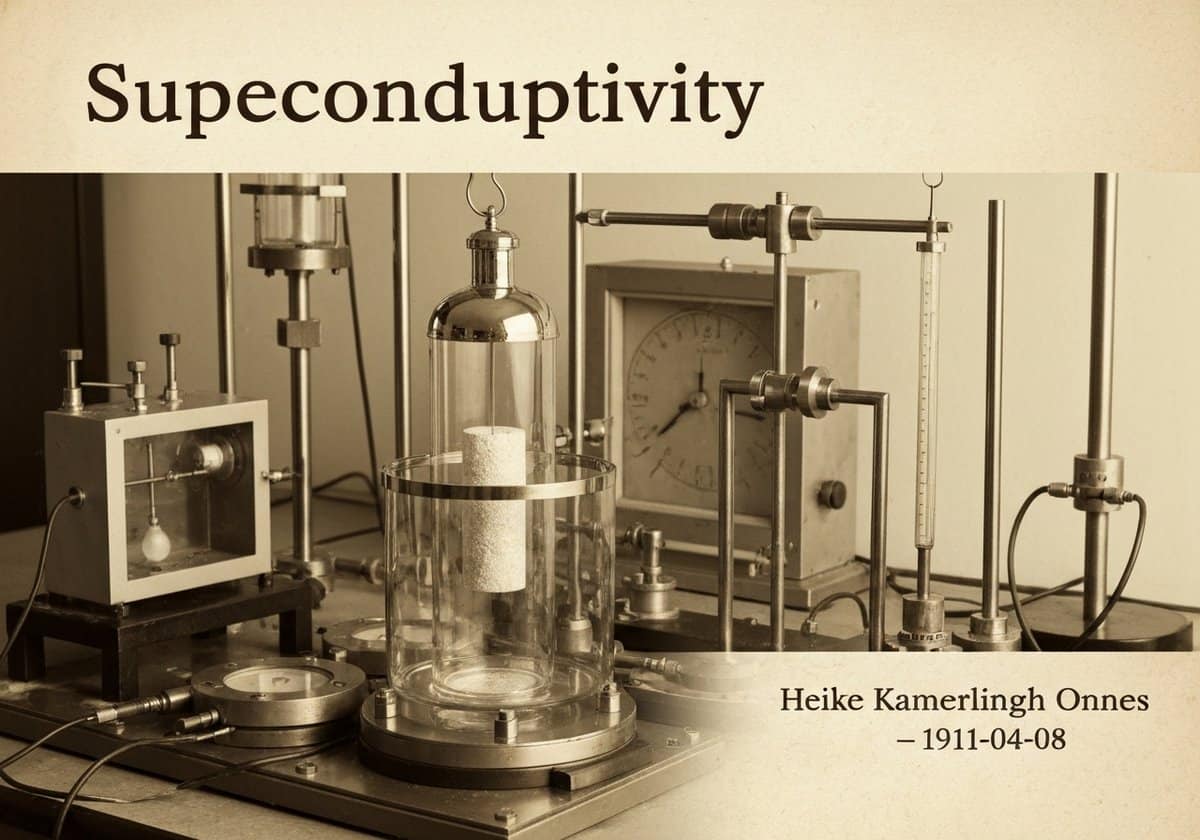
The discovery was a direct consequence of Onnes’s pioneering work in low-temperature physics, specifically his successful liquefaction of helium in 1908. This achievement opened up a new temperature regime for experimental investigation, down to about 1 K. Onnes was initially investigating how the electrical resistance of pure metals behaved at these extremely low temperatures. Prevailing theories suggested that resistance would either level off to a constant value or increase again as electron motion ceased. However, when his team cooled a sample of solid mercury, they observed a sudden, complete disappearance of resistance at 4.2 K. Onnes initially suspected a short circuit but soon confirmed the phenomenon was real and intrinsic to the material. He called this new state “supraconductivity” (later superconductivity). This discovery was revolutionary because classical physics could not explain how electrons could move through a material lattice without any energy loss. It marked the birth of a new field of physics and demonstrated the existence of macroscopic quantum phenomena, where quantum effects become visible on a large scale. The zero-resistance state implies that a current induced in a superconducting loop could persist indefinitely without a power source, a concept later verified in persistent current experiments.
The implications were profound, suggesting possibilities for lossless energy transmission and the creation of extremely powerful magnets. However, the extremely low temperatures required (liquid helium temperatures) made practical applications challenging for many decades. The discovery spurred a global research effort to find materials with higher critical temperatures and to develop a theoretical understanding of the underlying mechanism, a puzzle that would remain unsolved for nearly 50 years until the advent of the BCS theory.