の アボガドロ 定数[latex]N_A[/latex]は、物質1モルに含まれる構成粒子(原子、分子、イオン)の数を表します。これは、正確に定義された値[latex]6.02214076 times 10^{23} text{ mol}^{-1}[/latex]を持つ基本的な物理定数です。この定数は、モルという巨視的なスケールと個々の粒子という微視的な世界を結びつける重要な役割を果たし、定量化学の基礎となっています。

(画像はイメージです)
の アボガドロ 定数[latex]N_A[/latex]は、物質1モルに含まれる構成粒子(原子、分子、イオン)の数を表します。これは、正確に定義された値[latex]6.02214076 times 10^{23} text{ mol}^{-1}[/latex]を持つ基本的な物理定数です。この定数は、モルという巨視的なスケールと個々の粒子という微視的な世界を結びつける重要な役割を果たし、定量化学の基礎となっています。
While Amedeo アボガドロ proposed the principle that led to the mole concept, he never determined the value of the constant that bears his name. The first scientist to estimate the number of particles in a given volume of gas was Johann Josef Loschmidt in 1865, based on the kinetic theory of gases. For this reason, the constant is sometimes referred to as the Loschmidt constant in German-speaking countries, although that term now typically refers to the number of particles per unit volume.
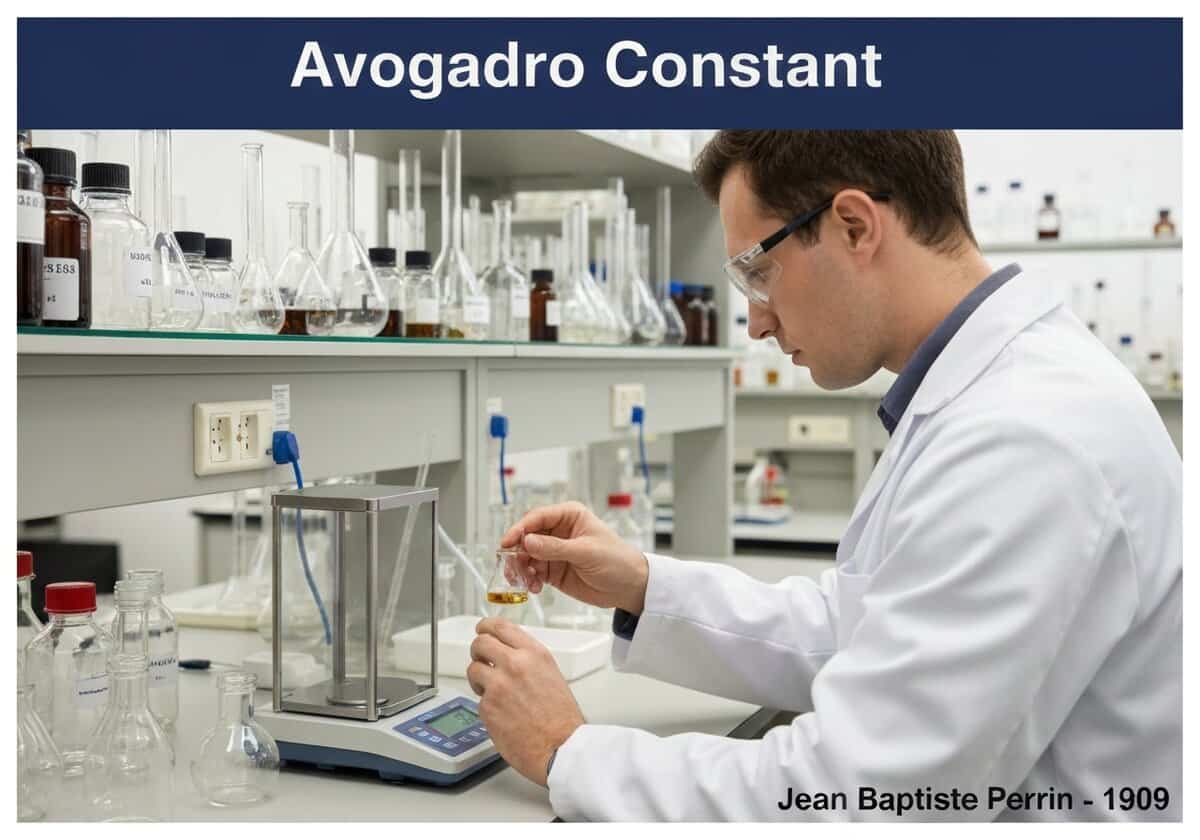
The name ‘Avogadro’s number’ or ‘Avogadro constant’ was coined by French physicist Jean Perrin in 1909. Perrin’s experiments on Brownian motion—the random movement of particles suspended in a fluid—provided a more accurate determination of its value and earned him the 1926 Nobel Prize in Physics. For over a century, the value was refined through various experimental methods. However, on May 20, 2019, as part of the redefinition of SI base units, the Avogadro constant was assigned a fixed, exact numerical value. This act fundamentally changed the definition of the mole, which is now defined as containing exactly [latex]6.02214076 times 10^{23}[/latex] elementary entities, rather than being based on the number of atoms in 12 grams of carbon-12.
Avogadro Constant
(日付が不明または関連性がない場合、例えば「流体力学」などでは、その注目すべき出現時期の概算値が提示されます。)

フルサイズの画像とダウンロードは、登録会員のみが100%無料で利用できます。
> ログイン <