Product Design, Manufacturing & Innovation Resources
집 » Heterogeneous Catalysis

Heterogeneous Catalysis

1910
  • Paul Sabatier
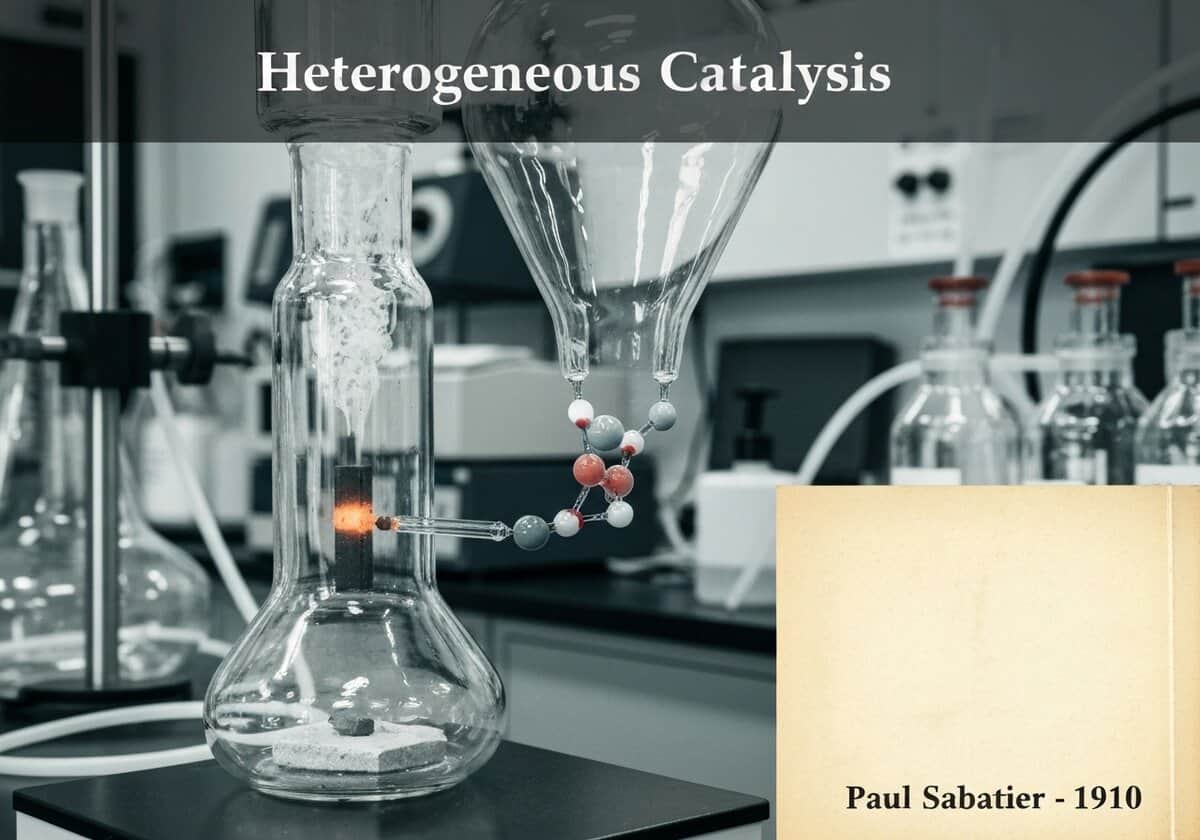
물리화학에서 불균일 촉매 반응을 보여주는 반응기 내 고체 촉매.

(설명을 위한 생성된 이미지입니다)

In heterogeneous 촉매 작용, 그 촉매 is in a different phase from the reactants. Typically, a solid catalyst is used with gaseous or liquid reactants. The process involves several steps: diffusion of reactants to the catalyst surface, adsorption onto active sites, chemical reaction on the surface, desorption of products, and diffusion of products away from the surface.

Heterogeneous catalysis is the cornerstone of the modern chemical industry, accounting for the vast majority of large-scale industrial processes. The key advantage is the ease of separating the catalyst from the product stream, which simplifies purification and allows for continuous operation. The catalyst is often a porous solid with a high surface area, maximizing the number of available active sites. These 촉매 can be unsupported (e.g., platinum gauze) or, more commonly, supported, where catalytically active metal nanoparticles are dispersed on a high-surface-area support material like alumina ([latex]Al_2O_3[/latex]), silica ([latex]SiO_2[/latex]), or activated carbon.

The mechanism, often described by the Langmuir–Hinshelwood model, involves the adsorption of reactant molecules onto the catalyst surface. This adsorption weakens the chemical bonds within the reactants, lowering the activation energy for the reaction. After the reaction occurs between adsorbed species, the product molecules desorb from the surface, freeing the active site for another catalytic cycle. The overall rate can be limited by any of these steps, from mass transport of reactants to the surface to the desorption of products. Catalyst deactivation through processes like poisoning (strong adsorption of impurities), coking (deposition of carbonaceous material), or sintering (loss of surface area at high temperatures) is a major practical challenge.

UNESCO Nomenclature: 2202
물리화학

유형

화학 공정

분열

혁명가

용법

널리 사용됨

전구체

  • discovery of 흡착 by Carl Wilhelm Scheele and Felice Fontana
  • 마이클 패러데이의 백금 촉매 특성에 대한 연구
  • 폴 사바티에의 유기 화합물 촉매 수소화 연구
  • 표면 과학 기술의 발전

응용 프로그램

  • 암모니아 합성을 위한 하버-보쉬 공정
  • 자동차용 촉매 변환기
  • 석유 정제에서의 유체 촉매 분해(FCC)
  • 합성 연료용 피셔-트로프쉬 공정
  • 황산 생산을 위한 접촉 공정

특허:

NA

잠재적 혁신 아이디어

  • single-atom catalysts for maximum efficiency and selectivity
  • 3D-printed catalyst structures for optimized flow and mass transfer
  • self-regenerating catalysts that can reverse poisoning effects
  • plasmonic catalysts that use light energy to drive reactions
  • metal-organic framework (mof) based catalysts with tunable porosity
  • catalytic membranes that combine reaction and separation in one step
  • nanoreactors with encapsulated catalysts for cascade reactions
  • catalysts for converting nitrogen directly into fertilizers at ambient conditions
  • magnetic catalysts for easy recovery from liquid-phase reactions
  • catalysts that operate efficiently at low temperatures to save energy
관련 주제: 불균일 촉매, 고체 촉매, 표면 화학, 흡착, 활성 부위, 탈착, 랭뮤어-힌셸우드 모델, 촉매 지지체, 산업 화학, 물질 전달.

역사적 맥락

Heterogeneous Catalysis

1904
1907
1909
1910
1912
1915
1915-11
1902
1907
1909
1910
1911-04-08
1913
1915
1916

(날짜를 알 수 없거나 관련이 없는 경우, 예를 들어 "유체역학"의 경우, 주목할 만한 등장 시기를 대략적으로 추정하여 제공합니다.)

10년차 기념일

고화질 이미지 및 다운로드는 등록된 회원에게만 100% 무료로 제공됩니다.

> 로그인 <