Product Design, Manufacturing & Innovation Resources
家 » 多相催化

多相催化

1910
  • Paul Sabatier
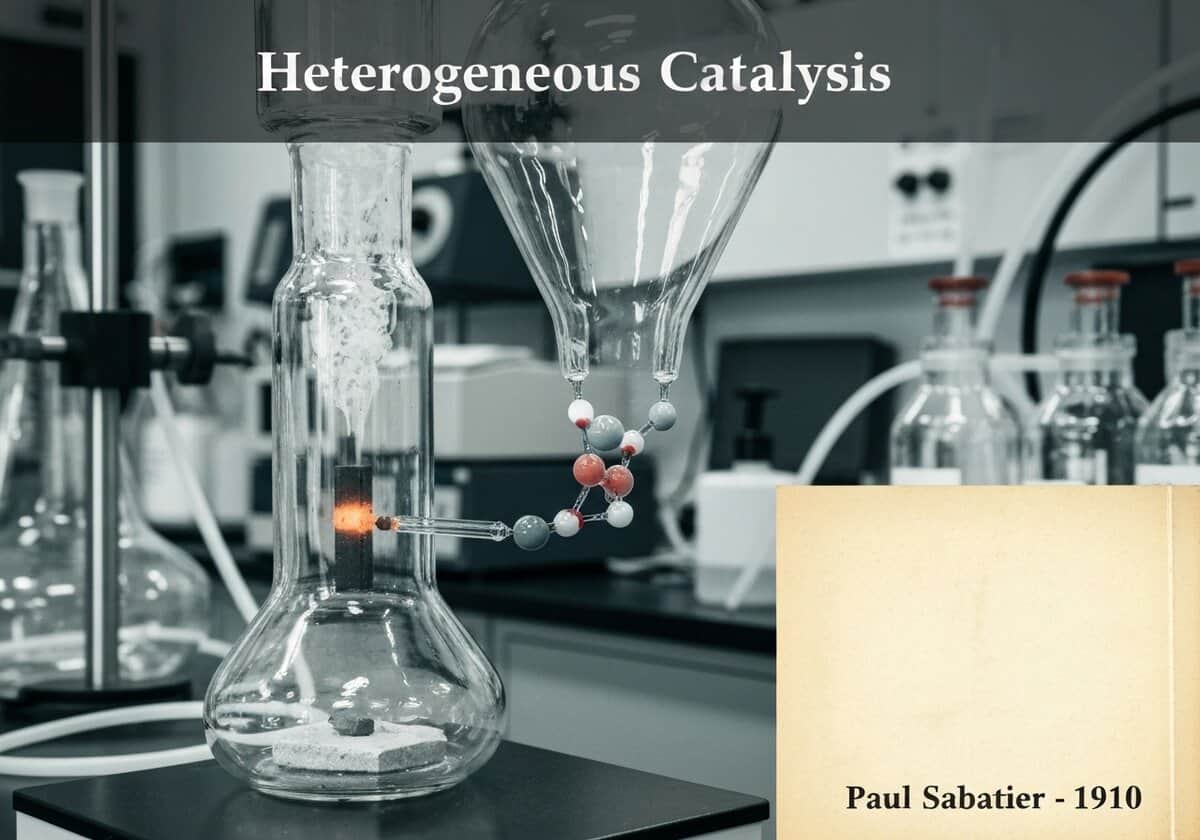
反应器中的固体催化剂展示了物理化学中的非均相催化。

(图片仅供参考)

In heterogeneous 催化作用, 这 催化剂 is in a different phase from the reactants. Typically, a solid catalyst is used with gaseous or liquid reactants. The process involves several steps: diffusion of reactants to the catalyst surface, adsorption onto active sites, chemical reaction on the surface, desorption of products, and diffusion of products away from the surface.

Heterogeneous catalysis is the cornerstone of the modern chemical industry, accounting for the vast majority of large-scale industrial processes. The key advantage is the ease of separating the catalyst from the product stream, which simplifies purification and allows for continuous operation. The catalyst is often a porous solid with a high surface area, maximizing the number of available active sites. These 催化剂 can be unsupported (e.g., platinum gauze) or, more commonly, supported, where catalytically active metal nanoparticles are dispersed on a high-surface-area support material like alumina ([latex]Al_2O_3[/latex]), silica ([latex]SiO_2[/latex]), or activated carbon.

The mechanism, often described by the Langmuir–Hinshelwood model, involves the adsorption of reactant molecules onto the catalyst surface. This adsorption weakens the chemical bonds within the reactants, lowering the activation energy for the reaction. After the reaction occurs between adsorbed species, the product molecules desorb from the surface, freeing the active site for another catalytic cycle. The overall rate can be limited by any of these steps, from mass transport of reactants to the surface to the desorption of products. Catalyst deactivation through processes like poisoning (strong adsorption of impurities), coking (deposition of carbonaceous material), or sintering (loss of surface area at high temperatures) is a major practical challenge.

UNESCO Nomenclature: 2202
- 物理化学

类型

化学过程

中断

革命

用法

广泛使用

前体

  • discovery of 吸附 by Carl Wilhelm Scheele and Felice Fontana
  • 迈克尔·法拉第对铂催化特性的研究
  • 保罗·萨巴蒂埃在有机化合物催化加氢方面的研究
  • 表面科学技术的发展

应用程序

  • 哈伯-博施法合成氨
  • 汽车催化转化器
  • 石油精炼中的流化催化裂化(FCC)
  • 费托合成燃料工艺
  • 接触法生产硫酸

专利:

NA

潜在创新理念

  • 单原子催化剂可实现最高效率和选择性
  • 3D打印催化剂结构,用于优化流动和质量传递
  • 可以逆转中毒效应的自再生催化剂
  • 利用光能驱动反应的等离子体催化剂
  • 金属有机框架 (mof) based catalysts with tunable porosity
  • 将反应和分离一步完成的催化膜
  • 用于级联反应的封装催化剂纳米反应器
  • 在环境条件下将氮直接转化为肥料的催化剂
  • 磁性催化剂易于从液相反应中回收
  • 低温下高效运行以节省能源的催化剂
相关领域:异相催化、固体催化剂、表面化学、吸附、活性位点、脱附、朗缪尔-欣谢尔伍德模型、催化剂载体、工业化学、质量传递。.

历史背景

多相催化

1904
1907
1909
1910
1912
1915
1915-11
1902
1907
1909
1910
1911-04-08
1913
1915
1916

(如果日期未知或不相关,例如“流体力学”,则提供其显著出现的近似估计)

第十年 周年纪念日

只有注册会员才能免费获得 100% 的全尺寸图片和下载。.

> 登录 <