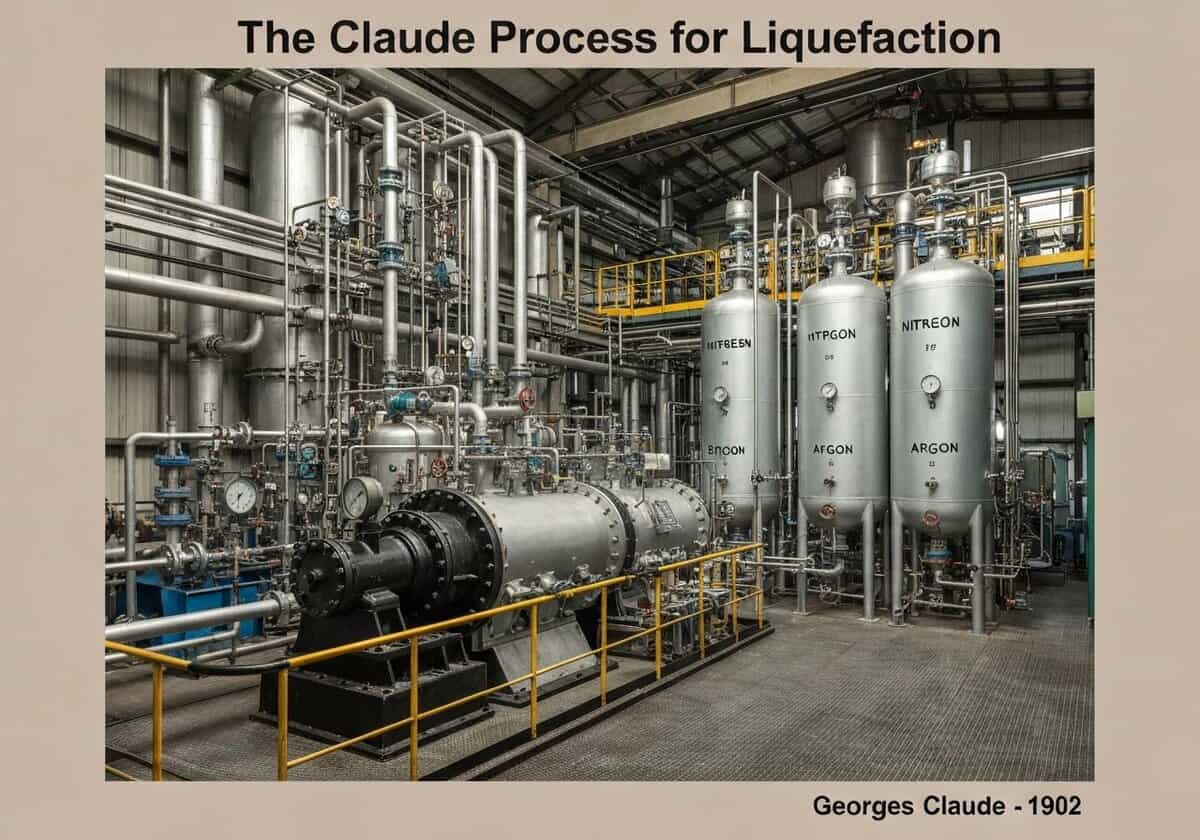
クロード法は、膨張エンジンまたはタービンを組み込むことで、ハンプソン・リンデサイクルを改良したものです。圧縮ガスの一部が膨張機で仕事をするため、ジュール・トムソン膨張のみの場合よりもはるかに大きな温度低下(ほぼ等エントロピー膨張)が生じます。これにより冷却効率が向上し、現在では大規模なガス液化および分離において主流の方法となっています。

(画像はイメージです)
クロード法は、膨張エンジンまたはタービンを組み込むことで、ハンプソン・リンデサイクルを改良したものです。圧縮ガスの一部が膨張機で仕事をするため、ジュール・トムソン膨張のみの場合よりもはるかに大きな温度低下(ほぼ等エントロピー膨張)が生じます。これにより冷却効率が向上し、現在では大規模なガス液化および分離において主流の方法となっています。
Georges Claude recognized the thermodynamic inefficiency of relying solely on the isenthalpic ジュール・トムソン効果. He reasoned that making the gas perform external work during expansion would extract more energy and thus produce a greater cooling effect. In his system, the main stream of high-pressure gas is split. One part goes to an expansion engine, where it cools significantly while producing work. This extremely cold gas is then used to pre-cool the other part of the high-pressure stream in a heat exchanger. This second stream then undergoes a final ジュール・トムソン expansion to produce the liquid. By combining the bulk cooling from the expander with the final-stage liquefaction from the J-T valve, the Claude cycle achieves higher efficiency and can operate at lower initial pressures than the Linde cycle. The work produced by the expander can also be recovered to help power the initial compressor, further improving overall efficiency. This principle is fundamental to virtually all modern large-scale cryogenic plants.
クロード法による液化
(日付が不明または関連性がない場合、例えば「流体力学」などでは、その注目すべき出現時期の概算値が提示されます。)

フルサイズの画像とダウンロードは、登録会員のみが100%無料で利用できます。
> ログイン <