Product Design, Manufacturing & Innovation Resources
Heim » Typ-II-Supraleiter

Typ-II-Supraleiter

1957
  • Alexei Abrikosov
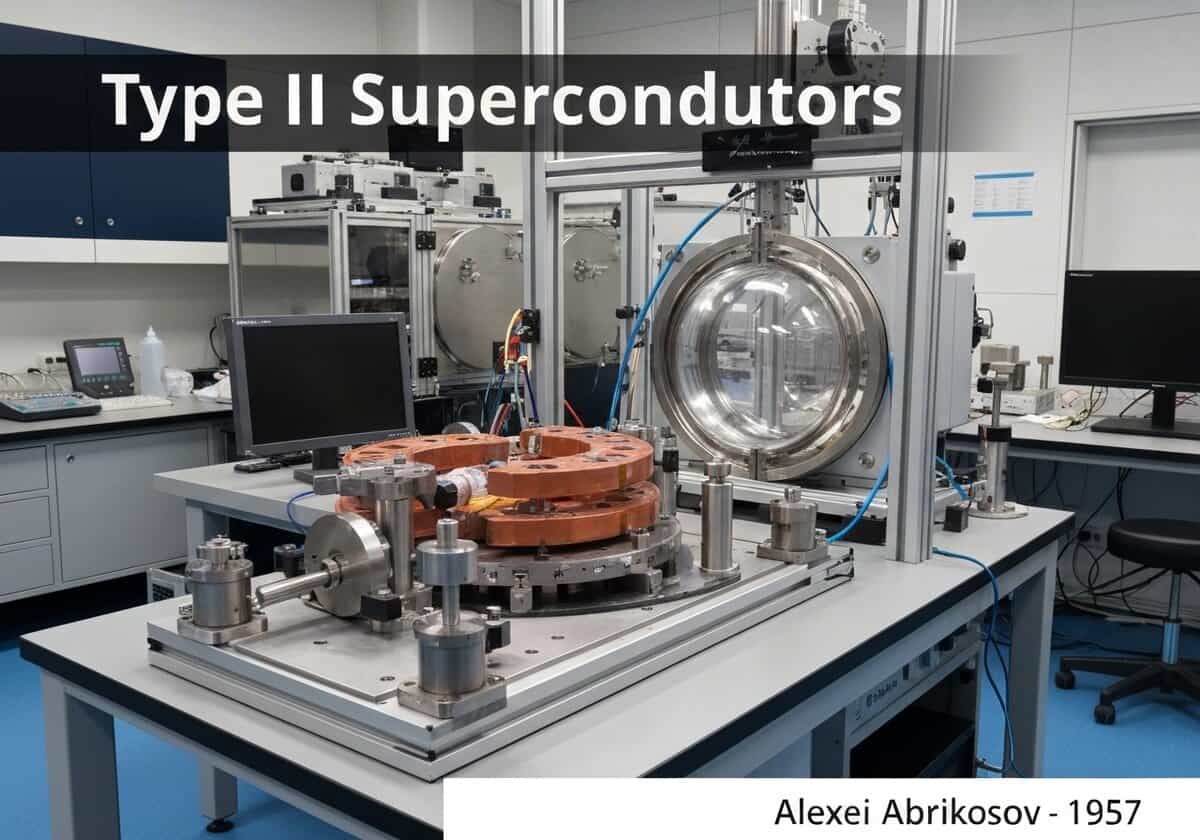
Aufbau eines supraleitenden Magneten zur Demonstration von Supraleitern des Typs II in einem Labor.

(Abbildung dient nur zur Veranschaulichung)

Theoretisch vorhergesagt von Alexei Abrikosov im Jahr 1957 basierend auf Ginzburg-Landau-Theorie, Type II superconductors are characterized by two critical magnetic fields, [latex]H_{c1}[/latex] and [latex]H_{c2}[/latex]. Between these fields, they enter a mixed or “vortex” state, allowing partial magnetic field penetration through quantized flux tubes called Abrikosov vortices. This allows them to remain superconducting in much higher magnetic fields than Type I superconductors.


The existence of Type II superconductors is crucial for most high-field applications of superconductivity. A Type I superconductor completely expels magnetic fields up to a critical field [latex]H_c[/latex], above which it abruptly transitions to the normal state. This [latex]H_c[/latex] is generally too low for building powerful magnets. Abrikosov showed that for materials where the Ginzburg-Landau parameter [latex]\kappa > 1/\sqrt{2}[/latex], it is energetically favorable for the material to allow magnetic flux to penetrate in a quantized manner rather than becoming fully normal. This penetration occurs above a lower critical field [latex]H_{c1}[/latex]. The flux enters in the form of cylindrical filaments called vortices or fluxons. Within the core of each vortex, the material is in the normal state, but the surrounding bulk remains superconducting. Each vortex carries a single quantum of magnetic flux, [latex]\Phi_0 = h/2e[/latex]. As the external field increases, more vortices enter the material, forming a regular triangular lattice known as an Abrikosov vortex lattice. The material remains superconducting, with zero resistance, until an upper critical field [latex]H_{c2}[/latex] is reached, at which point the vortex cores overlap and the entire material becomes normal. Since [latex]H_{c2}[/latex] can be hundreds of times larger than [latex]H_{c1}[/latex], Type II materials are essential for generating strong magnetic fields. All high-temperature superconductors and many alloys like Niobium-titanium (NbTi) and Niobium-tin (Nb3Sn) are Type II.

UNESCO Nomenclature: 2211
- Festkörperphysik

Typ

Klassifizierung der Materialien

Störung

Wesentliche

Verwendung

Weitverbreitete Verwendung

Vorläufer

Anwendungen

Patente:

NA

Potenzielle Innovationsideen

  • Desktop-NMR-Spektrometer für die chemische Analyse
  • magnetische Abschirmung für Lebensräume im Weltraum
  • Vortex-basierte Datenspeicherung mit hoher Dichte
  • Supraleitende Transformatoren für ein effizienteres Stromnetz
  • magnetische Arzneimittelabgabesysteme, die durch externe supraleitende Magnete gesteuert werden
  • kompakte Partikeltherapiesysteme zur Krebsbehandlung
  • elektromagnetische Flugzeugstartsysteme für Flugzeugträger
  • Wirbelmanipulation für Quantencomputer-Qubits
  • Hochgradienten-Magnettrennung zur Wasserreinigung
  • reibungslose Schwungräder für die Energiespeicherung im Netzmaßstab
Related to: Type II superconductor, Abrikosov vortex, mixed state, critical magnetic field, flux quantization, Ginzburg-Landau-Theorie, flux pinning, high-field magnets, NbTi, YBCO.

Historischer Kontext

Typ-II-Supraleiter

1950
1950
1957
1957
1959-11
1960
1960
1950
1950
1950
1957
1958
1960
1960
1960

(wenn das Datum unbekannt oder nicht relevant ist, z. B. „Strömungsmechanik“, wird eine gerundete Schätzung seines bemerkenswerten Auftretens bereitgestellt)

10. Jahr Jubiläum

Bilder in voller Größe und Downloads sind nur für registrierte Mitglieder 100% kostenlos verfügbar.

> Login <