Product Design, Manufacturing & Innovation Resources
Casa » Superconduttori di tipo II

Superconduttori di tipo II

1957
  • Alexei Abrikosov
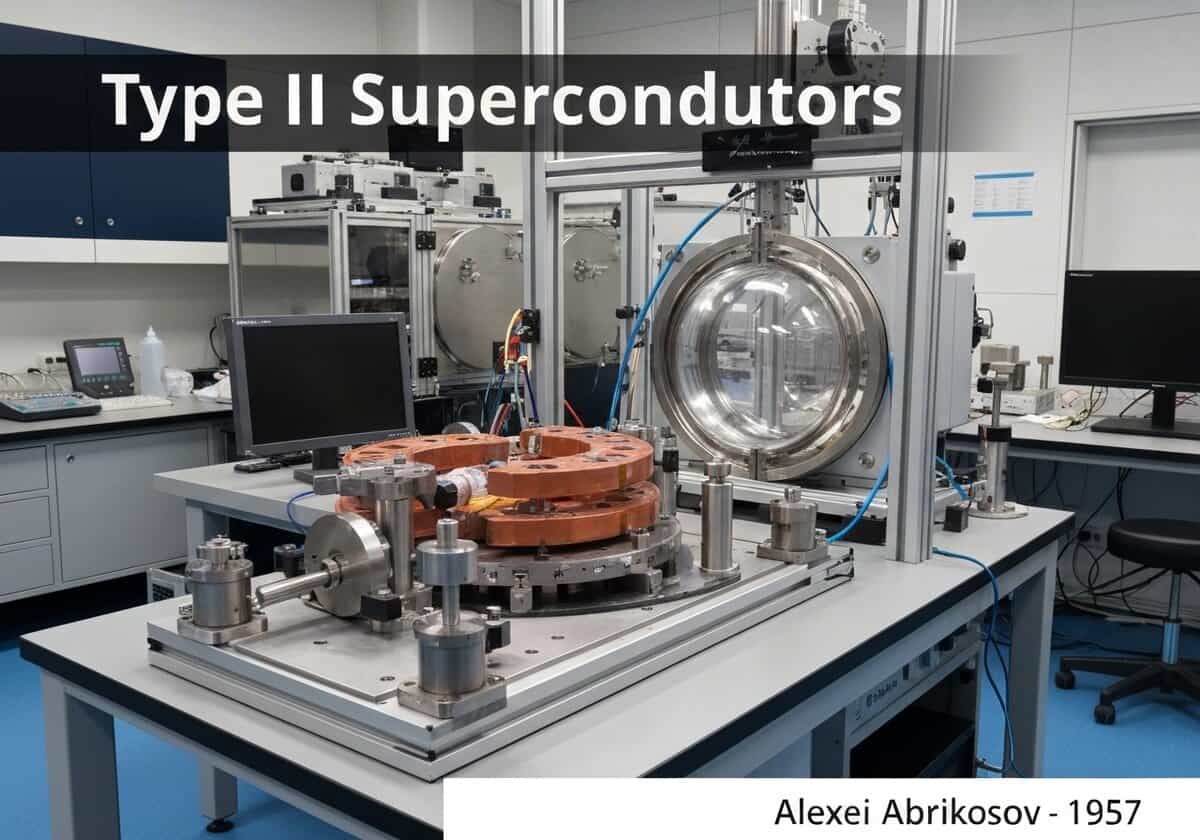
Installazione di un magnete superconduttore per la dimostrazione dei superconduttori di tipo II in laboratorio.

(Immagine generata a solo scopo illustrativo)

Previsto teoricamente da Alexei Abrikosov nel 1957 sulla base di Teoria Ginzburg-Landau, Type II superconductors are characterized by two critical magnetic fields, [latex]H_{c1}[/latex] and [latex]H_{c2}[/latex]. Between these fields, they enter a mixed or “vortex” state, allowing partial magnetic field penetration through quantized flux tubes called Abrikosov vortices. This allows them to remain superconducting in much higher magnetic fields than Type I superconductors.


The existence of Type II superconductors is crucial for most high-field applications of superconductivity. A Type I superconductor completely expels magnetic fields up to a critical field [latex]H_c[/latex], above which it abruptly transitions to the normal state. This [latex]H_c[/latex] is generally too low for building powerful magnets. Abrikosov showed that for materials where the Ginzburg-Landau parameter [latex]\kappa > 1/\sqrt{2}[/latex], it is energetically favorable for the material to allow magnetic flux to penetrate in a quantized manner rather than becoming fully normal. This penetration occurs above a lower critical field [latex]H_{c1}[/latex]. The flux enters in the form of cylindrical filaments called vortices or fluxons. Within the core of each vortex, the material is in the normal state, but the surrounding bulk remains superconducting. Each vortex carries a single quantum of magnetic flux, [latex]\Phi_0 = h/2e[/latex]. As the external field increases, more vortices enter the material, forming a regular triangular lattice known as an Abrikosov vortex lattice. The material remains superconducting, with zero resistance, until an upper critical field [latex]H_{c2}[/latex] is reached, at which point the vortex cores overlap and the entire material becomes normal. Since [latex]H_{c2}[/latex] can be hundreds of times larger than [latex]H_{c1}[/latex], Type II materials are essential for generating strong magnetic fields. All high-temperature superconductors and many alloys like Niobium-titanium (NbTi) and Niobium-tin (Nb3Sn) are Type II.

UNESCO Nomenclature: 2211
- Fisica dello stato solido

Tipo

Classificazione dei materiali

Interruzione

Sostanziale

Utilizzo

Uso diffuso

Precursori

Applicazioni

Brevetti:

NA

Idee e potenziali innovazioni

  • spettrometri NMR da tavolo per analisi chimiche
  • schermatura magnetica per habitat nello spazio profondo
  • archiviazione dati basata su vortice ad alta densità
  • trasformatori superconduttori per una rete elettrica più efficiente
  • sistemi di somministrazione di farmaci magnetici guidati da magneti superconduttori esterni
  • sistemi compatti di terapia a particelle per il trattamento del cancro
  • sistemi di lancio elettromagnetici per portaerei
  • manipolazione dei vortici per i qubit del calcolo quantistico
  • separazione magnetica ad alto gradiente per la purificazione dell'acqua
  • volani senza attrito per l'accumulo di energia su scala di rete
Related to: Type II superconductor, Abrikosov vortex, mixed state, critical magnetic field, flux quantization, Teoria Ginzburg-Landau, flux pinning, high-field magnets, NbTi, YBCO.

Contesto storico

Superconduttori di tipo II

1950
1950
1957
1957
1959-11
1960
1960
1950
1950
1950
1957
1958
1960
1960
1960

(se la data è sconosciuta o non rilevante, ad esempio "meccanica dei fluidi", viene fornita una stima approssimativa della sua notevole comparsa)

decimo anno anniversario

Le immagini a grandezza naturale e i download sono disponibili, gratuitamente al 100%, solo per gli utenti registrati.

> Login <