Product Design, Manufacturing & Innovation Resources
Lar » Supercondutores do tipo II

Supercondutores do tipo II

1957
  • Alexei Abrikosov
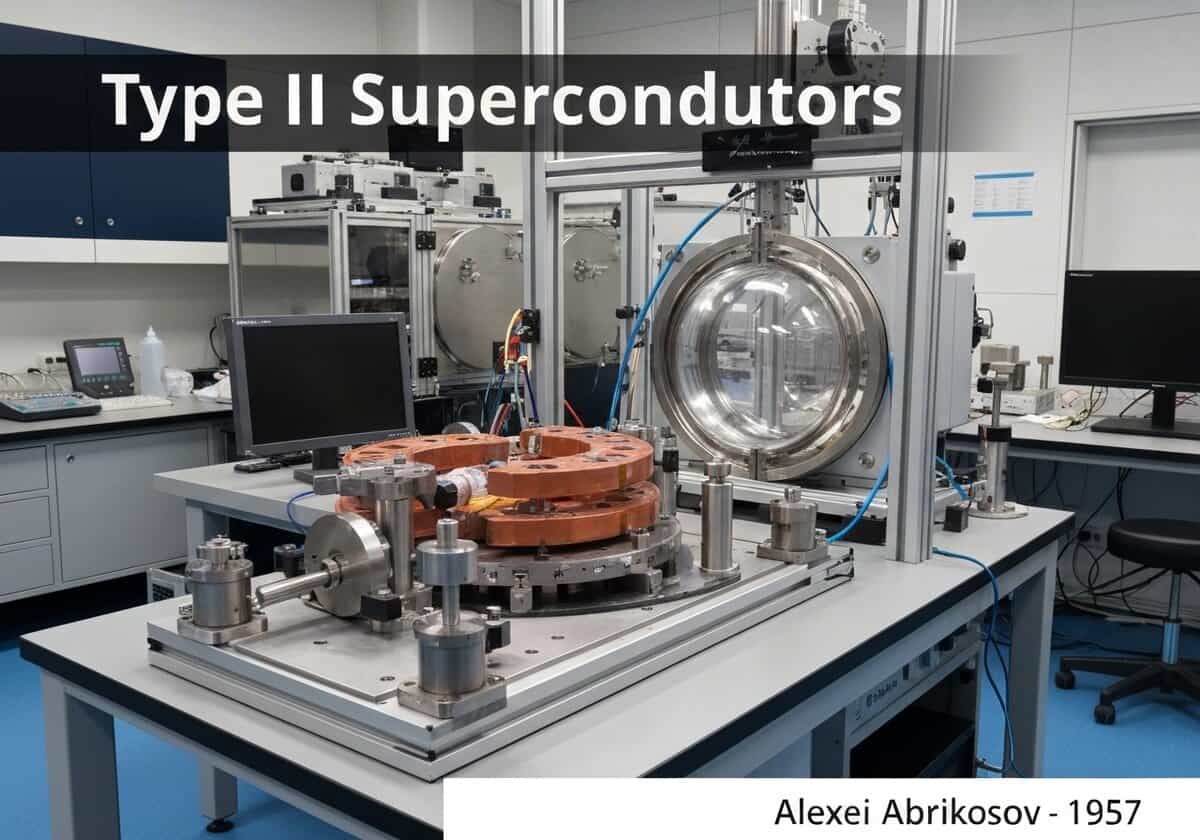
Configuração do ímã supercondutor demonstrando supercondutores do Tipo II em um laboratório.

(Imagem gerada apenas para fins ilustrativos)

Previsto teoricamente por Alexei Abrikosov em 1957 com base em Ginzburg-Landau theory, Type II superconductors are characterized by two critical magnetic fields, [latex]H_{c1}[/latex] and [latex]H_{c2}[/latex]. Between these fields, they enter a mixed or “vortex” state, allowing partial magnetic field penetration through quantized flux tubes called Abrikosov vortices. This allows them to remain superconducting in much higher magnetic fields than Type I superconductors.

The existence of Type II superconductors is crucial for most high-field applications of superconductivity. A Type I superconductor completely expels magnetic fields up to a critical field [latex]H_c[/latex], above which it abruptly transitions to the normal state. This [latex]H_c[/latex] is generally too low for building powerful magnets. Abrikosov showed that for materials where the Ginzburg-Landau parameter [latex]\kappa > 1/\sqrt{2}[/latex], it is energetically favorable for the material to allow magnetic flux to penetrate in a quantized manner rather than becoming fully normal. This penetration occurs above a lower critical field [latex]H_{c1}[/latex]. The flux enters in the form of cylindrical filaments called vortices or fluxons. Within the core of each vortex, the material is in the normal state, but the surrounding bulk remains superconducting. Each vortex carries a single quantum of magnetic flux, [latex]\Phi_0 = h/2e[/latex]. As the external field increases, more vortices enter the material, forming a regular triangular lattice known as an Abrikosov vortex lattice. The material remains superconducting, with zero resistance, until an upper critical field [latex]H_{c2}[/latex] is reached, at which point the vortex cores overlap and the entire material becomes normal. Since [latex]H_{c2}[/latex] can be hundreds of times larger than [latex]H_{c1}[/latex], Type II materials are essential for generating strong magnetic fields. All high-temperature superconductors and many alloys like Niobium-titanium (NbTi) and Niobium-tin (Nb3Sn) are Type II.

UNESCO Nomenclature: 2211
Física do estado sólido

Tipo

Classificação de Materiais

Interrupção

Substancial

Uso

Uso generalizado

Precursores

Aplicações

Patentes:

NA

Ideias de Inovação Potencial

  • desktop nmr spectrometers for chemical analysis
  • magnetic shielding for deep space habitats
  • vortex-based data storage with high density
  • superconducting transformers for a more efficient power grid
  • magnetic drug delivery systems guided by external superconducting magnets
  • compact particle therapy systems for cancer treatment
  • electromagnetic aircraft launch systems for aircraft carriers
  • vortex manipulation for quantum computing qubits
  • high-gradient magnetic separation for water purification
  • frictionless flywheels for grid-scale energy storage
Related to: Type II superconductor, Abrikosov vortex, mixed state, critical magnetic field, flux quantization, Ginzburg-Landau theory, flux pinning, high-field magnets, NbTi, YBCO.

Contexto histórico

Supercondutores do tipo II

1950
1950
1957
1957
1959-11
1960
1960
1950
1950
1950
1957
1958
1960
1960
1960

(Caso a data seja desconhecida ou irrelevante, por exemplo, "mecânica dos fluidos", é fornecida uma estimativa aproximada de seu surgimento notável)

10º ano aniversário

Imagens em tamanho real e downloads estão disponíveis apenas, 100% gratuitos, para membros registrados.