Product Design, Manufacturing & Innovation Resources
بيت » تأثير مايسنر

تأثير مايسنر

1933
  • Walther Meissner
  • Robert Ochsenfeld
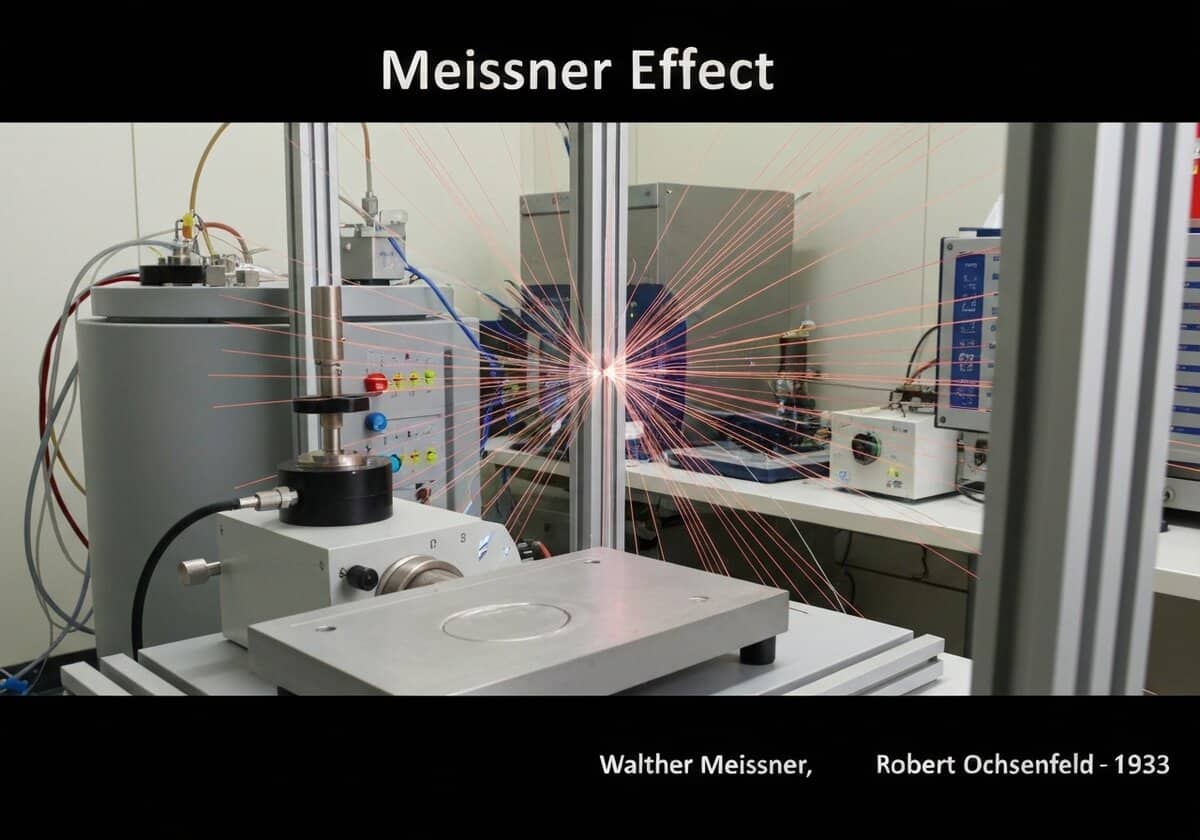
Superconductor in laboratory demonstrating Meissner effect in solid state physics.

(صورة توضيحية فقط)

Discovered in 1933 by Walther Meissner and Robert Ochsenfeld, the Meissner effect is the expulsion of a magnetic field from a superconductor during its transition to the superconducting state. When a material is cooled below its critical temperature ([latex]T_c[/latex]) in the presence of a weak external magnetic field, it actively cancels all magnetic flux inside it, becoming a perfect diamagnet.


The Meissner effect is a defining characteristic of superconductivity, distinguishing it from a hypothetical perfect conductor. A perfect conductor, according to Lenz’s law, would trap any existing magnetic field inside it as it cools, because changing the flux would induce currents to oppose the change. In contrast, a superconductor actively expels the field. This expulsion is achieved by the generation of screening currents on the surface of the material. These currents create a magnetic field that perfectly cancels the external field within the bulk of the superconductor. The magnetic field penetrates only a small distance into the surface, known as the London penetration depth ([latex]\lambda[/latex]). This discovery was crucial because it showed that superconductivity is a true thermodynamic phase transition, not just a case of infinite conductivity. It provided a key piece of the puzzle that any microscopic theory of superconductivity would have to explain. The effect is the basis for the dramatic levitation demonstrations where a magnet floats above a high-temperature superconductor cooled with liquid nitrogen. The expulsion of the magnet’s field by the superconductor creates a repulsive force strong enough to counteract gravity.

The Meissner effect breaks down when the applied magnetic field is too strong. For Type I superconductors, superconductivity is abruptly destroyed above a critical field [latex]H_c[/latex]. For Type II superconductors, the field begins to penetrate the material in the form of quantized flux vortices above a lower critical field [latex]H_{c1}[/latex], while the material remains superconducting until a much higher upper critical field [latex]H_{c2}[/latex].

UNESCO Nomenclature: 2211
– Solid state physics

يكتب

Physical Property

خلل

أساسيات

الاستخدام

استخدام واسع النطاق

مقدمات

  • اكتشاف الموصلية الفائقة (1911)
  • Maxwell’s equations of electromagnetism
  • Lenz’s law
  • فهم المغناطيسية المضادة

التطبيقات

  • قطارات ماجليف (الرفع المغناطيسي)
  • المحامل المغناطيسية الفائقة التوصيل
  • تشخيص المواد الفائقة الموصلية
  • مظاهر الظواهر الكمومية

براءات الاختراع:

NA

أفكار ابتكارية محتملة

  • أنظمة النقل عالية السرعة الخالية من الاحتكاك في الأنابيب المفرغة
  • الهياكل ذاتية التجميع باستخدام المجالات المغناطيسية القابلة للبرمجة والموصلات الفائقة
  • الحماية النشطة للإلكترونيات الحساسة ضد التداخل الكهرومغناطيسي
  • التعامل غير التلامسي مع الأشياء في التصنيع والطب
  • hoverboards using high-temperature superconductors
  • أنظمة تثبيت للعمارة العائمة
  • أجهزة ردود الفعل اللمسية التي تخلق أشكالًا لمسية متحركة
  • waste فرز systems using magnetic levitation to separate materials
  • مضخات صامتة خالية من الاحتكاك للسوائل المسببة للتآكل أو الحساسة
  • جيروسكوبات ذات دوارات متحركة للملاحة فائقة الدقة
Related to: Meissner effect, superconductivity, diamagnetism, magnetic field expulsion, London penetration depth, critical temperature, Type I superconductor, screening currents, magnetic levitation, phase transition.

السياق التاريخي

تأثير مايسنر

1930
1931
1932
1933
1937
1940
1947
1930
1930
1931
1932
1936-01-01
1938
1940
1950

(إذا كان التاريخ غير معروف أو غير ذي صلة، على سبيل المثال "ميكانيكا الموائع"، يتم توفير تقدير تقريبي لظهوره الملحوظ)

أحدث الإضافات

أهم المنشورات والمقالات

أفضل الأدوات الأصلية

السنة العاشرة عيد

الصور والتنزيلات بالحجم الكامل متاحة فقط، ومجانية تمامًا، للأعضاء المسجلين.