Product Design, Manufacturing & Innovation Resources
家 » II型超导体

II型超导体

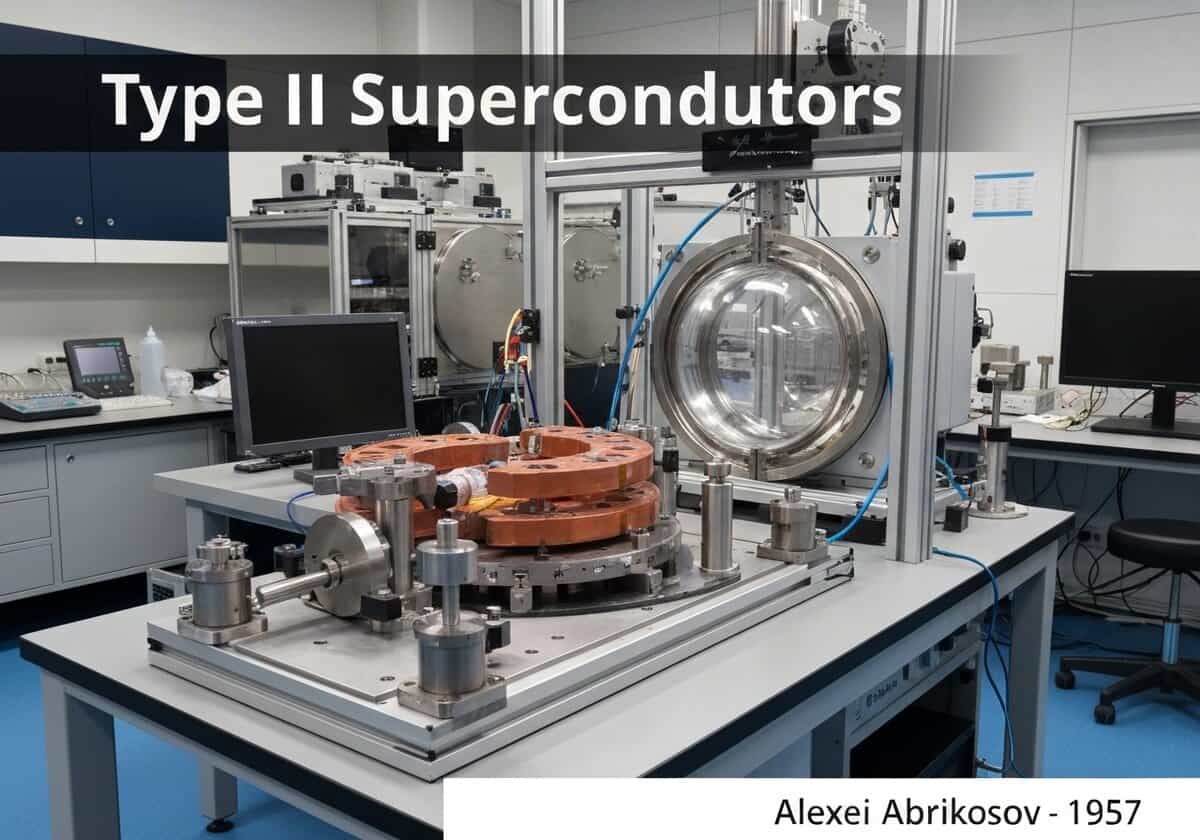
1957
  • Alexei Abrikosov
在实验室中演示 II 型超导体的超导磁体装置。.

(图片仅供参考)

理论上,阿列克谢·阿布里科索夫于1957年根据以下理论预测了这一点: 金兹堡-朗道理论, Type II superconductors are characterized by two critical magnetic fields, [latex]H_{c1}[/latex] and [latex]H_{c2}[/latex]. Between these fields, they enter a mixed or “vortex” state, allowing partial magnetic field penetration through quantized flux tubes called Abrikosov vortices. This allows them to remain superconducting in much higher magnetic fields than Type I superconductors.


The existence of Type II superconductors is crucial for most high-field applications of superconductivity. A Type I superconductor completely expels magnetic fields up to a critical field [latex]H_c[/latex], above which it abruptly transitions to the normal state. This [latex]H_c[/latex] is generally too low for building powerful magnets. Abrikosov showed that for materials where the 金兹堡-兰道 parameter [latex]\kappa > 1/\sqrt{2}[/latex], it is energetically favorable for the material to allow magnetic flux to penetrate in a quantized manner rather than becoming fully normal. This penetration occurs above a lower critical field [latex]H_{c1}[/latex]. The flux enters in the form of cylindrical filaments called vortices or fluxons. Within the core of each vortex, the material is in the normal state, but the surrounding bulk remains superconducting. Each vortex carries a single quantum of magnetic flux, [latex]\Phi_0 = h/2e[/latex]. As the external field increases, more vortices enter the material, forming a regular triangular lattice known as an Abrikosov vortex lattice. The material remains superconducting, with zero resistance, until an upper critical field [latex]H_{c2}[/latex] is reached, at which point the vortex cores overlap and the entire material becomes normal. Since [latex]H_{c2}[/latex] can be hundreds of times larger than [latex]H_{c1}[/latex], Type II materials are essential for generating strong magnetic fields. All high-temperature superconductors and many alloys like Niobium-titanium (NbTi) and Niobium-tin (Nb3Sn) are Type II.

UNESCO Nomenclature: 2211
- 固体物理学

类型

材料分类

中断

重大的

用法

广泛使用

前体

应用程序

  • 用于核磁共振成像的超导磁体和 核磁共振 机器
  • 粒子加速器(例如 LHC)
  • 磁悬浮列车
  • 高场研究磁体
  • 超导磁能存储 (smes)

专利:

NA

潜在创新理念

  • 用于化学分析的台式核磁共振波谱仪
  • 深空栖息地的磁屏蔽
  • 基于涡流的高密度数据存储
  • 超导变压器,实现更高效的电网
  • 外部超导磁体引导的磁性药物输送系统
  • 用于癌症治疗的紧凑型粒子治疗系统
  • 航空母舰电磁飞机弹射系统
  • 用于量子计算量子比特的涡旋操纵
  • 高梯度磁分离用于水净化
  • 用于电网规模储能的无摩擦飞轮
Related to: Type II superconductor, Abrikosov vortex, mixed state, critical magnetic field, flux quantization, 金兹堡-朗道理论, flux pinning, high-field magnets, NbTi, YBCO.

历史背景

II型超导体

1950
1950
1957
1957
1959-11
1960
1960
1950
1950
1950
1957
1958
1960
1960
1960

(如果日期未知或不相关,例如“流体力学”,则提供其显著出现的近似估计)

第十年 周年纪念日

只有注册会员才能免费获得 100% 的全尺寸图片和下载。.

> 登录 <