Product Design, Manufacturing & Innovation Resources
Heim » Optical Resonator

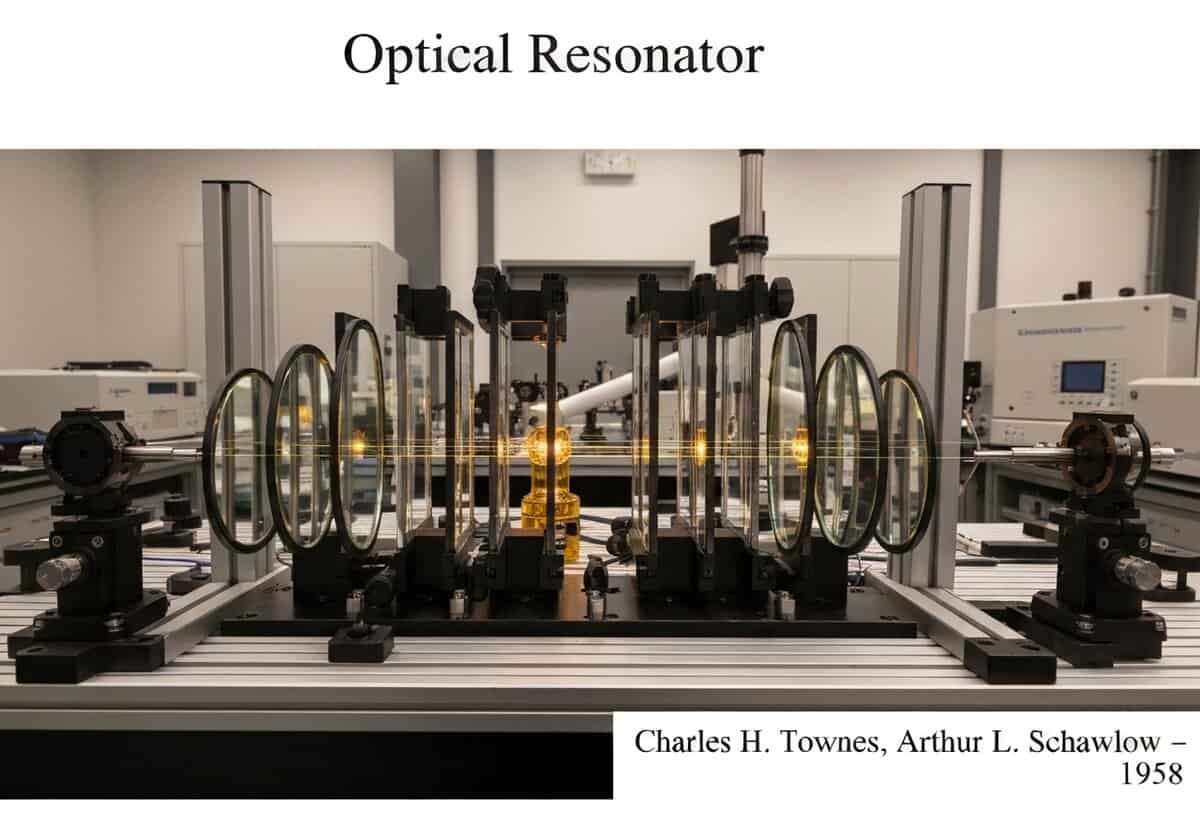
Optical Resonator

1958
  • Charles H. Townes
  • Arthur L. Schawlow
Optischer Resonatoraufbau im Laserphysiklabor mit Spiegeln und Verstärkungsmedium.

(Abbildung dient nur zur Veranschaulichung)

Ein optischer Resonator, auch optischer Hohlraum genannt, ist eine Anordnung von Spiegeln, die einen stehenden Wellenhohlraum für Lichtwellen bildet. In einem Laser umschließt er das Verstärkungsmedium und sorgt für positive Rückkopplung. Das Licht der stimulierten Emission wird mehrfach reflektiert und durchläuft das Verstärkungsmedium mehrfach, was zu einer signifikanten Verstärkung und zur Bildung eines kohärenten Ausgangsstrahls führt.

Der optische Resonator ist eine entscheidende Komponente der meisten Laser. Er ist verantwortlich für den Aufbau der Lichtintensität und die Bestimmung der Eigenschaften des Ausgangsstrahls. Der einfachste und gebräuchlichste Typ ist der Fabry-Pérot-Resonator. Er besteht aus zwei parallelen Spiegeln, die beidseitig des Verstärkungsmediums angeordnet sind. Ein Spiegel ist ein hochreflektierender Spiegel (nahezu 100 % Reflexionsgrad), während der andere, der Auskoppler, teilreflektierend ist (z. B. 99 % Reflexionsgrad) und einen Teil des Lichts als Laserstrahl austreten lässt.

As photons are generated by stimulated emission, they travel within the cavity. Those traveling along the axis between the mirrors are reflected back into the gain medium, stimulating further emission and amplifying the light. Photons not aligned with the axis are lost from the cavity. This process not only amplifies the light but also acts as a filter. Only light waves of specific frequencies, those that form a standing wave within the cavity (i.e., where the cavity length is an integer multiple of half the wavelength), are sustained. This resonant condition is what determines the longitudinal modes of the laser. The geometry of the mirrors (e.g., flat, concave) determines the stability of the resonator and the spatial profile (transverse modes) of the output beam, such as the fundamental Gaussian mode (TEM00).

UNESCO Nomenclature: 2210
- Optik

Typ

Physikalisches Gerät

Störung

Grundlegendes

Verwendung

Weitverbreitete Verwendung

Vorläufer

  • fabry-pérot interferometer
  • microwave cavity resonators used in masers
  • principles of optical reflection and interference

Anwendungen

  • laser construction
  • optical parametric oscillators
  • optical interferometers (e.g., Fabry-Pérot)
  • Gravitationswelle Detektoren wie Ligo
  • high-precision optical frequency standards

Patente:

  • US2929922A

Potenzielle Innovationsideen

  • micro-ring resonators for on-chip optical Signalverarbeitung
  • Photonik crystal cavities for ultra-low threshold lasers
  • unstable resonators for high-power, large-area lasers
  • optomechanical cavities for sensing minute forces
  • foldable cavity designs for compact, high-power lasers
  • active mirror systems that correct for thermal lensing in real-time
  • plasmonic nanocavities for single-molecule detection
  • chiral optical cavities for controlling chemical reactions
  • integrated optical cavities for quantum information processing
  • fiber-based ring resonators for gyroscopes and sensors
Verwandt mit: optischem Resonator, optischem Hohlraum, Laser, Fabry-Pérot-Interferometer, Spiegeln, Rückkopplung, Verstärkung, stehender Welle, Lasermoden, Strahlqualität.

Historischer Kontext

Optical Resonator

1950
1950
1957
1958
1960
1960
1960
1950
1950
1957
1957
1959-11
1960
1960
1960

(wenn das Datum unbekannt oder nicht relevant ist, z. B. „Strömungsmechanik“, wird eine gerundete Schätzung seines bemerkenswerten Auftretens bereitgestellt)

10. Jahr Jubiläum

Bilder in voller Größe und Downloads sind nur für registrierte Mitglieder 100% kostenlos verfügbar.

> Login <