Product Design, Manufacturing & Innovation Resources
Hogar » Superconductores de tipo II

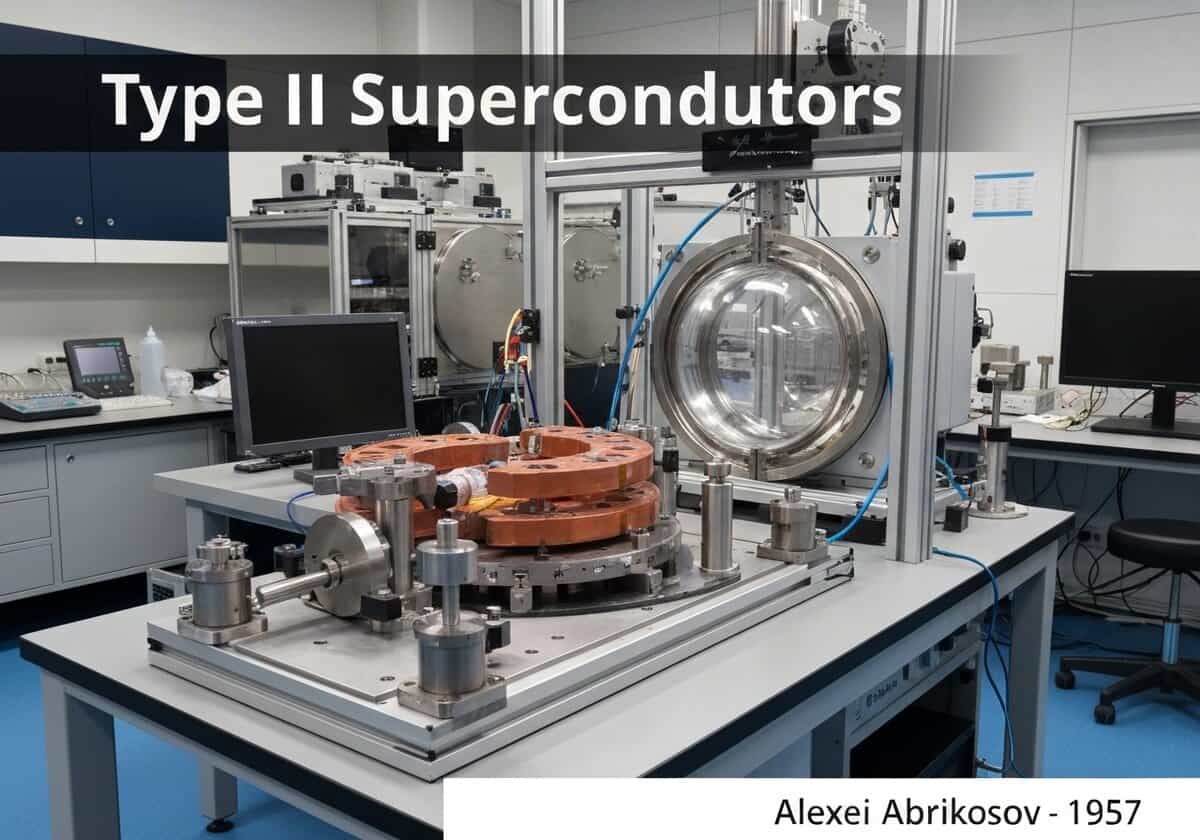
Superconductores de tipo II

1957
  • Alexei Abrikosov
Montaje de un imán superconductor para demostrar la presencia de superconductores de tipo II en un laboratorio.

(Imagen generada únicamente con fines ilustrativos)

Predicho teóricamente por Alexei Abrikosov en 1957 basándose en Teoría de Ginzburg-Landau, Type II superconductors are characterized by two critical magnetic fields, [latex]H_{c1}[/latex] and [latex]H_{c2}[/latex]. Between these fields, they enter a mixed or “vortex” state, allowing partial magnetic field penetration through quantized flux tubes called Abrikosov vortices. This allows them to remain superconducting in much higher magnetic fields than Type I superconductors.


The existence of Type II superconductors is crucial for most high-field applications of superconductivity. A Type I superconductor completely expels magnetic fields up to a critical field [latex]H_c[/latex], above which it abruptly transitions to the normal state. This [latex]H_c[/latex] is generally too low for building powerful magnets. Abrikosov showed that for materials where the Ginzburg-Landau parameter [latex]\kappa > 1/\sqrt{2}[/latex], it is energetically favorable for the material to allow magnetic flux to penetrate in a quantized manner rather than becoming fully normal. This penetration occurs above a lower critical field [latex]H_{c1}[/latex]. The flux enters in the form of cylindrical filaments called vortices or fluxons. Within the core of each vortex, the material is in the normal state, but the surrounding bulk remains superconducting. Each vortex carries a single quantum of magnetic flux, [latex]\Phi_0 = h/2e[/latex]. As the external field increases, more vortices enter the material, forming a regular triangular lattice known as an Abrikosov vortex lattice. The material remains superconducting, with zero resistance, until an upper critical field [latex]H_{c2}[/latex] is reached, at which point the vortex cores overlap and the entire material becomes normal. Since [latex]H_{c2}[/latex] can be hundreds of times larger than [latex]H_{c1}[/latex], Type II materials are essential for generating strong magnetic fields. All high-temperature superconductors and many alloys like Niobium-titanium (NbTi) and Niobium-tin (Nb3Sn) are Type II.

UNESCO Nomenclature: 2211
- Física del estado sólido

Tipo

Clasificación de materiales

Ruptura

Sustancial

Uso

Uso generalizado

Precursores

Aplicaciones

Patentes:

NA

Ideas para posibles innovaciones

  • Espectrómetros de RMN de escritorio para análisis químico
  • blindaje magnético para hábitats del espacio profundo
  • Almacenamiento de datos basado en vórtices de alta densidad
  • Transformadores superconductores para una red eléctrica más eficiente
  • Sistemas de administración de fármacos magnéticos guiados por imanes superconductores externos
  • Sistemas de terapia de partículas compactas para el tratamiento del cáncer
  • Sistemas electromagnéticos de lanzamiento de aeronaves para portaaviones
  • Manipulación de vórtices para qubits de computación cuántica
  • Separación magnética de alto gradiente para la purificación del agua
  • Volantes de inercia sin fricción para el almacenamiento de energía a escala de red
Related to: Type II superconductor, Abrikosov vortex, mixed state, critical magnetic field, flux quantization, Teoría de Ginzburg-Landau, flux pinning, high-field magnets, NbTi, YBCO.

Contexto histórico

Superconductores de tipo II

1950
1950
1957
1957
1959-11
1960
1960
1950
1950
1950
1957
1958
1960
1960
1960

(Si la fecha es desconocida o no es relevante, por ejemplo "mecánica de fluidos", se proporciona una estimación redondeada de su aparición notable)

décimo año aniversario

Las imágenes en tamaño completo y las descargas solo están disponibles, de forma totalmente gratuita, para los miembros registrados.

> Acceso <