Product Design, Manufacturing & Innovation Resources
بيت » الموصلات الفائقة من النوع الثاني

الموصلات الفائقة من النوع الثاني

1957
  • Alexei Abrikosov
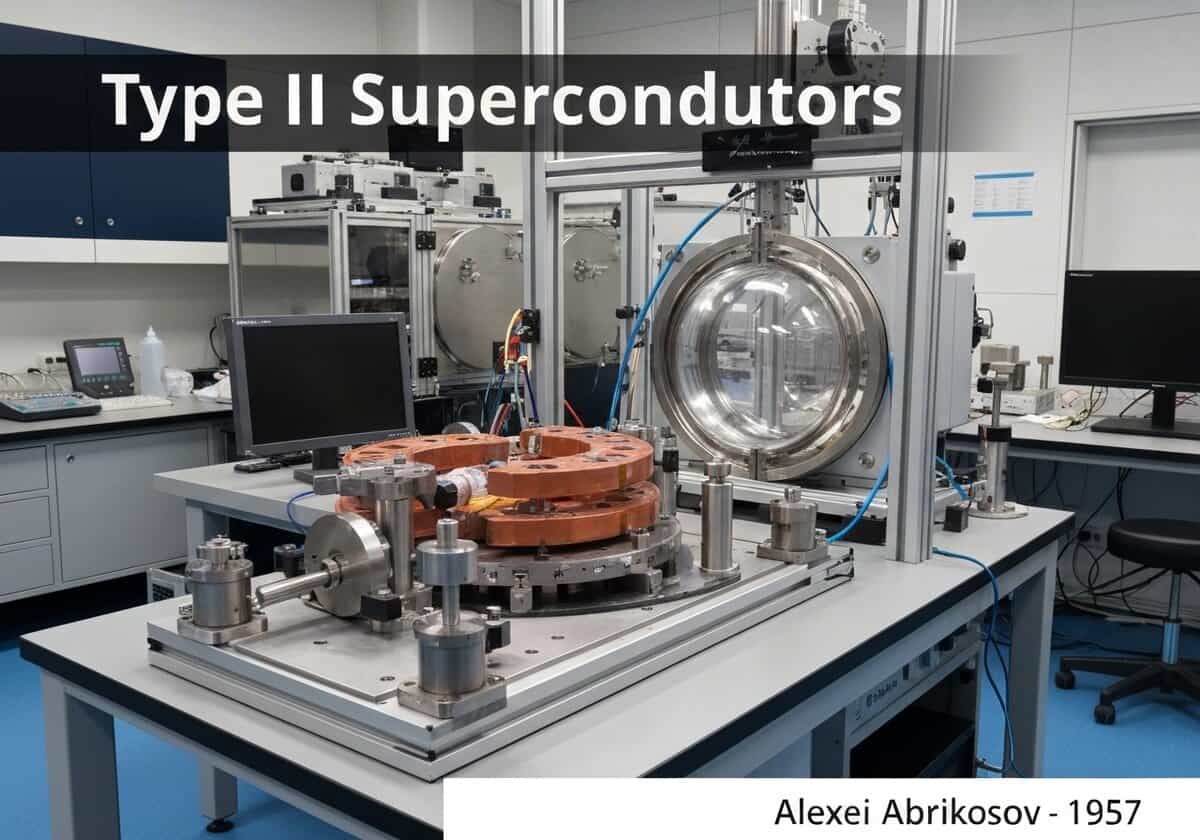
Superconducting magnet setup demonstrating Type II superconductors in a laboratory.

(صورة توضيحية فقط)

تنبأ أليكسي أبريكوسوف نظريًا بذلك في عام 1957 بناءً على نظرية جينزبورغ-لانداو, Type II superconductors are characterized by two critical magnetic fields, [latex]H_{c1}[/latex] and [latex]H_{c2}[/latex]. Between these fields, they enter a mixed or “vortex” state, allowing partial magnetic field penetration through quantized flux tubes called Abrikosov vortices. This allows them to remain superconducting in much higher magnetic fields than Type I superconductors.


The existence of Type II superconductors is crucial for most high-field applications of superconductivity. A Type I superconductor completely expels magnetic fields up to a critical field [latex]H_c[/latex], above which it abruptly transitions to the normal state. This [latex]H_c[/latex] is generally too low for building powerful magnets. Abrikosov showed that for materials where the Ginzburg-Landau parameter [latex]\kappa > 1/\sqrt{2}[/latex], it is energetically favorable for the material to allow magnetic flux to penetrate in a quantized manner rather than becoming fully normal. This penetration occurs above a lower critical field [latex]H_{c1}[/latex]. The flux enters in the form of cylindrical filaments called vortices or fluxons. Within the core of each vortex, the material is in the normal state, but the surrounding bulk remains superconducting. Each vortex carries a single quantum of magnetic flux, [latex]\Phi_0 = h/2e[/latex]. As the external field increases, more vortices enter the material, forming a regular triangular lattice known as an Abrikosov vortex lattice. The material remains superconducting, with zero resistance, until an upper critical field [latex]H_{c2}[/latex] is reached, at which point the vortex cores overlap and the entire material becomes normal. Since [latex]H_{c2}[/latex] can be hundreds of times larger than [latex]H_{c1}[/latex], Type II materials are essential for generating strong magnetic fields. All high-temperature superconductors and many alloys like Niobium-titanium (NbTi) and Niobium-tin (Nb3Sn) are Type II.

UNESCO Nomenclature: 2211
– Solid state physics

يكتب

تصنيف المواد

خلل

Substantial

الاستخدام

استخدام واسع النطاق

مقدمات

التطبيقات

براءات الاختراع:

NA

أفكار ابتكارية محتملة

  • مطياف الرنين المغناطيسي النووي المكتبي للتحليل الكيميائي
  • الحماية المغناطيسية للموائل في الفضاء العميق
  • تخزين البيانات القائم على الدوامة بكثافة عالية
  • المحولات الفائقة التوصيل لشبكة طاقة أكثر كفاءة
  • أنظمة توصيل الأدوية المغناطيسية الموجهة بواسطة مغناطيسات فائقة التوصيل الخارجية
  • أنظمة العلاج بالجسيمات المدمجة لعلاج السرطان
  • أنظمة إطلاق الطائرات الكهرومغناطيسية لحاملات الطائرات
  • التلاعب بالدوامة لبتات الحوسبة الكمومية
  • الفصل المغناطيسي عالي التدرج لتنقية المياه
  • عجلات موازنة خالية من الاحتكاك لتخزين الطاقة على نطاق الشبكة
Related to: Type II superconductor, Abrikosov vortex, mixed state, critical magnetic field, flux quantization, نظرية جينزبورغ-لانداو, flux pinning, high-field magnets, NbTi, YBCO.

السياق التاريخي

الموصلات الفائقة من النوع الثاني

1950
1950
1957
1957
1959-11
1960
1960
1950
1950
1950
1957
1958
1960
1960
1960

(إذا كان التاريخ غير معروف أو غير ذي صلة، على سبيل المثال "ميكانيكا الموائع"، يتم توفير تقدير تقريبي لظهوره الملحوظ)

أحدث الإضافات

أهم المنشورات والمقالات

أفضل الأدوات الأصلية

السنة العاشرة عيد

الصور والتنزيلات بالحجم الكامل متاحة فقط، ومجانية تمامًا، للأعضاء المسجلين.