Product Design, Manufacturing & Innovation Resources
Maison » Supraconducteurs de type II

Supraconducteurs de type II

1957
  • Alexei Abrikosov
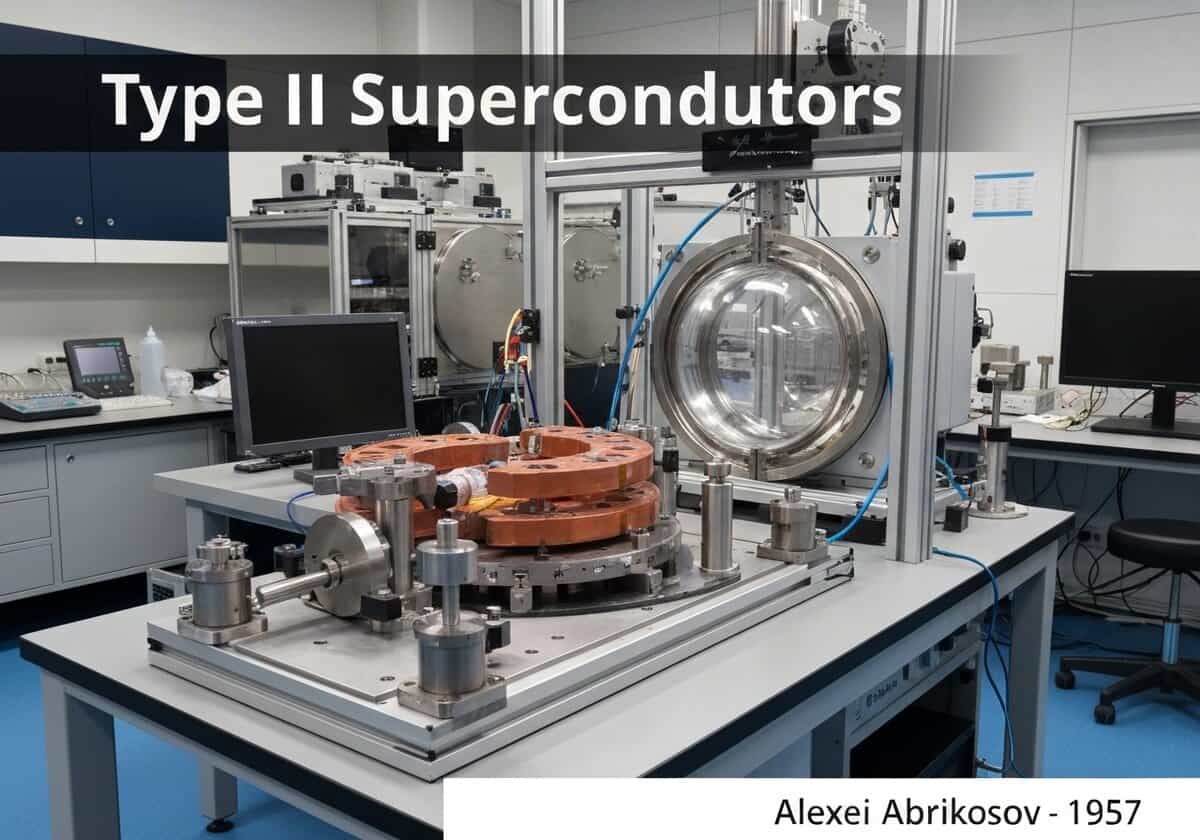
Installation d'un aimant supraconducteur démontrant les supraconducteurs de type II dans un laboratoire.

(Image générée à titre d'illustration uniquement)

Prédit théoriquement par Alexei Abrikosov en 1957 sur la base de théorie de Ginzburg-Landau, Type II superconductors are characterized by two critical magnetic fields, [latex]H_{c1}[/latex] and [latex]H_{c2}[/latex]. Between these fields, they enter a mixed or “vortex” state, allowing partial magnetic field penetration through quantized flux tubes called Abrikosov vortices. This allows them to remain superconducting in much higher magnetic fields than Type I superconductors.


The existence of Type II superconductors is crucial for most high-field applications of superconductivity. A Type I superconductor completely expels magnetic fields up to a critical field [latex]H_c[/latex], above which it abruptly transitions to the normal state. This [latex]H_c[/latex] is generally too low for building powerful magnets. Abrikosov showed that for materials where the Ginzburg-Landau parameter [latex]\kappa > 1/\sqrt{2}[/latex], it is energetically favorable for the material to allow magnetic flux to penetrate in a quantized manner rather than becoming fully normal. This penetration occurs above a lower critical field [latex]H_{c1}[/latex]. The flux enters in the form of cylindrical filaments called vortices or fluxons. Within the core of each vortex, the material is in the normal state, but the surrounding bulk remains superconducting. Each vortex carries a single quantum of magnetic flux, [latex]\Phi_0 = h/2e[/latex]. As the external field increases, more vortices enter the material, forming a regular triangular lattice known as an Abrikosov vortex lattice. The material remains superconducting, with zero resistance, until an upper critical field [latex]H_{c2}[/latex] is reached, at which point the vortex cores overlap and the entire material becomes normal. Since [latex]H_{c2}[/latex] can be hundreds of times larger than [latex]H_{c1}[/latex], Type II materials are essential for generating strong magnetic fields. All high-temperature superconductors and many alloys like Niobium-titanium (NbTi) and Niobium-tin (Nb3Sn) are Type II.

UNESCO Nomenclature: 2211
- Physique de l'état solide

Taper

Classification des matériaux

Perturbation

Substantiel

Usage

Utilisation généralisée

Précurseurs

Applications

Brevets:

NA

Idées d'innovations potentielles

  • spectromètres RMN de bureau pour l'analyse chimique
  • blindage magnétique pour les habitats de l'espace lointain
  • stockage de données basé sur le vortex à haute densité
  • transformateurs supraconducteurs pour un réseau électrique plus efficace
  • systèmes d'administration magnétique de médicaments guidés par des aimants supraconducteurs externes
  • systèmes de thérapie par particules compactes pour le traitement du cancer
  • systèmes de lancement électromagnétiques pour porte-avions
  • manipulation de vortex pour les qubits de calcul quantique
  • séparation magnétique à gradient élevé pour la purification de l'eau
  • volants d'inertie sans frottement pour le stockage d'énergie à l'échelle du réseau
Related to: Type II superconductor, Abrikosov vortex, mixed state, critical magnetic field, flux quantization, théorie de Ginzburg-Landau, flux pinning, high-field magnets, NbTi, YBCO.

Contexte historique

Supraconducteurs de type II

1950
1950
1957
1957
1959-11
1960
1960
1950
1950
1950
1957
1958
1960
1960
1960

(si la date est inconnue ou non pertinente, par exemple « mécanique des fluides », une estimation arrondie de son émergence notable est fournie)

10e année anniversaire

Les images en pleine résolution et les téléchargements sont uniquement disponibles, et 100% gratuits, pour les membres inscrits.