Product Design, Manufacturing & Innovation Resources
Heim » Redox in der Zellatmung

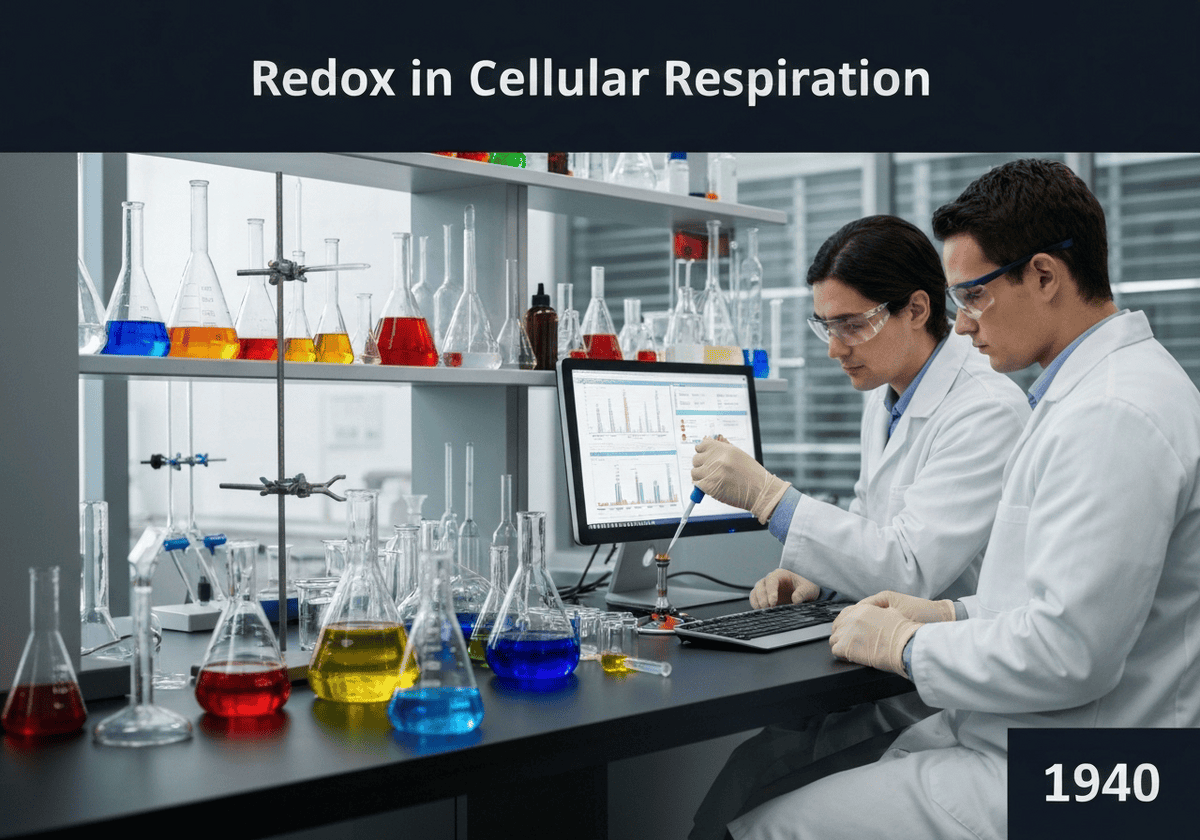
Redox in der Zellatmung

1940
Biochemiker, der in einem Labor Redoxreaktionen bei der Zellatmung untersucht.

(Abbildung dient nur zur Veranschaulichung)

Innovation.Welt

Cellular respiration is a controlled, multi-step oxidation of glucose. Unlike direct combustion, which releases energy explosively as heat, the cell breaks down glucose gradually through glycolysis, the Krebs cycle (citric acid cycle), and oxidative phosphorylation. In this cascade, electrons are stripped from glucose and its intermediates and transferred to electron carriers like [latex]NAD^+[/latex] and [latex]FAD[/latex], reducing them to [latex]NADH[/latex] and [latex]FADH_2[/latex].

These reduced coenzymes then donate their high-energy electrons to the electron transport chain (ETC), a series of protein complexes in the inner mitochondrial membrane. As electrons are passed down the chain, they move to successively lower energy levels. The final electron acceptor is molecular oxygen, which is highly electronegative and is reduced to form water. The energy released during this Elektronentransfer is used to Pumpe protons ([latex]H^+[/latex]) from the mitochondrial matrix into the intermembrane space, establishing an electrochemical gradient. This proton-motive force is a form of stored energy. The flow of protons back into the matrix through an enzyme called ATP synthase powers the synthesis of large amounts of ATP from ADP and inorganic phosphate, a process called chemiosmosis.

UNESCO Nomenclature: 2406
- Biochemie

Typ

Chemischer Prozess

Störung

Grundlegendes

Verwendung

Weitverbreitete Verwendung

Vorläufer

  • Entdeckung von Enzymen
  • antoine lavoisier’s work showing respiration is a form of slow combustion
  • Aufklärung der Struktur von Glucose
  • Entdeckung von ATP und seiner Rolle bei der Energieübertragung

Anwendungen

  • Stoffwechselerkrankungen verstehen
  • Entwicklung von Medikamenten, die auf Stoffwechselwege abzielen (z. B. Metformin)
  • Trainingsphysiologie
  • Lebensmittelwissenschaft und Konservierung
  • biotechnology (e.g., mikrobiell fuel cells)

Patente:

NA

Potenzielle Innovationsideen

  • Therapien zur Verjüngung alternder Mitochondrien durch Verbesserung der Effizienz der Elektronentransportkette
  • Biotechnologisch hergestellte Bakterien für eine effiziente Abfall-Energie-Umwandlung in mikrobiellen Brennstoffzellen
  • Stoffwechselmodulatoren zur Verbesserung der sportlichen Leistung durch Optimierung der Redoxwege
  • Biosensoren zur Erkennung früher Anzeichen des metabolischen Syndroms durch Überwachung zellulärer Redoxzustände
  • artificial Photosynthese systems that mimic the electron transport chain to produce hydrogen fuel
  • Medikamente, die selektiv Apoptose in Krebszellen induzieren, indem sie deren mitochondriale Atmung stören
  • Kryokonservierungstechniken, die mitochondriale Schäden durch oxidativen Stress minimieren
  • Synthetische Biologie circuits powered by cellular redox gradients for in-body computing
Related to: cellular respiration, metabolism, ATP, electron transport chain, krebs cycle, glycolysis, oxidative phosphorylation, mitochondria.

Historischer Kontext

Redox in der Zellatmung

1920
1928
1930
1940
1950
1950
1954
1910
1921
1930
1930
1940
1950
1951
1958

(wenn das Datum unbekannt oder nicht relevant ist, z. B. „Strömungsmechanik“, wird eine gerundete Schätzung seines bemerkenswerten Auftretens bereitgestellt)

10. Jahr Jubiläum

Bilder in voller Größe und Downloads sind nur für registrierte Mitglieder 100% kostenlos verfügbar.

> Login <