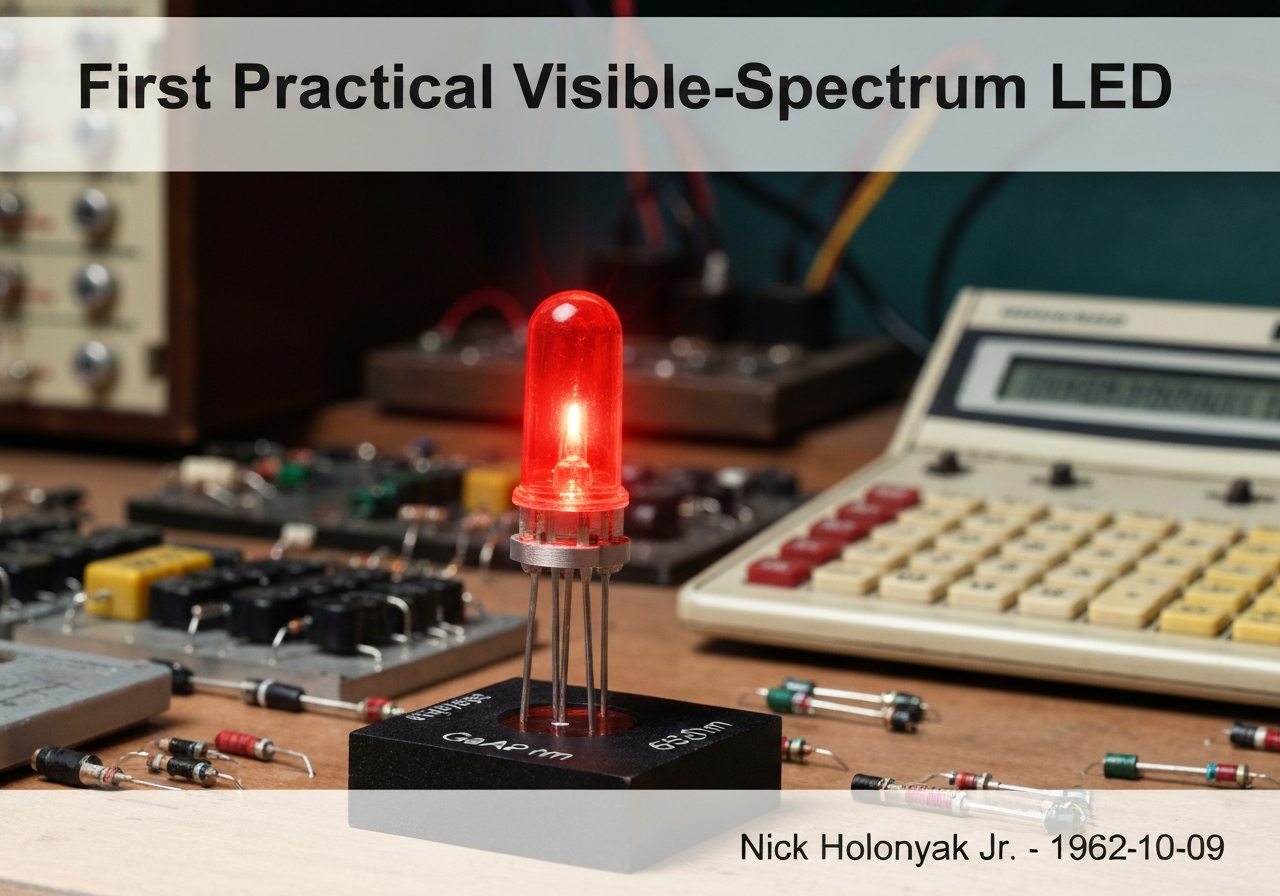
Working at General Electric, Nick Holonyak Jr. successfully created the first light-emitting diode that produced light in the visible part of the spectrum, specifically red light. This was a significant advancement over previous semiconductor diodes that only emitted invisible infrared light. Holonyak’s device used a ternary 合金, Gallium Arsenide Phosphide (GaAsP), grown on a Gallium Arsenide (GaAs) substrate. The creation of this alloy was a materials science challenge, but it allowed for a band gap large enough to produce red photons.
The invention was a proof of concept that solid-state devices could generate useful visible light. Its initial brightness was about 0.001 lumens, and it was expensive to produce. However, its robustness, small size, and low power consumption compared to incandescent bulbs made it ideal for indicator applications. This breakthrough directly led to the development of seven-segment displays that dominated the calculator and digital watch markets in the 1970s, replacing older 技术 like Nixie tubes. It marked the beginning of the transition from vacuum tube and incandescent technologies to solid-state optoelectronics.