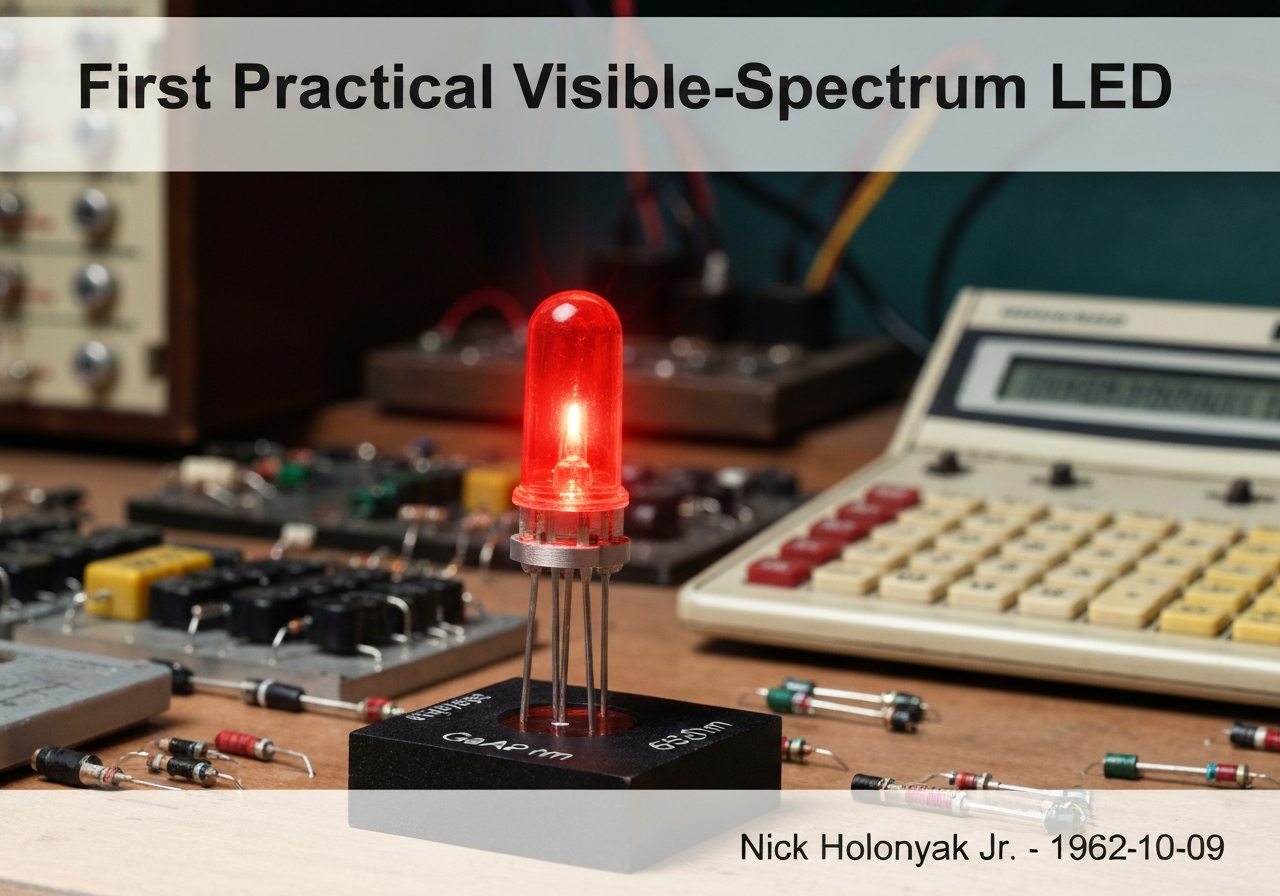
実用的な可視光LEDが初めて発明されたのは1962年のことだった。このデバイスは、ガリウムヒ素リン(GaAsP)半導体基板をベースとしており、波長約650nmの赤色光を発した。初期の効率は低かったものの、実用化に十分な明るさを持つ最初のLEDであり、初期の電卓などに使われていたような固体表示器やディスプレイの産業の幕開けとなった。

(画像はイメージです)
実用的な可視光LEDが初めて発明されたのは1962年のことだった。このデバイスは、ガリウムヒ素リン(GaAsP)半導体基板をベースとしており、波長約650nmの赤色光を発した。初期の効率は低かったものの、実用化に十分な明るさを持つ最初のLEDであり、初期の電卓などに使われていたような固体表示器やディスプレイの産業の幕開けとなった。

Working at General Electric, Nick Holonyak Jr. successfully created the first light-emitting diode that produced light in the visible part of the spectrum, specifically red light. This was a significant advancement over previous semiconductor diodes that only emitted invisible infrared light. Holonyak’s device used a ternary 合金, Gallium Arsenide Phosphide (GaAsP), grown on a Gallium Arsenide (GaAs) substrate. The creation of this alloy was a materials science challenge, but it allowed for a band gap large enough to produce red photons.
The invention was a proof of concept that solid-state devices could generate useful visible light. Its initial brightness was about 0.001 lumens, and it was expensive to produce. However, its robustness, small size, and low power consumption compared to incandescent bulbs made it ideal for indicator applications. This breakthrough directly led to the development of seven-segment displays that dominated the calculator and digital watch markets in the 1970s, replacing older テクノロジー like Nixie tubes. It marked the beginning of the transition from vacuum tube and incandescent technologies to solid-state optoelectronics.
初の実用的な可視光スペクトル(赤色)LED
(日付が不明または関連性がない場合、例えば「流体力学」などでは、その注目すべき出現時期の概算値が提示されます。)

フルサイズの画像とダウンロードは、登録会員のみが100%無料で利用できます。
> ログイン <