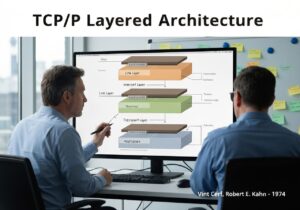
数据封装是指数据在协议栈中向下移动时,在每一层都被封装上协议信息的过程。当应用数据传递到传输层时,会添加 TCP 或 UDP 报头。然后,该数据段被传递到互联网层,在那里添加 IP 报头以形成数据包。最后,链路层添加自己的报头,从而创建用于传输的帧。
数据封装是实现分层架构的核心机制。 TCP/IP suite to function. Each layer operates independently, concerned only with its own protocol header. When a sending host prepares data, each layer adds its header containing control information specific to that layer’s function. For example, the TCP header includes port numbers for application identification and sequence numbers for reliability. The IP header includes source and destination IP addresses for routing. The link-layer header (e.g., Ethernet) includes MAC addresses for local delivery. At the receiving host, the process is reversed in a process called de-encapsulation. As the data moves up the stack, each layer strips off its corresponding header, reads the control information, and passes the remaining payload up to the next layer. This modular process ensures that, for instance, the IP layer doesn’t need to know what application generated the data, and the link layer doesn’t need to know the final destination IP address—it only cares about the next hop’s physical address.