Product Design, Manufacturing & Innovation Resources
Casa » Primo LED pratico a spettro visibile (rosso)

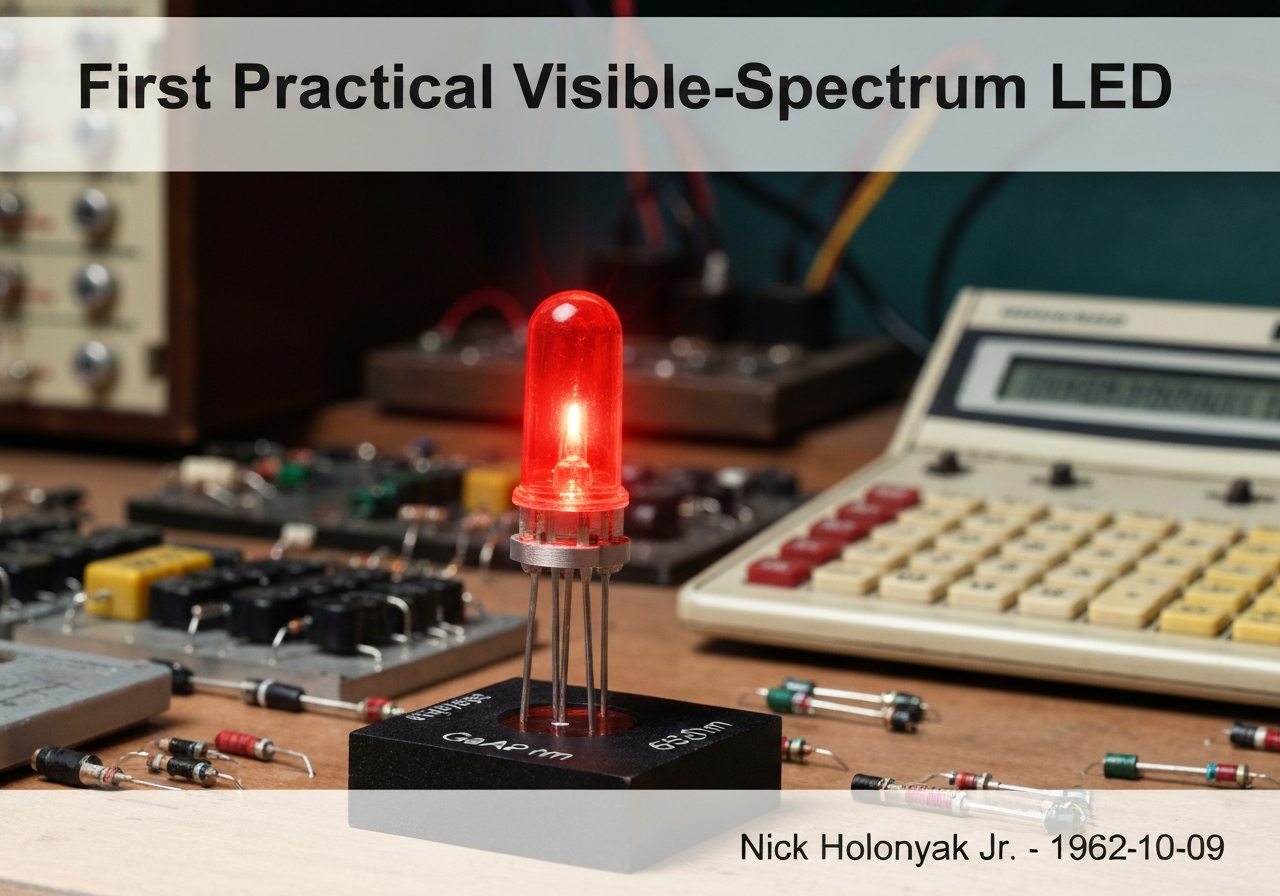
Primo LED pratico a spettro visibile (rosso)

1962-10-09
  • Nick Holonyak Jr.
LED a base di arseniuro di gallio fosfuro, che emette luce rossa ed è fondamentale nell'optoelettronica.

(Immagine generata a solo scopo illustrativo)

Il primo spettro visibile pratico GUIDATO was invented in 1962. This device, based on a Gallium Arsenide Phosphide (GaAsP) semiconduttore substrate, emitted red light at a wavelength of approximately 650 nm. While its initial efficiency was low, it was the first LED bright enough for practical use, launching the industry of solid-state indicators and displays like those in early calculators.

Working at General Electric, Nick Holonyak Jr. successfully created the first light-emitting diode that produced light in the visible part of the spectrum, specifically red light. This was a significant advancement over previous semiconductor diodes that only emitted invisible infrared light. Holonyak’s device used a ternary lega, Gallium Arsenide Phosphide (GaAsP), grown on a Gallium Arsenide (GaAs) substrate. The creation of this alloy was a materials science challenge, but it allowed for a band gap large enough to produce red photons.

The invention was a proof of concept that solid-state devices could generate useful visible light. Its initial brightness was about 0.001 lumens, and it was expensive to produce. However, its robustness, small size, and low power consumption compared to incandescent bulbs made it ideal for indicator applications. This breakthrough directly led to the development of seven-segment displays that dominated the calculator and digital watch markets in the 1970s, replacing older tecnologie like Nixie tubes. It marked the beginning of the transition from vacuum tube and incandescent technologies to solid-state optoelectronics.

UNESCO Nomenclature: 3308
- Elettronica

Tipo

Dispositivo fisico

Interruzione

Sostanziale

Utilizzo

Uso diffuso

Precursori

  • sviluppo della tecnologia dell'arseniuro di gallio (GaAs).
  • epitassia in fase vapore per la crescita di cristalli
  • comprensione delle giunzioni pn nei semiconduttori composti
  • lavori precedenti sui LED a infrarossi di James R. Biard e Gary Pittman nel 1961

Applicazioni

  • display delle calcolatrici (ad esempio, HP-35)
  • display degli orologi digitali
  • spie luminose sulle apparecchiature elettroniche
  • presto optical data transmission links
  • semaforo

Brevetti:

NA

Idee e potenziali innovazioni

  • high-efficiency red leds for automotive brake lights
  • red laser diodes for dvd players and barcode scanners
  • led-based pulse oximeters using red and infrared light
  • advanced horticultural lighting systems using red leds to promote flowering
  • traffic signal retrofits for energy savings
  • large-scale video billboards and scoreboards
  • aircraft and vehicle instrumentation panels
  • emergency exit signs with long life and low power consumption
  • led-based photodynamic therapy in medicine
  • optical mice using red led illumination
Correlato a: LED rosso, Nick Holonyak, fosfuro di arseniuro di gallio, GAASP, General Electric, display a sette segmenti, spia luminosa, spettro visibile, optoelettronica.

Contesto storico

Primo LED pratico a spettro visibile (rosso)

1960
1960
1960
1962-10-09
1964
1970
1970
1960
1960
1960
1962
1963
1965-12-21
1970
1970

(se la data è sconosciuta o non rilevante, ad esempio "meccanica dei fluidi", viene fornita una stima approssimativa della sua notevole comparsa)

decimo anno anniversario

Le immagini a grandezza naturale e i download sono disponibili, gratuitamente al 100%, solo per gli utenti registrati.

> Login <