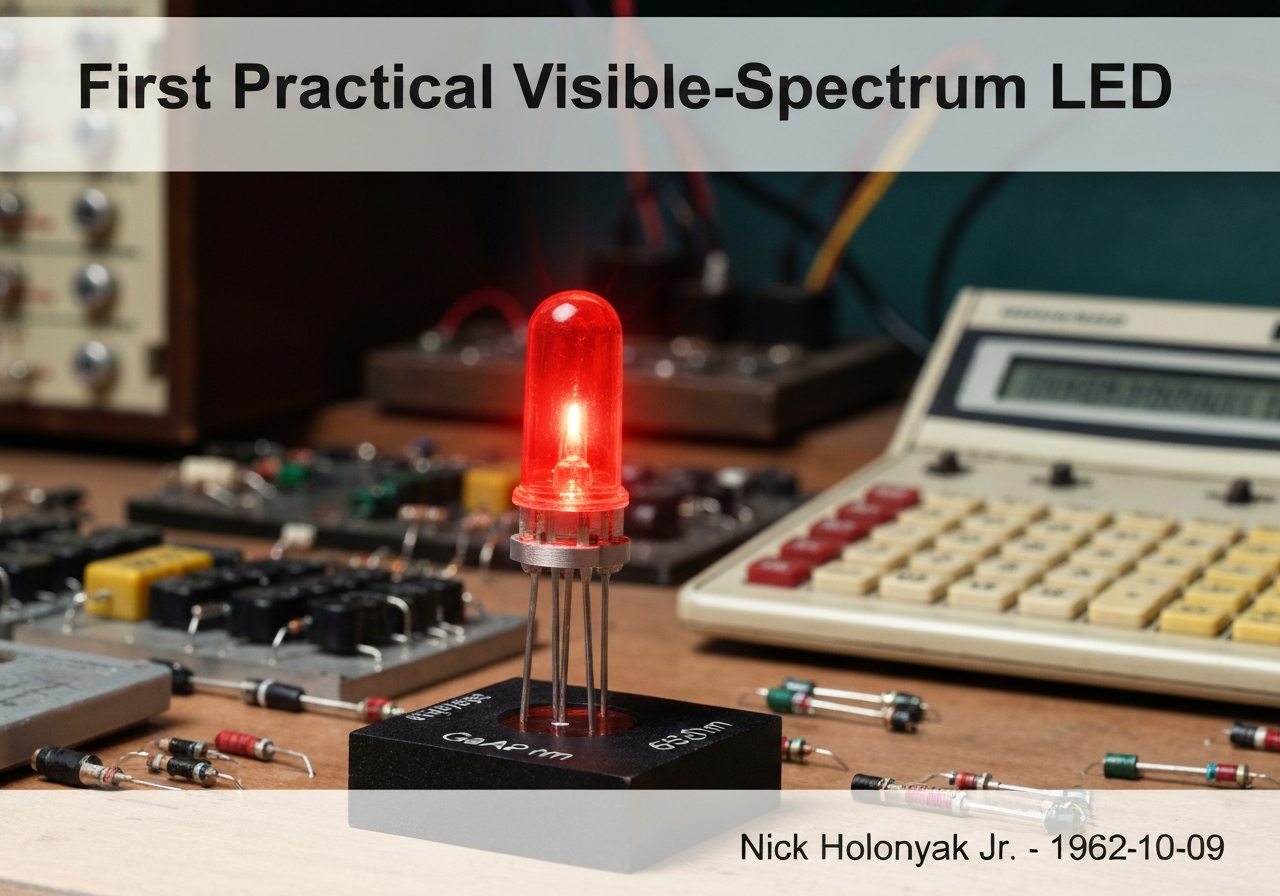
최초의 실용적인 가시광선 LED는 1962년에 발명되었습니다. 갈륨비소인화물(GaAsP) 반도체 기판을 기반으로 한 이 소자는 약 650nm 파장의 붉은색 빛을 방출했습니다. 초기 효율은 낮았지만, 실용적인 용도로 사용할 수 있을 만큼 밝은 최초의 LED였으며, 초기 계산기에 사용된 것과 같은 고체형 표시기 및 디스플레이 산업을 촉발했습니다.

(설명을 위한 생성된 이미지입니다)
최초의 실용적인 가시광선 LED는 1962년에 발명되었습니다. 갈륨비소인화물(GaAsP) 반도체 기판을 기반으로 한 이 소자는 약 650nm 파장의 붉은색 빛을 방출했습니다. 초기 효율은 낮았지만, 실용적인 용도로 사용할 수 있을 만큼 밝은 최초의 LED였으며, 초기 계산기에 사용된 것과 같은 고체형 표시기 및 디스플레이 산업을 촉발했습니다.

Working at General Electric, Nick Holonyak Jr. successfully created the first light-emitting diode that produced light in the visible part of the spectrum, specifically red light. This was a significant advancement over previous semiconductor diodes that only emitted invisible infrared light. Holonyak’s device used a ternary 합금, Gallium Arsenide Phosphide (GaAsP), grown on a Gallium Arsenide (GaAs) substrate. The creation of this alloy was a materials science challenge, but it allowed for a band gap large enough to produce red photons.
The invention was a proof of concept that solid-state devices could generate useful visible light. Its initial brightness was about 0.001 lumens, and it was expensive to produce. However, its robustness, small size, and low power consumption compared to incandescent bulbs made it ideal for indicator applications. This breakthrough directly led to the development of seven-segment displays that dominated the calculator and digital watch markets in the 1970s, replacing older 기술 like Nixie tubes. It marked the beginning of the transition from vacuum tube and incandescent technologies to solid-state optoelectronics.
최초의 실용적인 가시광선(적색) LED
(날짜를 알 수 없거나 관련이 없는 경우, 예를 들어 "유체역학"의 경우, 주목할 만한 등장 시기를 대략적으로 추정하여 제공합니다.)

고화질 이미지 및 다운로드는 등록된 회원에게만 100% 무료로 제공됩니다.
> 로그인 <