粒子数反转是指原子或分子系统中处于较高激发态的粒子数多于处于较低激发态的粒子数的一种状态。这种非平衡状态是受激辐射光放大的先决条件。如果没有粒子数反转,吸收将占主导地位,无法获得净增益,激光作用也就无法实现。

(图片仅供参考)
粒子数反转是指原子或分子系统中处于较高激发态的粒子数多于处于较低激发态的粒子数的一种状态。这种非平衡状态是受激辐射光放大的先决条件。如果没有粒子数反转,吸收将占主导地位,无法获得净增益,激光作用也就无法实现。
Under normal thermal equilibrium, the population of energy levels is described by the Boltzmann distribution, which dictates that lower energy states are always more populated than higher energy states. To achieve laser action, this natural state must be inverted. Population inversion is the condition where the number of atoms in an excited state, [latex]N_2[/latex], exceeds the number in a lower energy state, [latex]N_1[/latex], i.e., [latex]N_2 > N_1[/latex]. This is a necessary condition for net optical gain, as the rate of stimulated emission (proportional to [latex]N_2[/latex]) must be greater than the rate of absorption (proportional to [latex]N_1[/latex]).
实现粒子数反转需要外部能量源,这一过程称为“泵浦”。常见的泵浦方法包括光泵浦(使用闪光灯或其他激光器)、电放电(在气体激光器中)和直流注入(在半导体激光器中)。系统被“泵浦”到高能级,然后迅速衰变到寿命相对较长的“亚稳态”上激光能级。下激光能级被设计成快速衰变,以确保其保持未激发状态。这就在亚稳态上能级和快速衰变的下能级之间实现了粒子数反转。这通常使用三能级或四能级能级方案来实现,其中四能级系统效率更高,因为下激光能级不是基态,更容易保持未激发状态。
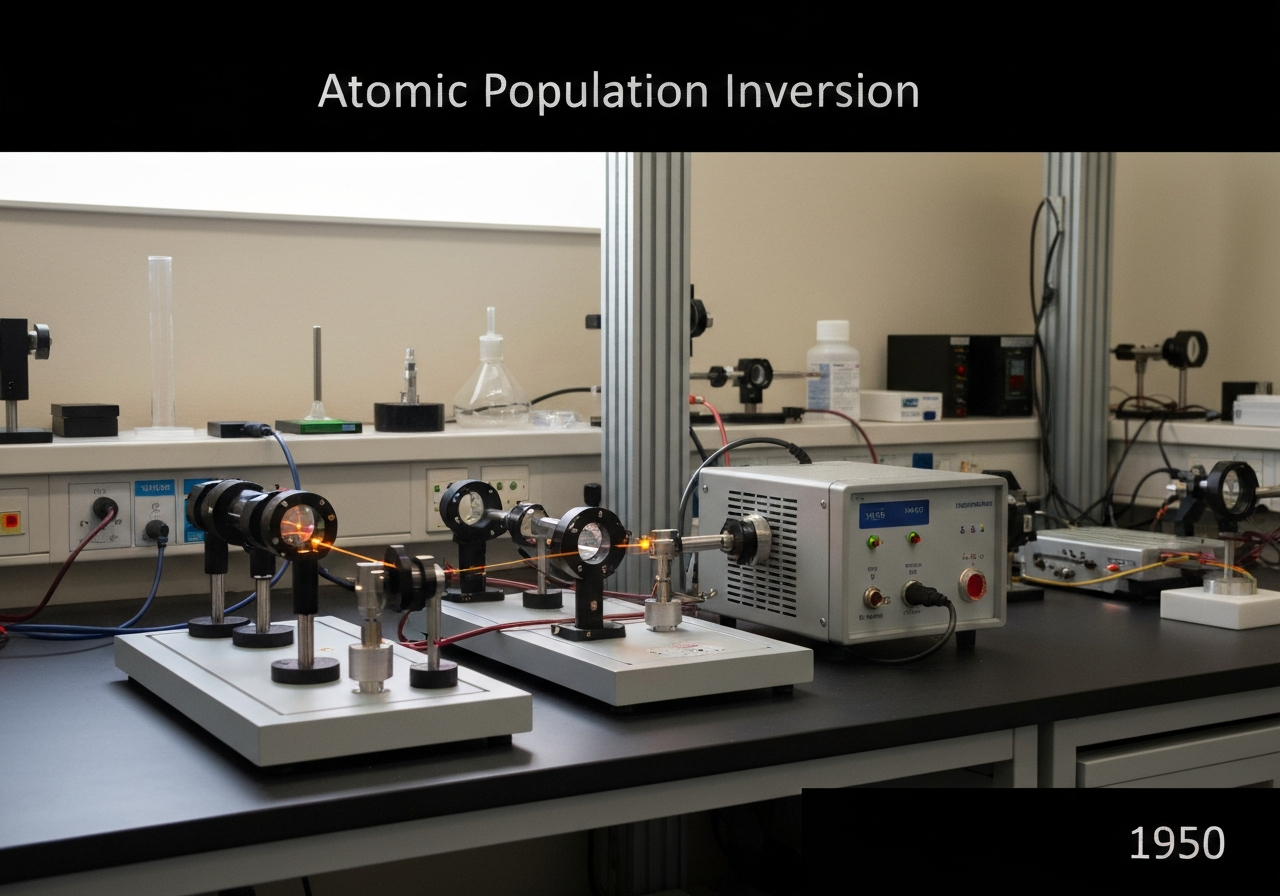
原子布居反转
(如果日期未知或不相关,例如“流体力学”,则提供其显著出现的近似估计)
只有注册会员才能免费获取完整尺寸的图片和下载内容。
> 登录 <