Product Design, Manufacturing & Innovation Resources
Maison » Première LED pratique à spectre visible (rouge)

Première LED pratique à spectre visible (rouge)

1962-10-09
  • Nick Holonyak Jr.
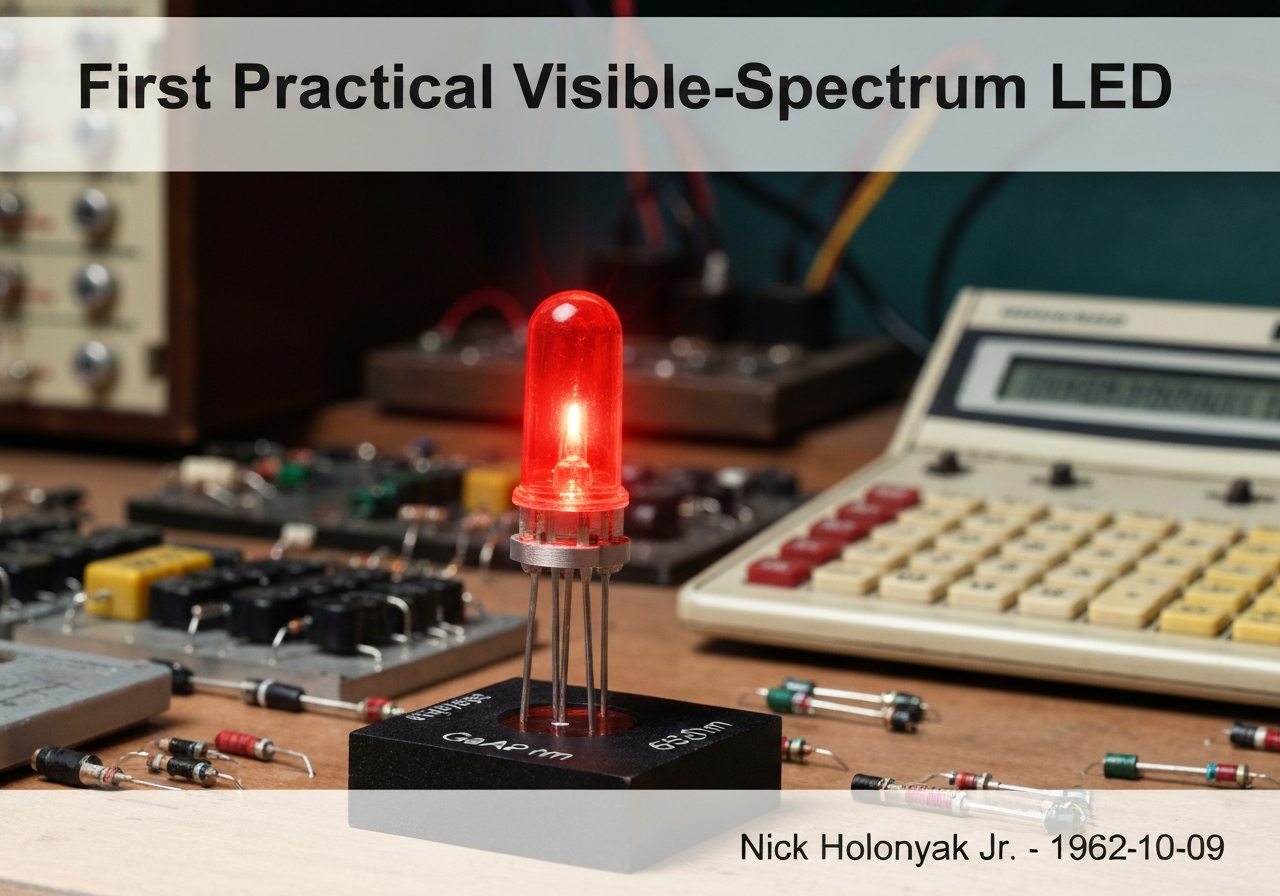
LED à base de phosphure d'arséniure de gallium émettant une lumière rouge, élément essentiel en optoélectronique.

(Image générée à titre d'illustration uniquement)

Le premier spectre visible pratique DIRIGÉ was invented in 1962. This device, based on a Gallium Arsenide Phosphide (GaAsP) semi-conducteur substrate, emitted red light at a wavelength of approximately 650 nm. While its initial efficiency was low, it was the first LED bright enough for practical use, launching the industry of solid-state indicators and displays like those in early calculators.

Working at General Electric, Nick Holonyak Jr. successfully created the first light-emitting diode that produced light in the visible part of the spectrum, specifically red light. This was a significant advancement over previous semiconductor diodes that only emitted invisible infrared light. Holonyak’s device used a ternary alliage, Gallium Arsenide Phosphide (GaAsP), grown on a Gallium Arsenide (GaAs) substrate. The creation of this alloy was a materials science challenge, but it allowed for a band gap large enough to produce red photons.

The invention was a proof of concept that solid-state devices could generate useful visible light. Its initial brightness was about 0.001 lumens, and it was expensive to produce. However, its robustness, small size, and low power consumption compared to incandescent bulbs made it ideal for indicator applications. This breakthrough directly led to the development of seven-segment displays that dominated the calculator and digital watch markets in the 1970s, replacing older technologies like Nixie tubes. It marked the beginning of the transition from vacuum tube and incandescent technologies to solid-state optoelectronics.

UNESCO Nomenclature: 3308
- Électronique

Taper

Dispositif physique

Perturbation

Substantiel

Usage

Utilisation généralisée

Précurseurs

  • développement de la technologie de l'arséniure de gallium (GaAs)
  • épitaxie en phase vapeur pour la croissance cristalline
  • compréhension des jonctions pn dans les semi-conducteurs composés
  • travaux antérieurs sur les LED infrarouges réalisés par James R. Biard et Gary Pittman en 1961

Applications

  • écrans de calculatrice (par exemple, HP-35)
  • affichages de montres numériques
  • Voyants lumineux sur les équipements électroniques
  • début optical data transmission links
  • feux de signalisation

Brevets:

NA

Idées d'innovations potentielles

  • high-efficiency red leds for automotive brake lights
  • red laser diodes for dvd players and barcode scanners
  • led-based pulse oximeters using red and infrared light
  • advanced horticultural lighting systems using red leds to promote flowering
  • traffic signal retrofits for energy savings
  • large-scale video billboards and scoreboards
  • aircraft and vehicle instrumentation panels
  • emergency exit signs with long life and low power consumption
  • led-based photodynamic therapy in medicine
  • optical mice using red led illumination
En lien avec : LED rouge, Nick Holonyak, phosphure d'arséniure de gallium, GAASP, General Electric, afficheur sept segments, voyant lumineux, spectre visible, optoélectronique.

Contexte historique

Première LED pratique à spectre visible (rouge)

1960
1960
1960
1962-10-09
1964
1970
1970
1960
1960
1960
1962
1963
1965-12-21
1970
1970

(si la date est inconnue ou non pertinente, par exemple « mécanique des fluides », une estimation arrondie de son émergence notable est fournie)

10e année anniversaire

Les images en pleine résolution et les téléchargements sont uniquement disponibles, et 100% gratuits, pour les membres inscrits.