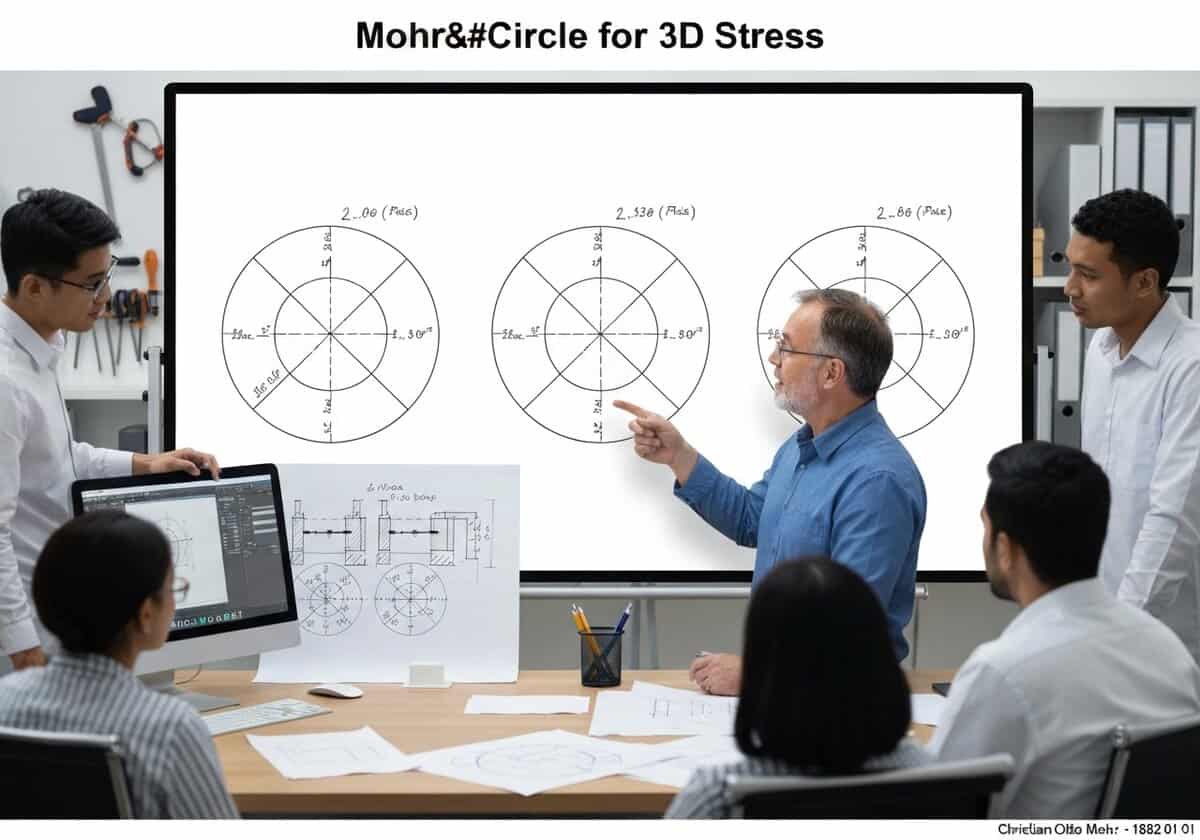
The stress state ([latex]\sigma_n, \tau_n[/latex]) for any arbitrarily oriented plane at the point will lie within the shaded area bounded by these three circles. A crucial insight from this 3D representation is the determination of the absolute maximum 剪应力. Unlike the 2D case where the maximum in-plane shear is the radius, the absolute maximum shear stress for a 3D state is always the radius of the largest circle, given by [latex]\tau_{abs max} = R_{max} = (\sigma_{max} – \sigma_{min})/2 = (\sigma_1 – \sigma_3)/2[/latex]. This value is fundamental for applying failure criteria like the Tresca yield criterion in a general 3D context, as it represents the true maximum shear stress experienced by the material at that point.
有限元 analysis (fea) post-processors with interactive 3d mohr’s circle visualization
用于设计深海潜水器和分析船体应力的软件
计算并显示骨骼和组织中三维应力状态的医学成像软件
适用于各向异性材料(例如木材、复合材料)的先进材料模型,包含三维应力状态
seismic analysis tools for modeling stress changes in the earth’s crust
用于培训工程师进行复杂三维应力分析的虚拟现实工具
复杂载荷下3D打印部件拓扑优化算法
深部采矿作业中岩爆的预测模型
analysis tools for residual stresses in advanced manufacturing processes like 快速成型制造
Related to: 3D stress, Mohr’s circle, principal stresses, absolute maximum shear stress, cauchy stress tensor, triaxial stress, geomechanics, 固体力学, failure analysis, continuum mechanics.