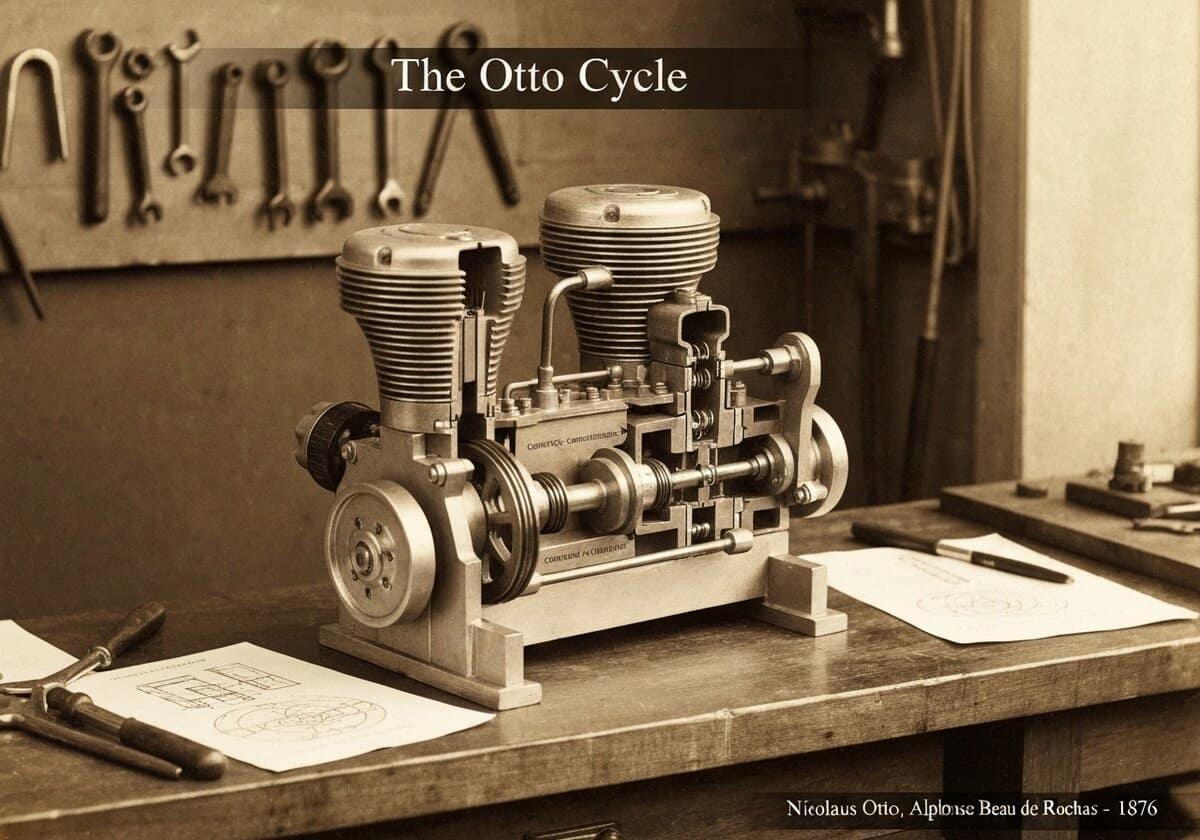
The Otto cycle is visualized on a Pressure-Volume (P-V) diagram, forming a 闭环. The analysis begins at state 1, at the start of the compression stroke, with the piston at bottom dead center (BDC).
工艺 2-3:恒容加热。 At TDC, the spark plug ignites the mixture. The combustion is assumed to be instantaneous, occurring while the volume does not change (an isochoric process). This adds heat ([latex]Q_{in}[/latex]) to the working fluid, causing a sharp increase in temperature and pressure to state 3, the point of maximum cycle pressure and temperature.
工艺 4-1:定容散热。 At BDC, the exhaust valve is assumed to open, and the pressure instantly drops back to the initial pressure of state 1. This is modeled as an isochoric process where heat ([latex]Q_{out}[/latex]) is rejected from the working fluid to the surroundings, completing the cycle and returning the fluid to its initial state.