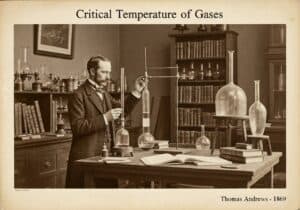
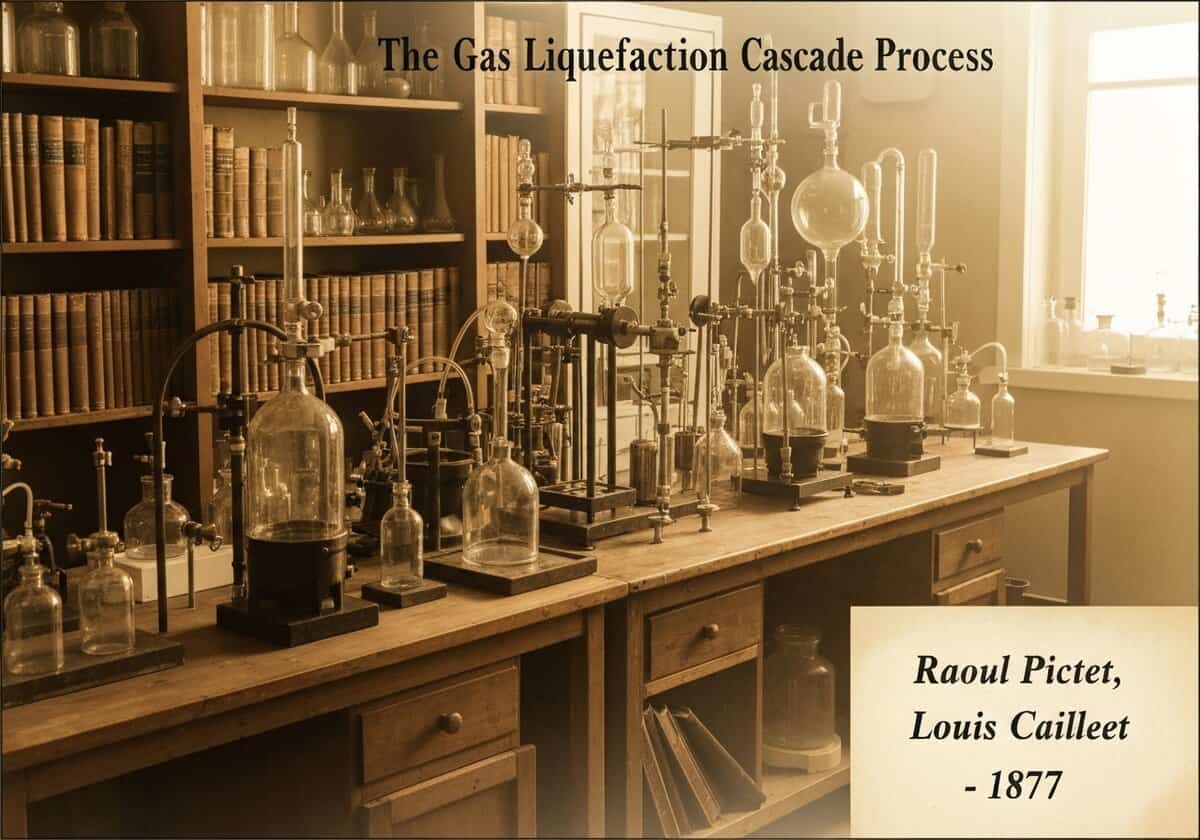
Raoul Pictet’s apparatus in 1877 was a landmark achievement. He used sulfur dioxide (SO2), which liquefies at -10 °C under pressure, as the first stage. By allowing the liquid SO2 to evaporate, he cooled carbon dioxide (CO2) below its critical temperature, allowing it to be liquefied. The evaporating liquid CO2, which boils at -78 °C, then provided the intense cold needed to cool oxygen gas below its critical temperature (-118 °C). By subjecting this cold oxygen gas to very high pressure, Pictet produced the first visible droplets of liquid oxygen. Louis Paul Cailletet achieved a similar result independently at the same time using a different method. The cascade method is thermodynamically efficient but complex, requiring multiple refrigeration circuits with different refrigerants. It was a crucial step before the development of more integrated systems like the Hampson-Linde cycle, and its principles are still applied in modern multi-stage refrigeration cycles, particularly in large-scale LNG production.