Product Design, Manufacturing & Innovation Resources
家 » 玻尔兹曼熵公式

玻尔兹曼熵公式

1877
  • Ludwig Boltzmann
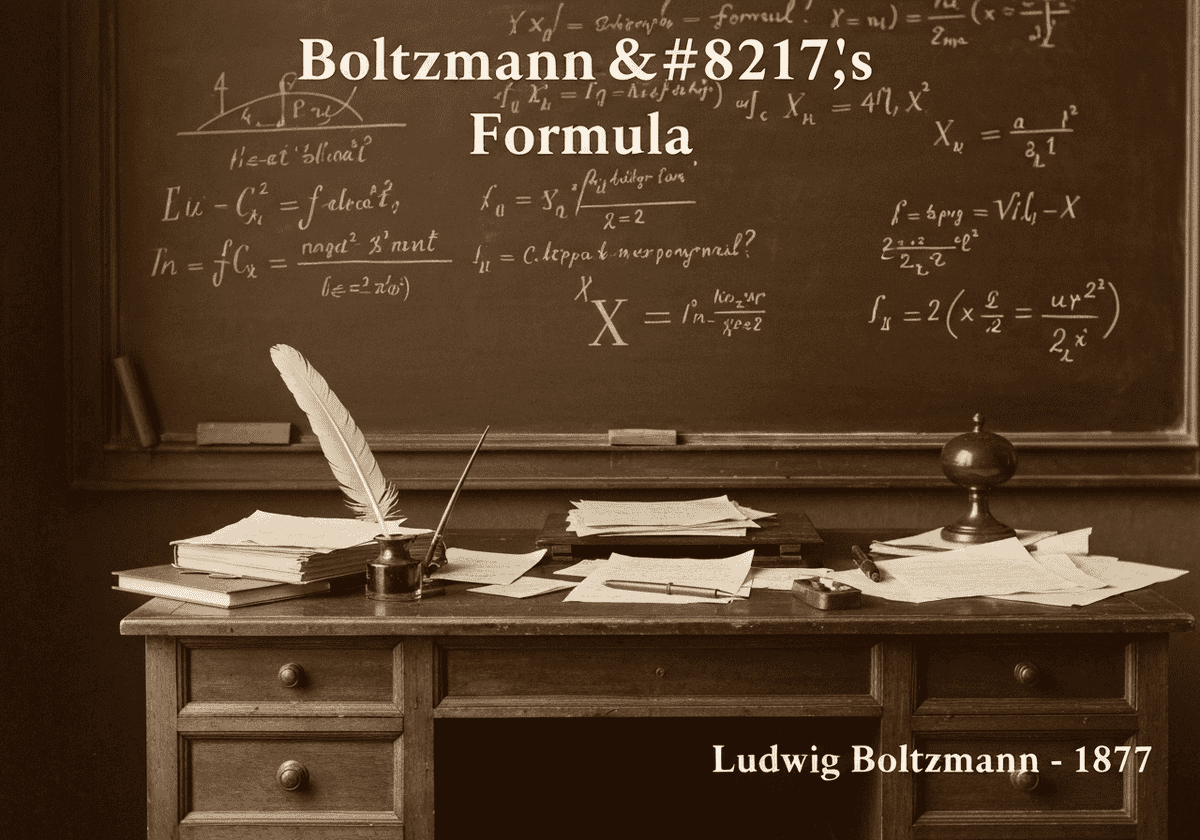
19th-century scientific office with Boltzmann's Entropy Formula and thermodynamic equations.

(图片仅供参考)

这一基础公式将宏观层面联系起来 热力学 quantity of entropy (S) with the number of possible microscopic arrangements, or microstates (W), corresponding to the system’s macroscopic state. The equation, [latex]S = k_B \ln W[/latex], reveals that entropy is a measure of statistical disorder or randomness. The constant [latex]k_B[/latex] is the Boltzmann constant, linking energy at the particle level with temperature. To write this equation in a report, a LaTeX cheat sheet lists the commands for subscripts, logarithms and the Boltzmann constant symbol, and a LaTeX math cheat sheet extends it to fractions and integrals.


Boltzmann’s entropy formula provides a statistical definition for the 热力学 concept of entropy, which was previously defined by Rudolf Clausius in terms of heat transfer ([latex]dS = \frac{\delta Q}{T}[/latex]). Boltzmann’s breakthrough was to link this macroscopic quantity to the statistical properties of the system’s constituent particles. A ‘macrostate’ is defined by macroscopic variables like pressure, volume, and temperature. A ‘microstate’ is a specific configuration of the positions and momenta of all individual particles. The key insight is that a single macrostate can be realized by an enormous number of different microstates. The quantity W, sometimes called the statistical weight or thermodynamic probability, is this number.

该公式意味着,孤立系统的平衡态,也就是熵值最大的状态。 热力学第二定律, is simply the most probable macrostate—the one with the largest number of corresponding microstates (largest W). The logarithmic relationship is crucial because it ensures that entropy is an extensive property. If you combine two independent systems, their total entropy is the sum of their individual entropies ([latex]S_{tot} = S_1 + S_2[/latex]), while the total number of microstates is the product ([latex]W_{tot} = W_1 W_2[/latex]). The logarithm turns this product into a sum: [latex]k_B \ln(W_1 W_2) = k_B \ln W_1 + k_B \ln W_2[/latex]. This formula is famously engraved on Boltzmann’s tombstone in Vienna.

UNESCO Nomenclature: 2211
- 热力学

类型

抽象系统

中断

革命

用法

广泛使用

前体

  • 鲁道夫·克劳修斯的理论 第二定律 of thermodynamics and the classical definition of entropy
  • 詹姆斯-克拉克-麦克斯韦关于气体中分子速度统计分布的研究成果
  • 皮埃尔-西蒙等数学家发展概率论 拉普拉斯
  • 气体动力学理论

应用程序

  • 信息论(香农熵)
  • 黑洞 热力学(贝肯斯坦-霍金熵)
  • 预测相稳定性的材料科学
  • 计算反应熵的计算化学
  • 玻璃转变物理学

专利:

NA

潜在创新理念

  • design of high-entropy alloys with tailored disorder for extreme environments
  • development of more efficient data compression algorithms based on entropy minimization
  • creating self-assembling nanomaterials by programming their most probable (highest w) structures
  • optimizing drug-receptor binding by calculating the entropic cost of conformational changes
  • modeling urban growth and traffic flow as systems tending towards maximum statistical complexity
  • advanced cryptographic systems using principles of statistical randomness
  • ai algorithms for protein design that maximize the conformational entropy of flexible regions
  • predictive models for ecosystem stability based on species diversity as a form of entropy
相关内容: 熵、玻尔兹曼、微观状态、宏观状态、热力学、概率、统计力学、玻尔兹曼常数。.

历史背景

玻尔兹曼熵公式

1868
1870
1873
1877
1880
1882-01-01
1883
1865
1869
1871
1876
1877
1880
1882-01-01
1884

(如果日期未知或不相关,例如“流体力学”,则提供其显著出现的近似估计)

第十年 周年纪念日

只有注册会员才能免费获得 100% 的全尺寸图片和下载。.

> 登录 <