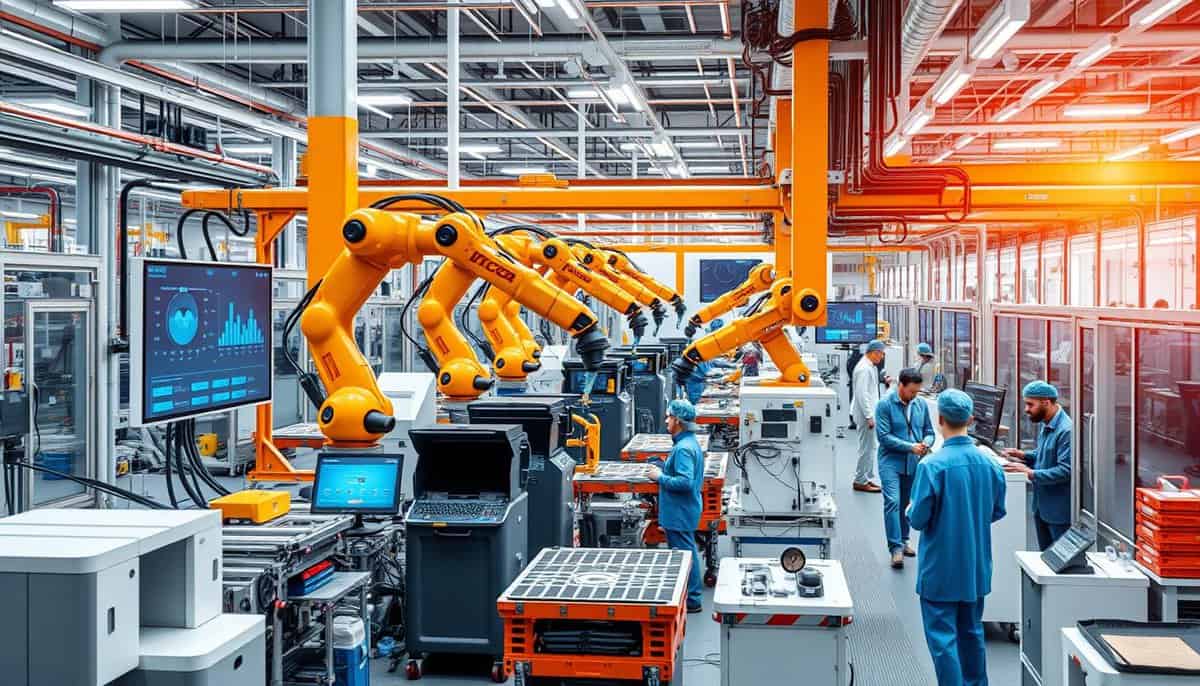
Are you making the most of every tool at your disposal to enhance production? Knowing and using the right Key Performance Indicators (KPIs) can change your operation’s success. These metrics help reduce downtime and plan production better, showing every part of the manufacturing process.
在当今制造业中,生产关键绩效指标 (KPI) 至关重要。它们帮助企业监控、分析和改进生产环节。诸如整体设备效率 (OEE)、库存周转率和准时交付率等指标,能够帮助企业发现问题、减少浪费并预测未来需求。这些指标指导生产朝着目标前进,同时适应市场变化和环境变化,从而使运营更加灵活高效。
关键要点
- Using KPIs well can greatly improve efficiency in manufacturing.
- 整体设备效率 (OEE) 综合考虑了可用性、性能和质量。
- Low inventory turns can release cash and better meet customer needs.
- On-Time Delivery is key to pleasing customers and encouraging staff.
- Tracking Customer Returns is crucial for fixing issues in production.
What are Production KPIs?
Production Key Performance Indicators (KPIs) are key measures in manufacturing. They track how well and efficiently production processes work. These indicators help companies figure out what’s working and what’s not. This way, they can improve and make their operations smoother.
Definition of Production KPIs
生产关键绩效指标 (KPI) 是衡量生产流程是否达到目标的指标。它们涵盖周期时间、吞吐率和整体设备效率 (OEE) 等重要因素。跟踪这些指标可以帮助企业优化生产,并准确衡量生产进度。
Importance of Tracking KPIs
The value of tracking KPIs is huge. They turn lots of data into useful insights. Regular monitoring is key for several reasons:
- 目标设定与实现: KPIs make it possible to set clear goals. This keeps production lines up with what the company wants.
- 找出瓶颈: 通过分析关键绩效指标 (KPI),企业可以快速发现生产中的瓶颈。这使他们能够迅速解决问题,确保生产顺利进行。
- 提高生产过程效率: 关注关键绩效指标 (KPI) 有助于企业提高效率。这意味着他们可以节省成本并生产更多产品。
Keeping an eye on KPIs gives manufacturers a way to improve their performance. This is crucial to stay ahead in a fast-changing market.
Types of Production KPIs
生产关键绩效指标 (KPI) 主要分为三大类:设备、产品和成本效益。了解这些 KPI 类别有助于更好地跟踪和改进生产流程。
Machinery or Asset Focused
This KPI type looks at machinery and asset management. Important metrics are:
- 机器正常运行时间率: 这衡量的是设备的持续运行时间。计算公式为(机器总使用时间/可用生产时间)* 100。目标是将机器正常运行时间保持在 90%。
- 缺陷率: 这用于追踪产品质量。计算公式为:缺陷数/产量*100。目标是降低缺陷率。
- Overall Equipment Effectiveness (OEE): 这用于检查机器的运行效率。计算公式为(产量 × 最大周期时间)/ 可用生产时间。我们希望今年将设备综合效率 (OEE) 提高 5%。
Unit or Product Focused
Here, KPIs look at the number of units or products, giving insights into how production tracks. Included metrics are:
- Cycle time这就是一个生产周期所需的时间。
- 生产能力率这显示的是最大可能产量。它是通过机器产能率乘以时间计算得出的。
- Throughput rate:这衡量的是一段时间内的产品产量。
Cost Focused
Cost-focused KPIs help look at money and keeping costs low in production. Key metrics are:
- 单位生产成本:这衡量的是生产一个单位产品的成本。计算公式为:总制造成本 / 生产数量。目标是到 2022 年将单位制造成本降低 2 美分。
- 单位维护成本这项指标考察的是单位维护成本。计算方法为:总维护成本除以产量。今年的目标是将单位维护成本降低 5%。
- 未使用的产能成本这项指标用于评估未充分利用产能的成本影响。计算公式为:可用未利用产能百分比 × 总制造成本。我们的目标是在 6 个月内将未利用产能降低 10%。
Below is a table showing key metrics in these categories:
| KPI Type | 公制 | Formula | Example Goal |
|---|---|---|---|
| Machinery or Asset Focused | Machine Uptime Rate | (Total Time Machine Used / Available Production Time) * 100 | Keep each machine uptime rate at 90% |
| Unit or Product Focused | Production Capacity Rate | Machine Capacity Rate * Time | Ensure each machine uptime rate is 90% |
| Cost Focused | Production Cost per Unit | Total Manufacturing Cost / Number of Units Produced | Cut unit production cost by 2 cents by 2022 |
Key Performance Indicators (KPIs) for production
KPIs for production cover many metrics key for assessing manufacturing efficiency and productivity. These indicators provide data that helps manufacturing leaders make smart choices. They work to optimize operations, lower costs, and boost output. Knowing how to track manufacturing with key metrics is vital to compete today.

Several KPIs measure different aspects of production. They are crucial for quality assurance, equipment upkeep, cost control, and overall productivity. Key production KPIs include:
- Revenue: The total income from sales or services.
- Gross Profit Margin: The revenue percentage after removing the cost of goods sold.
- Return on Investment (投资回报率): The profit to investment ratio.
- Customer Acquisition: The new customers gained within a period.
- Customer Retention: The rate of customers staying over time.
- Employee Satisfaction: How happy employees are in the company.
- Website Traffic: The site visitors count over time.
- Conversion Rate: The share of visitors who perform a desired action.
- Inventory Turnover: How often inventory is sold and replaced.
- Time to Market: The period to launch a new product.
Manufacturing-specific KPIs include:
- Count: the total products made.
- Reject ratio: the scrap production measure.
- Capacity utilization: how much production capacity is used.
- Rate: the speed of producing goods.
- Target: specific goals for production periods.
- Takt time: time needed to complete a task.
- Overall Equipment Effectiveness (OEE): the production equipment’s efficiency.
- Downtime: the time when production equipment is idle.
- Cycle time: the total time for a full production cycle.
- Lead time: the time for a product to go through production.
To monitor manufacturing well, finding the most crucial KPIs is key. Setting targets for each KPI, and consistently watching and analyzing KPI data, helps track progress and spot improvement areas. By using these indicators, manufacturers can get better results and stay ahead in the market.
| 公制 | 定义 |
|---|---|
| OEE | Calculation: Availability x Performance x Quality |
| Total cycle time | Components: Production Time + Inspection Time + Transportation Time + Wait Time + Any Other Relevant Time |
| Throughput | Formula: Number of Units Produced ÷ Total Time of Production |
| 投资回报率 | Formula: (Total Investment / Net Profit) x 100 |
| On-time delivery | Formula: On-Time Units Delivered ÷ Total Units Delivered |
| Changeover time | Formula: Time to Produce First Quality Item – Time to Produce Last Quality Item |
| 屈服 | Also known as FTT; Formula: (Total Items Produced – Defective Items) ÷ Items Produced |
| Scrap | Formula: Total Scrap ÷ Total Product Run |
| Customer return rate | Formula: Rejected Goods ÷ Total Number of Goods Delivered |
| Maintenance cost | Formula: (Maintenance Labor + Parts) ÷ Hours Running |
Top Production KPIs to Monitor
Monitoring production KPIs is key to manufacturing success. By focusing on important metrics, companies can see where they need to do better. They can improve how things work. Let’s look at four main production KPIs that manufacturers can’t do without.
Cycle Time
Cycle time measures how long making a product takes, from beginning to end. This KPI shows how fast products are made. It spots slowdowns in making goods. Watching and cutting down cycle time boosts manufacturing speed and efficiency.
Throughput Rate
The throughput rate tells how many items are made in a set time. It shows if a production line is doing well. A high rate means things are running smoothly. Yet, it’s important to keep making high-quality products.

Production Attainment
Production attainment compares what was actually made to the goals. It’s vital for checking if manufacturing aims are reached. A high rate means good progress. A low rate might show problems that need to be fixed.
整体设备效率 (OEE)
Overall Equipment Effectiveness (OEE) looks at three key parts: how available, performant, and quality the equipment is. The best factories score about 85% on OEE. Most companies score between 40% and 60%. Keeping an eye on OEE ensures machines work well and downtime is minimal. Forbes says downtime can cost companies $50 billion a year.
| 关键绩效指标 | 定义 | 重要性 |
|---|---|---|
| Cycle time | Time to complete one production cycle | Identifies bottlenecks and improves speed |
| Throughput rate | Units produced over time | Assesses production capacity and efficiency |
| Production attainment | Actual output vs. planned targets | Tracks progress against goals |
| 整体设备效率 (OEE) | Combines availability, performance, quality | Maximizes equipment efficiency and uptime |
How to Calculate Essential Production KPIs
Achieving manufacturing excellence means knowing your key performance indicators (KPIs) well. Using KPI calculation effectively and setting the right KPI targets help make smart choices and improve operations. Let’s explore important performance metrics formulas and look at examples.
Formulas for Calculating KPIs
It’s crucial to understand the formulas for production KPIs. This knowledge helps measure and track accurately. Here are some essential KPIs and their performance metrics formulas:
- Cycle time: cycle Time = Process End Time – Process Start Time
- Asset utilization: (Actual Output / Maximum Capacity) x 100
- Opportunity gap: Maximum Capacity – Actual Output
- 整体设备效率 (OEE): Availability x Performance x Quality
- Capacity utilization: Actual Factory Utilization / Total Productive Capacity
- On-time delivery: Number of units ordered / Number of orders delivered on time
- Throughput rate: Production Time / Number of Units Produced
Examples of KPI Goals
After mastering KPI calculation, setting KPI targets in line with your goals is the next step. Here are examples of goals to aim for:
- Reduce cycle time: work to cut cycle time by 10% in the coming quarter.
- Improve asset utilization: boost asset use to 85% for better efficiency.
- Enhance on-time delivery: raise the on-time delivery rate to 95% to please customers.
- Optimize OEE: aim for an OEE score of 80% by tackling downtime and quality issues.
Below is a detailed table showing key KPIs, their formulas, and targets:
| 关键绩效指标 | Formula | Target Goal |
|---|---|---|
| Cycle Time | Process End Time – Process Start Time | Reduce by 10% |
| Asset Utilization | (Actual Output/Maximum Capacity) x 100% | Increase to 85% |
| Opportunity Gap | Maximum Capacity – Actual Output | Minimize gap by 15% |
| 整体设备效率 (OEE) | Availability x Performance x Quality | Achieve 80% |
| Capacity Utilization | Actual Factory Utilization/Total Productive Capacity | Maximize to 90% |
| On-time Delivery | Number of units ordered / Number of orders delivered on time | Reach 95% |
Common Challenges in Measuring Production KPIs
It’s important for organizations to measure production KPIs to improve efficiency. But, measuring KPIs has its challenges. One main challenge is ensuring the data is right.
Problems like mistakes, double entries, and old info can harm KPI efforts. Data silos make it worse by splitting up the data. This can cause wrong decisions.
For better decision-making, companies need strong data management. They should use new tech and focus on data. Choosing the best KPIs is also hard but crucial.
Organizations get overwhelmed by too many metrics, which can confuse their KPI strategy. KPIs should match the company’s goals. Teams must work together and understand their business well.
Setting realistic goals is another big hurdle. Unrealistic targets can make employees feel bad, leading to missed goals. It’s better to aim for small wins than impossible goals.
Tracking metrics like sales growth, customer happiness, and team efficiency is vital. These KPIs show where a business stands. They help spot strengths and areas to improve.
With the right data and analysis, companies can see why they’re doing well or not. KPIs can also aid in doing a SWOT analysis, giving a full picture of performance.
| 挑战 | 细节 |
|---|---|
| Data Quality Issues | Inaccuracies, inconsistencies, and incompleteness in data. |
| Data Silos | Fragmented data landscape within organizations. |
| Selecting Relevant KPIs | Difficulty in choosing specific, measurable, and contextually relevant metrics. |
| Achievable Targets | Risk of demotivation from unattainable goals. |
To beat these challenges, companies should train their teams well. Good training helps keep data correct and makes KPIs useful. Overcoming these issues is key to getting reliable insights and hitting production goals.
Best Practices for Implementing KPI Dashboards
Implementing effective KPI dashboards is key to boosting production and making data-driven decisions. They should be user-friendly and integrate real-time manufacturing data. This way, organizations can gain insights to improve their operations.
Designing Effective Dashboards
Designing a KPI dashboard requires understanding the users and their needs. It should focus on simplicity, ease of use, and clear information layout. These aspects ensure users can quickly understand data and make decisions.
High-level insights come from strategic dashboards, helpful for top management. Operational dashboards, on the other hand, provide real-time data for daily decision-making. Choosing the right software, like Klipfolio or Tableau, lets organizations customize dashboards to their needs.
Using Real-Time Data for Insights
Real-time data in KPI dashboards spot issues and opportunities instantly. Operational dashboards show live updates, helping to adjust quickly and improve constantly.
A KPI Institute study found 68% of companies with a KPI strategy saw business improvements. Analytical dashboards dive deep into data for root causes, while tactical dashboards track goal progress. This helps everyone in the organization aim for excellence.
Setting SMART KPI targets helps ensure goals are clear and achievable. For example, a 网络安全 firm might aim for 50,000 monthly visitors, tracking time on site and bounce rates as success metrics.
Well-designed KPI dashboards, aligned with goals, enhance data knowledge and a culture of improvement. This leads to better efficiency and business growth.
常问问题
What are Production KPIs and why are they important?
Production Key Performance Indicators (KPIs) measure the manufacturing process’s success. They are vital for measuring efficiency, spotting problems, and meeting goals. This boosts the whole operation’s performance.
What types of Production KPIs should be monitored?
生产关键绩效指标 (KPI) 分为三种类型。首先是设备或资产导向型指标,例如机器正常运行时间;其次是单位或产品导向型指标,例如吞吐率;最后是成本导向型指标,例如单位生产成本。密切关注这些指标有助于改进生产。
How do you calculate essential Production KPIs?
Calculating Production KPIs uses specific formulas. For Cycle Time, subtract Production Start Time from Production End Time. These calculation methods set clear targets and track improvements.
What are the top Production KPIs to monitor for manufacturing efficiency?
重要的KPI包括周期时间和吞吐率,以及生产完成率和整体设备效率(OEE)。它们反映了制造的速度、效率和产量。
External Links on Production and Quality Optimization
国际标准
(将鼠标悬停在链接上即可查看内容描述)
常用术语表
Conversion Rate (CR): 转化率是指网站或着陆页的访问者完成所需操作(例如购买商品或注册新闻通讯)的百分比,计算方法是将转化次数除以访问者总数。
Cost of Goods Sold (COGS): 公司销售的商品生产的直接成本,包括材料和人工,但不包括分销和销售人员成本等间接费用。
Key Performance Indicator (KPI): 一个可衡量的值,表明组织实现关键业务目标的效率,通常用于评估实现目标的成功程度。
Overall Equipment Effectiveness (OEE): 用于评估制造流程效率的指标,通过将可用性、性能和合格率相乘得出。它可以识别损失,从而提高生产力和运营效率。
Return on Investment (ROI): 用于评估投资盈利能力的财务指标,通过将投资净利润除以初始成本计算得出,以百分比表示。
Specific Measurable Achievable Relevant Timely (SMART): 制定明确、可量化、可实现、与更广泛的目标相一致且有时间限制的目标的框架,有助于有效规划和评估进展。
Takt Time: 生产满足客户需求的产品所需的最大允许时间,用可用生产时间除以所需产量计算得出。它有助于同步生产节奏和需求,确保高效的工作流程和资源配置。