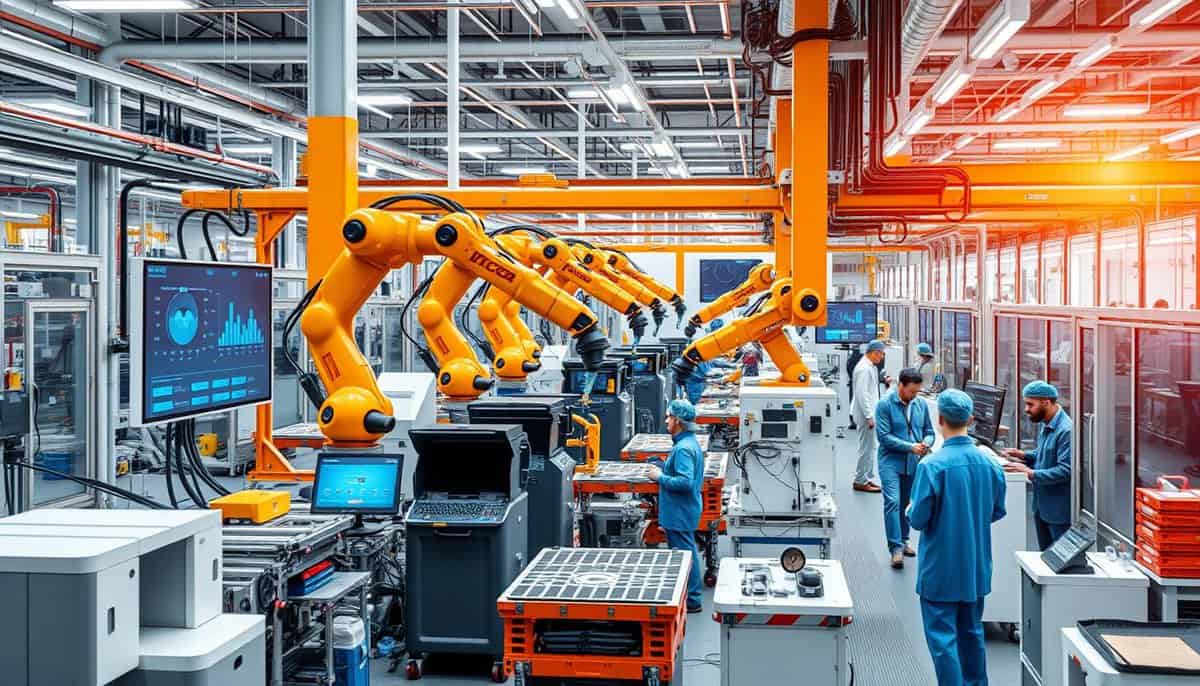
Are you making the most of every tool at your disposal to enhance production? Knowing and using the right Key Performance Indicators (KPIs) can change your operation’s success. These metrics help reduce downtime and plan production better, showing every part of the manufacturing process.
KPIs for production are essential in today’s manufacturing world. They help firms monitor, analyze, and improve their production stages. Metrics like Overall Equipment Effectiveness (OEE), Inventory Turns, and On-Time Delivery let businesses spot problems, cut waste, and predict future needs. These indicators guide production towards goals while adapting to market shifts and environmental changes. This makes operations more agile and efficient.
Key Takeaways
- Using KPIs well can greatly improve efficiency in manufacturing.
- Overall Equipment Effectiveness (OEE) blends availability, performance, and quality.
- Low inventory turns can release cash and better meet customer needs.
- On-Time Delivery is key to pleasing customers and encouraging staff.
- Tracking Customer Returns is crucial for fixing issues in production.
What are Production KPIs?
Production Key Performance Indicators (KPIs) are key measures in manufacturing. They track how well and efficiently production processes work. These indicators help companies figure out what’s working and what’s not. This way, they can improve and make their operations smoother.
Definition of Production KPIs
Production KPIs are numbers that show how the production process meets goals. They cover important factors like cycle time, throughput rate, and Overall Equipment Effectiveness (OEE). Tracking these lets companies fine-tune production. It also allows them to measure progress accurately.
Importance of Tracking KPIs
The value of tracking KPIs is huge. They turn lots of data into useful insights. Regular monitoring is key for several reasons:
- Goal setting and achievement: KPIs make it possible to set clear goals. This keeps production lines up with what the company wants.
- Identifying bottlenecks: by looking at KPIs, companies can spot hold-ups in production quickly. This lets them fix issues fast and keep things running smoothly.
- Enhancing production process efficiency: focusing on KPIs helps companies boost their efficiency. This means they can save money and make more products.
Keeping an eye on KPIs gives manufacturers a way to improve their performance. This is crucial to stay ahead in a fast-changing market.
Types of Production KPIs
There are three main types of Production KPIs. They focus on machinery, products, and cost efficiency. Knowing these KPI categories helps in better tracking and improving production processes.
Machinery or Asset Focused
This KPI type looks at machinery and asset management. Important metrics are:
- Machine uptime rate: this measures how long equipment stays operational. The formula is (Total Time Machine Used / Available Production Time) * 100. The goal is to keep the machine uptime rate at 90%.
- Defect rate: this tracks the quality of what’s made. The formula is the Number of Defects / Units Produced * 100. The aim is to lower the Defect Rate.
- Overall Equipment Effectiveness (OEE): this checks how well machinery works. The formula is (Units Produced × max Cycle Time) / Available Production Time. We want to boost OEE by 5% this year.
Unit or Product Focused
Here, KPIs look at the number of units or products, giving insights into how production tracks. Included metrics are:
- Cycle time: this is how long one production cycle takes.
- Production capacity rate: this shows the max amount of output possible. It’s calculated by Machine Capacity Rate * Time.
- Throughput rate: this measures product output over time.
Cost Focused
Cost-focused KPIs help look at money and keeping costs low in production. Key metrics are:
- Production cost per Unit: this measures the cost to make one unit. The formula is Total Manufacturing Cost / Number of Units Produced. The goal is to cut the cost of making a unit by 2 cents by 2022.
- Unit maintenance cost: this looks at upkeep costs per unit. It’s calculated by Total Maintenance Cost / Number of Units Produced. The target is to slash Unit Maintenance costs by 5% this year.
- Unused capacity costs: this checks the cost impact of not using full production capacity. The formula is Percentage of available unused capacity × Total Manufacturing Cost. We aim to reduce unused capacity by 10% over 6 months.
Below is a table showing key metrics in these categories:
| KPI Type | Metric | Formula | Example Goal |
|---|---|---|---|
| Machinery or Asset Focused | Machine Uptime Rate | (Total Time Machine Used / Available Production Time) * 100 | Keep each machine uptime rate at 90% |
| Unit or Product Focused | Production Capacity Rate | Machine Capacity Rate * Time | Ensure each machine uptime rate is 90% |
| Cost Focused | Production Cost per Unit | Total Manufacturing Cost / Number of Units Produced | Cut unit production cost by 2 cents by 2022 |
The rest of this article is reserved for members
To limit scraping bots (currently 40,000 hits per day!),
we had to restrict access to full articles and tools to registered members only.
to access all the rest.
FAQ
What are Production KPIs and why are they important?
Production Key Performance Indicators (KPIs) measure the manufacturing process’s success. They are vital for measuring efficiency, spotting problems, and meeting goals. This boosts the whole operation’s performance.
What types of Production KPIs should be monitored?
There are three types of Production KPIs. These include Machinery or Asset Focused, such as machine uptime. Then there’s Unit or Product Focused, like throughput rate. And the Cost Focused, for example, unit production costs. Keeping an eye on these helps make the production better.
How do you calculate essential Production KPIs?
Calculating Production KPIs uses specific formulas. For Cycle Time, subtract Production Start Time from Production End Time. These calculation methods set clear targets and track improvements.
What are the top Production KPIs to monitor for manufacturing efficiency?
Important KPIs include Cycle Time and Throughput Rate. Also, Production Attainment and Overall Equipment Effectiveness (OEE). They show the manufacturing’s speed, efficiency, and output.
External Links on Production and Quality Optimization
International Standards
(hover the link to see our description of the content)
Glossary of Terms Used
Conversion Rate (CR): the percentage of visitors to a website or landing page who complete a desired action, such as making a purchase or signing up for a newsletter, calculated by dividing the number of conversions by the total number of visitors.
Cost of Goods Sold (COGS): the direct costs attributable to the production of goods sold by a company, including materials and labor, excluding indirect expenses such as distribution and sales force costs.
Key Performance Indicator (KPI): a measurable value that demonstrates how effectively an organization is achieving key business objectives, often used to evaluate success at reaching targets.
Overall Equipment Effectiveness (OEE): a metric used to evaluate the efficiency of manufacturing processes, calculated by multiplying availability, performance, and quality rates. It identifies losses, enabling improvements in productivity and operational effectiveness.
Return on Investment (ROI): a financial metric used to evaluate the profitability of an investment, calculated by dividing the net profit from the investment by the initial cost, expressed as a percentage.
Specific Measurable Achievable Relevant Timely (SMART): a framework for setting objectives that are clear, quantifiable, attainable, aligned with broader goals, and time-bound, facilitating effective planning and evaluation of progress.
Takt Time: the maximum allowable time to produce a product to meet customer demand, calculated by dividing available production time by required output. It helps synchronize production pace with demand, ensuring efficient workflow and resource allocation.