Did you know vacuum forming can cut tooling costs by up to 50%? This makes it cost-effective compared to injection molding. It’s also fast for prototyping and allows for easy customization. These advantages have made vacuum forming a favorite for custom plastic manufacturing in many fields.
In places like North Carolina, South Carolina, Maryland, Georgia, and Pennsylvania, companies use vacuum forming a lot. They make everything from complex plastic sheet fabrication for medical devices to large car panels. The process uses thermoplastic sheets that come in a variety of thicknesses, colors, and finishes. This shows how flexible it is for designing products.
We will guide you through the detailed uses, basic steps, and benefits of using vacuum forming. It’s great for your custom plastic manufacturing needs.
Key Takeaways
- Vacuum forming cuts tooling costs by up to 50% compared to injection molding.
- Thermoplastic sheets come in various thicknesses, colors, and finishes for diverse applications.
- Vacuum forming is widely used across packaging, automotive, and medical industries.
- It’s ideal for low to medium-volume production runs and offers rapid prototyping.
Introduction to Vacuum Forming
Vacuum forming is a popular and efficient way to shape thermoplastic sheets. It is often used to make big automotive parts or packaging, and consumer goods. This process is great for making up to 250-1000 items a year.
What is Vacuum Forming?
Vacuum forming is part of thermoforming. In this process, a heated plastic sheet is placed over a mold. Then, vacuum pressure shapes the material. As the mold can be in a soft easy-to-machine material -like wood-, this method is affordable and quick, especially when making tools.
Overview of the Vacuum Forming Process
The vacuum forming process has several steps. First, a thermoplastic sheet is clamped to a frame. Then, it’s heated until it’s soft. This could use one or two heaters, depending on how thick the material is.
After heating, the soft sheet is put over a mold. Vacuum pressure pulls the material against the mold for a precise shape. Then, optionnaly, fans with a spray can cool it down fast, by up to 30%.
Key Components and Equipment
Several pieces of equipment are crucial for vacuum forming:
- Clamp Frame: Keeps the sheet in place.
- Heaters: Ceramic heaters need about 15 minutes to get ready. Twin quartz heaters are best for materials that need a lot of heat.
- Vacuum Pump: This pump creates a strong suction, shaping the material well.
- Cooling System: Controls the mold’s temperature to cool the product correctly. This is important for certain plastics.
Choosing the right equipment is key for top-quality products and the perfect details.
Materials and Design Considerations
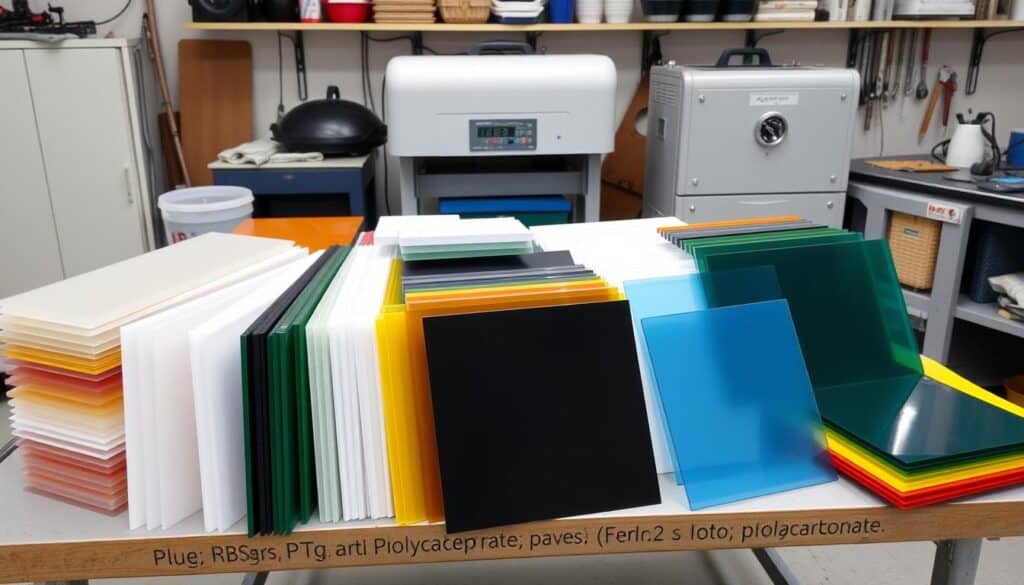
When we talk about vacuum forming, it’s crucial to know the suitable vacuum forming materials and design considerations. Choosing the right thermoplastic sheets, which vary in thickness and finish, is essential. They play a big role in how the final product looks and works.
In the design stage, it’s important to consider several key factors. These factors help make sure the molds fill up right and the plastic keeps its shape. Adding draft angles to your design is one such factor. Putting in just 1º of draft for every 2cm of height can make a big difference. It makes it easier to take the mold off the formed sheet.
Designs should avoid sharp angles, as angles over 90º can cause manufacturing problems. It’s better to round corners and edges for easier mold release. Also, the texture of 3D printed molds impacts the final surface. Using thin 0.1mm layers for 3D printing leads to a smoother surface, perfect for capturing details.
Putting air holes in the mold improves detail reproduction in vacuum forming. It’s also noted that wider parts are simpler to work with than taller ones. Choosing the right thermoplastic sheet, like high-density polyethylene (HDPE) for food storage or medical parts, depends on the project’s needs. These choices affect the cost, durability, and look of your project.
Vacuum forming is great for making 250-300 units a year. It’s more budget-friendly than plastic injection molding, costing much less. Additionally, making vacuum forming tooling takes less time, offering a faster turnaround. This speed is boosted by using 3D printers for accurate molds.
It’s been a method for affordable prototyping, allowing for creative design experiments since the ’70s. This process also makes it possible to offer custom solutions to clients without breaking the bank.
Yet, this process is best for parts with thin walls and simple shapes. Creating concave parts with deep draws remains a challenge. While vacuum forming is cost-effective for small batches, other plastic manufacturing methods might be cheaper for larger quantities.
The rest of this article is reserved for members
To limit scraping bots (currently 40,000 hits per day!),
we had to restrict access to full articles and tools to registered members only.
to access all the rest.
FAQ
What is Vacuum Forming?
Vacuum forming is a way to shape plastic. It heats the plastic until soft. Then, it shapes it over a mold with vacuum pressure. It’s used a lot for making custom plastic items with details.
What Materials Are Used in Vacuum Forming?
Thermoplastic sheets are mainly used in vacuum forming. They can be different thicknesses and finishes. ABS, polystyrene, and polycarbonate are common materials. The material chosen impacts the product’s look and quality.
How Does the Vacuum Forming Process Work?
First, the plastic sheet is heated until it’s soft. Then, it’s formed over a mold. Vacuum pressure makes the plastic take the mold’s shape. After that, the plastic cools down, gets trimmed, and is finished.
What Are the Key Components of a Vacuum Forming Machine?
A vacuum forming machine has frames to hold the sheets, heating elements to soften the plastic, and high-temperature molds. These parts help in shaping the plastic correctly and consistently.
What Are the Advantages of Vacuum Forming?
Vacuum forming is cost-effective and fast for making prototypes. It offers design flexibility and quick production times. This makes it a popular choice for certain products.
What Are the Disadvantages of Vacuum Forming?
The downsides include limits on material thickness and types. This can affect the strength and detail of complex designs. Some designs might need extra steps to reach the final look.
What Industries Use Vacuum Forming?
Many industries use vacuum forming. This includes automotive, healthcare, and consumer goods. It makes items like packaging, car panels, and medical device housings. It’s chosen for its design and production flexibility.
What Design Considerations Are Important for Vacuum Forming?
Important design points include draft angles, wall thickness, and material selection. These help ensure molds are filled properly and the plastic keeps its shape. This avoids any warping or flaws.
External Links on Vacuum Forming and Plastic Manufacturing
International Standards
(hover the link to see our description of the content)
Glossary of Terms Used
Computer Numerically Controlled (CNC): a manufacturing process that uses programmed computer software to control machine tools, enabling precise and automated operation for tasks such as cutting, milling, drilling, and engraving materials.