Product Design, Manufacturing & Innovation Resources
Home » Economic Scale of B2B vs. B2C Commerce

Economic Scale of B2B vs. B2C Commerce

1950
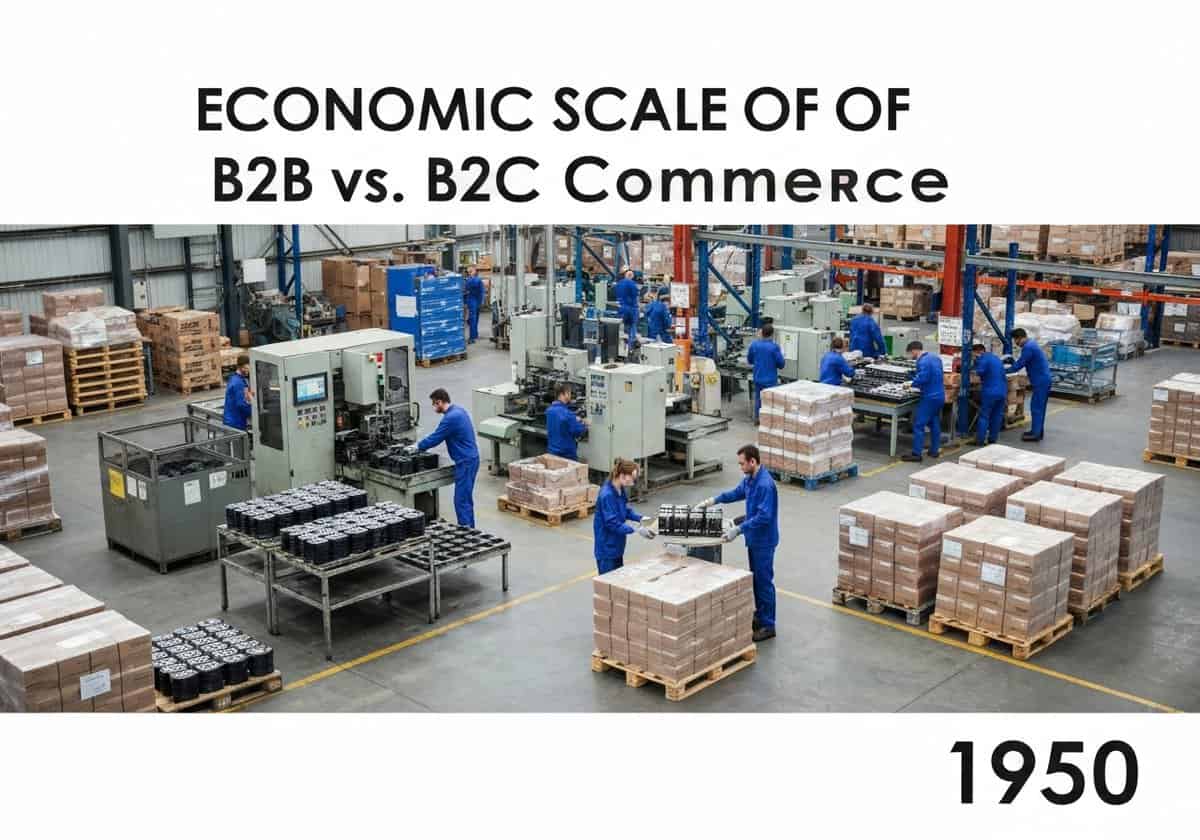
Industrial warehouse illustrating B2B supply chain processes in economics.

(generated image for illustration only)

A foundational economic fact is that the total monetary volume of business-to-business (B2B) transactions significantly surpasses that of business-to-consumer (B2C) transactions. This is because a single finished consumer product often involves a long supply chain with multiple B2B transactions—from raw materials to manufacturing components to wholesale distribution—before the final B2C sale occurs.


The greater volume of B2B commerce compared to B2C is a direct consequence of the complexity of modern production. Consider the manufacturing of a smartphone. The final sale to a consumer is a single B2C transaction. However, leading up to that sale, numerous B2B transactions took place. The phone manufacturer bought processors from one company, screens from another, and batteries from a third. Each of those component suppliers, in turn, bought raw materials, manufacturing equipment, and software from their own set of suppliers. This cascading effect, known as the supply chain, multiplies the number and value of transactions at each stage of production. Economists and policymakers track B2B activity closely as it serves as a leading indicator of economic health. A slowdown in B2B sales, particularly in sectors like manufacturing and construction, often precedes a downturn in the broader economy and consumer spending. This principle underscores why industries like logistics, corporate banking, and enterprise software are so massive, despite being largely invisible to the average consumer.

UNESCO Nomenclature: 3301
– Economics

Type

Abstract System

Disruption

Foundational

Usage

Widespread Use

Precursors

  • development of double-entry bookkeeping
  • theories of industrial organization
  • leontief’s input-output model of economics
  • formalization of supply chain management as a discipline

Applications

  • national economic forecasting and gdp calculation
  • supply chain management and logistics planning
  • investment analysis for industrial and commercial sectors
  • government tax policy and trade regulation
  • development of b2b payment and financing systems

Patents:

NA

Potential Innovations Ideas

  • real-time b2b transaction trackers using blockchain for macroeconomic analysis
  • ai-powered supply chain optimization services that predict and mitigate bottlenecks based on b2b transaction data
  • a ‘b2b economic health index’ offered as a financial product for investors
  • sustainable supply chain certifications based on transparent b2b transaction histories
  • automated b2b tax collection systems integrated directly into transaction platforms
  • microlending platforms specifically for financing individual transactions within a complex supply chain
  • predictive models for consumer price inflation based on shifts in b2b transaction costs
  • gamified educational tools to teach students about the scale and complexity of modern supply chains
Related to: b2b transactions, b2c, supply chain, economic volume, gdp, commerce, wholesale, manufacturing.

Historical Context

Economic Scale of B2B vs. B2C Commerce

1940
1940
1948
1950
1950
1950
1950
1940
1940
1945-01-01
1949
1950
1950
1950
1950

(if date is unknown or not relevant, e.g. "fluid mechanics", a rounded estimation of its notable emergence is provided)

10th year anniversary

Full size images and downloads are only available, 100% free, for registered members.

> Login <