Product Design, Manufacturing & Innovation Resources
Home » Powder Coating Application Process

Powder Coating Application Process

1950
  • Erwin Gemmer
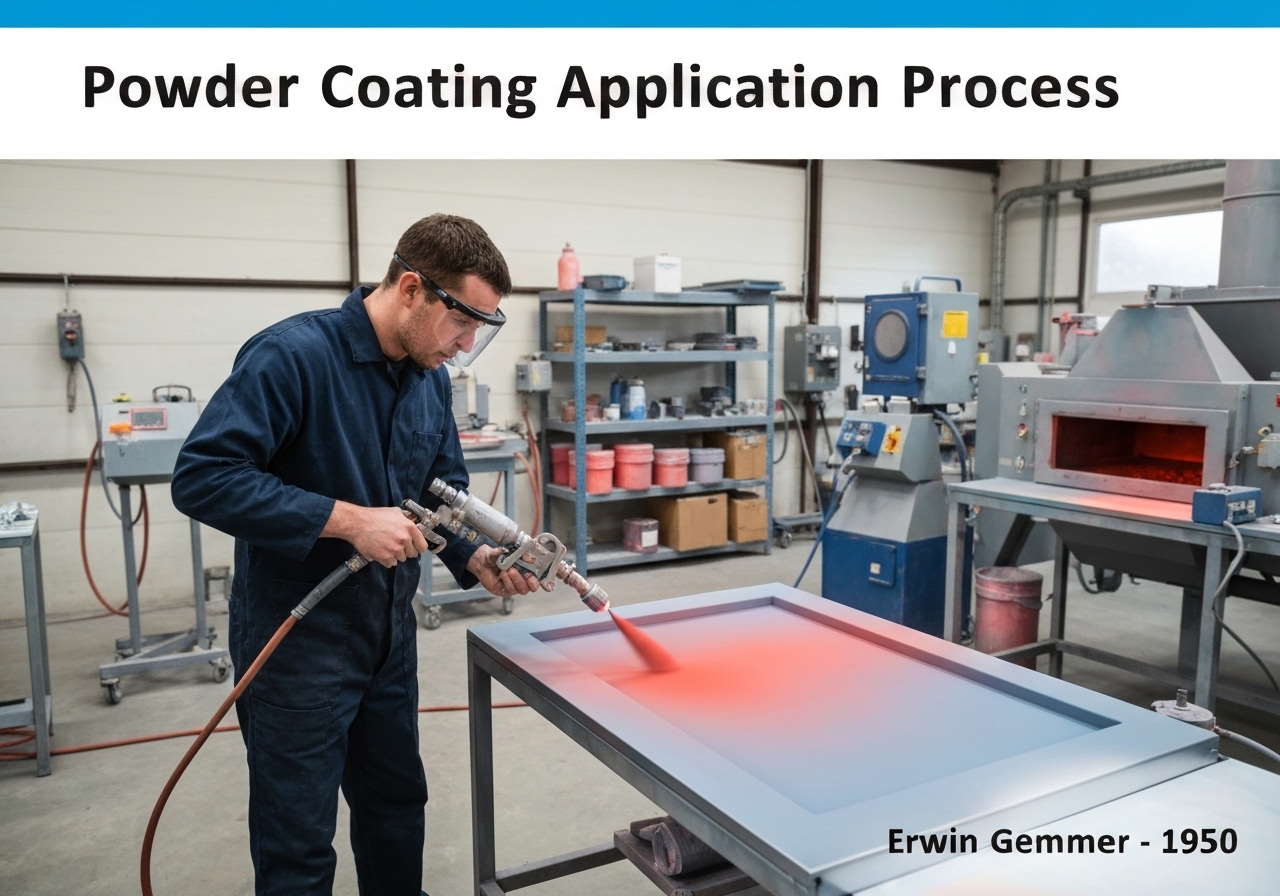
Powder coating application in polymer technology for industrial equipment.

(generated image for illustration only)

Powder coating is a dry finishing process where a thermoplastic or thermoset polymer powder is applied to a surface, typically electrostatically, and then cured under heat. The powder particles are charged, causing them to adhere to the grounded substrate. Heating melts the powder, allowing it to flow and form a continuous, durable, and high-quality finish, often superior to conventional paint.
The powder coating process involves three main steps: part preparation, powder application, and curing. Proper surface preparation is critical for adhesion and involves cleaning and often pre-treatment like phosphating or chromating. In the application stage, the most common method is electrostatic spray deposition (ESD). A spray gun imparts an electrostatic charge (typically negative) to the powder particles as they exit the nozzle. The object to be coated is electrically grounded, creating an electrostatic field that attracts the charged powder particles to its surface. This attraction is strong enough to hold the powder in place temporarily. The coated part is then moved into a curing oven. The heat melts the powder, causing it to flow together and chemically react to form a cross-linked polymer network. This process, known as curing, results in a hard, durable finish. A key advantage of powder coating is its environmental friendliness, as it emits near-zero volatile organic compounds (VOCs). Furthermore, any oversprayed powder can be collected and reused, making the process highly efficient with material usage rates often exceeding 95%. The resulting coating is generally thicker and more resistant to chipping, scratching, and fading than liquid paint.

UNESCO Nomenclature: 3319
– Polymer science and technology

Type

Industrial Process

Disruption

Substantial

Usage

Widespread Use

Precursors

  • development of thermoplastic and thermoset polymers
  • understanding of electrostatics and triboelectric charging
  • invention of the spray gun
  • advances in industrial oven technology
  • fluidized-bed techniques for handling powders

Applications

  • automotive parts and wheels
  • household appliances (e.g., refrigerators, washing machines)
  • architectural metalwork (e.g., window frames, facades)
  • bicycles and outdoor furniture
  • industrial equipment and machinery

Patents:

  • DE933019

Potential Innovations Ideas

  • low-temperature cure powders for heat-sensitive substrates like wood and plastics
  • UV-curable powder coatings for rapid, energy-efficient curing
  • super-durable powders with enhanced weather and UV resistance for architectural applications
  • antimicrobial powder coatings for medical equipment and public surfaces
  • thin-film powder coatings that compete with the finish of liquid paints
  • powder-in-powder systems for creating multi-layer or multi-color effects in a single step
  • digital direct-to-metal powder coating printers
  • self-healing powder coatings with microcapsules that release repair agents when scratched
  • conductive powder coatings for EMI/RFI shielding applications
  • chrome-effect and other metallic-finish powder coatings that mimic plating
Related to: powder coating, electrostatic, curing, thermoset, polymer, VOC-free, finishing, industrial coating, durable, surface treatment.

Historical Context

Powder Coating Application Process

1945-01-01
1949
1950
1950
1950
1950
1950
1940
1948
1950
1950
1950
1950
1950
1950

(if date is unknown or not relevant, e.g. "fluid mechanics", a rounded estimation of its notable emergence is provided)

10th year anniversary

Full size images and downloads are only available, 100% free, for registered members.

> Login <