Product Design, Manufacturing & Innovation Resources
Home » Hollomon Equation for Strain Hardening

Hollomon Equation for Strain Hardening

1945-01-01
  • John H. Hollomon, Jr.
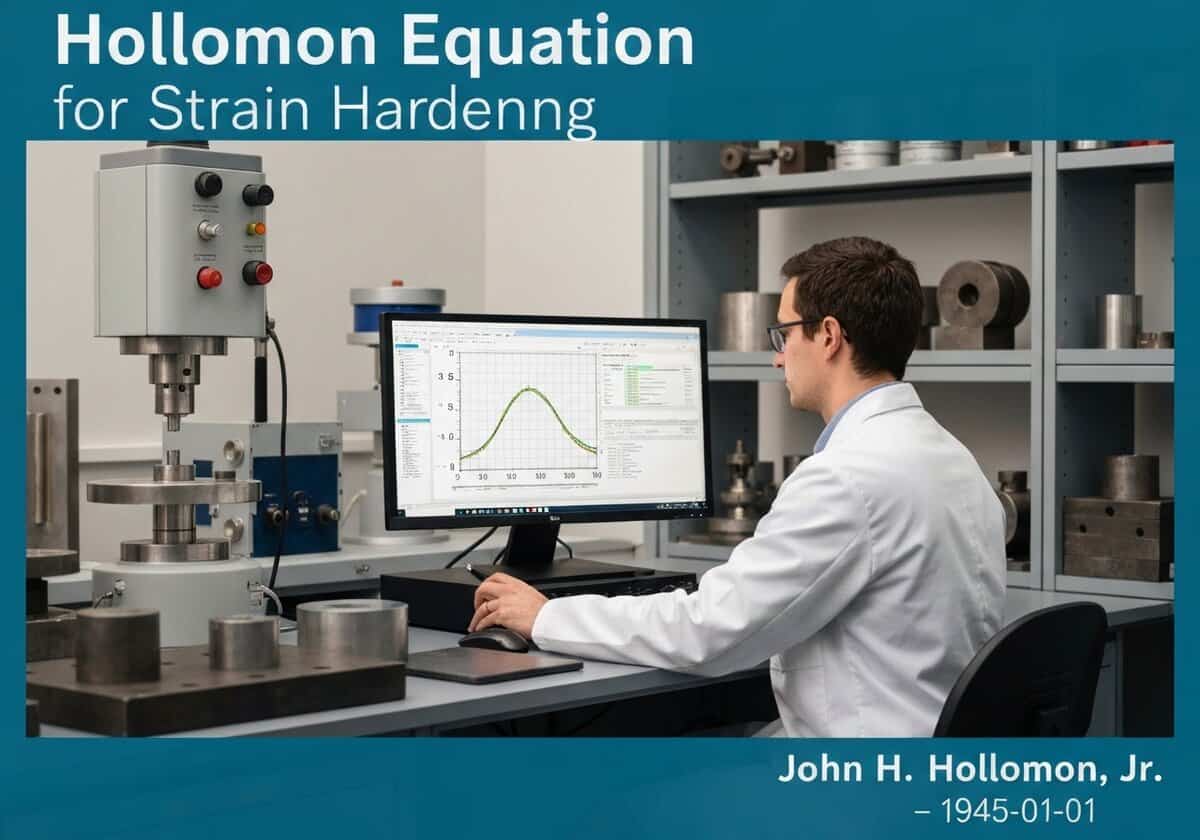
Researcher analyzing the Hollomon equation in a materials science lab for plastic deformation modeling.

(generated image for illustration only)

The Hollomon equation is an empirical power-law relationship that describes the portion of the true stress-true strain curve between the onset of plastic deformation (yielding) and the onset of necking (UTS). The equation is \(\sigma_t = K \epsilon_t^n\), where \(\sigma_t\) is the true stress, \(\epsilon_t\) is the true plastic strain, K is the strength coefficient, and n is the strain-hardening exponent.
The Hollomon equation provides a simple yet effective mathematical model for the phenomenon of strain hardening (or work hardening), where a ductile material becomes stronger and harder as it is plastically deformed. The strain-hardening exponent, ‘n’, is a key material property derived from this equation. It typically ranges from 0 (for a perfectly plastic solid) to 1. A higher ‘n’ value indicates a greater capacity for strain hardening. For many metals, ‘n’ is numerically equal to the true strain at the point of ultimate tensile strength. The strength coefficient, ‘K’, represents the true stress at a true strain of 1.0. This equation is valid only in the plastic region, after yielding and before necking begins. It is determined by plotting true stress versus true strain on a log-log scale; the data in the plastic region should form a straight line. The slope of this line is ‘n’, and the intercept at \(\epsilon_t = 1\) is ‘K’. While it is an empirical model and doesn’t capture all complexities of plastic deformation (like the Bauschinger effect), its simplicity and utility have made it a standard tool in materials science and mechanical engineering for analyzing and predicting the response of metals to plastic deformation.

UNESCO Nomenclature: 3313
– Materials science

Type

Mathematical Model

Disruption

Substantial

Usage

Widespread Use

Precursors

  • concepts of true stress and true strain
  • experimental observation of work hardening in metals
  • development of logarithmic plotting techniques for data analysis
  • need for predictive models in metal forming industries

Applications

  • finite element analysis (FEA) for modeling plastic deformation
  • predicting material behavior in metal forming operations like deep drawing and stamping
  • characterizing the work-hardening capacity of metals
  • material model development for crash simulations
  • assessing the formability of sheet metals

Patents:

NA

Potential Innovations Ideas

Due to scrapping bot traffic, currently more than 40k per day, this content is reserved to community members.
> Login < or > Register < (100% free) to access this, so as all other restricted content and tools.

Related to: Hollomon equation, strain hardening, work hardening, true stress, true strain, plastic deformation, strength coefficient, strain-hardening exponent, metal forming, constitutive model.

Historical Context

Hollomon Equation for Strain Hardening

1940
1940
1940
1945-01-01
1949
1950
1950
1940
1940
1940
1940
1948
1950
1950
1950

(if date is unknown or not relevant, e.g. "fluid mechanics", a rounded estimation of its notable emergence is provided)

Related Invention, Innovation & Technical Principles

Full size images and downloads are only available, 100% free, for registered members.

> Login <