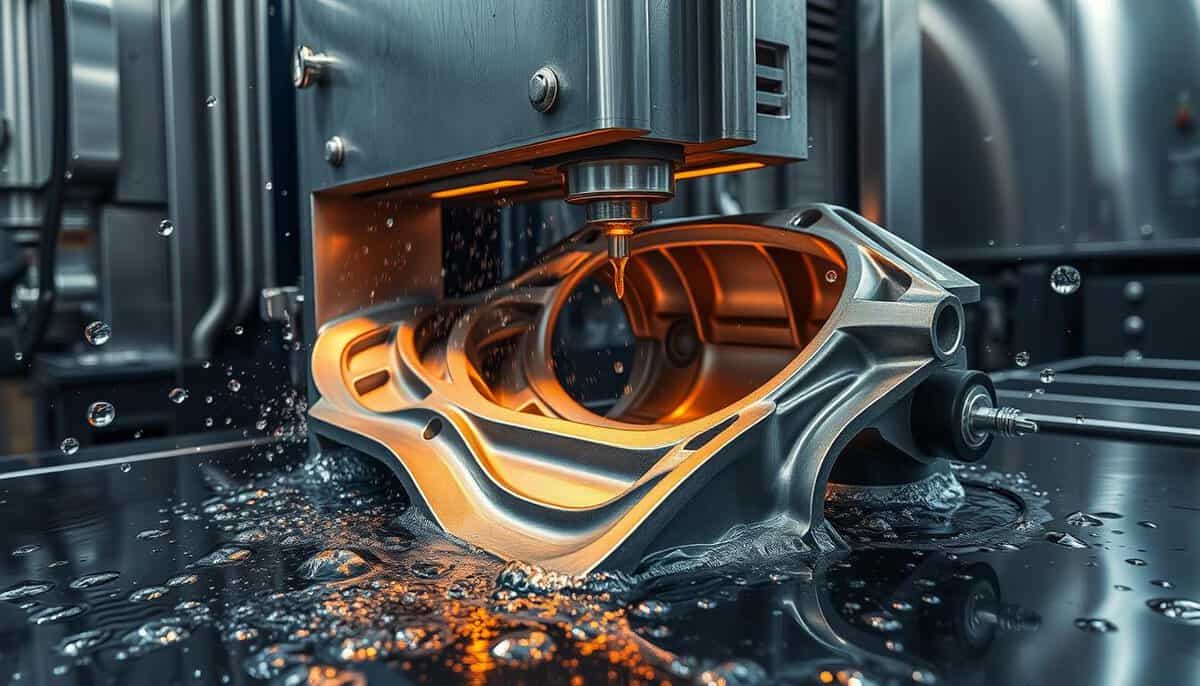
Have you heard about hydroforming? It uses fluid pressure up to 10,000 PSI to mold metal. This amazing ability shows how hydroforming has changed metal shaping today.
Deep draw hydroforming is especially popular. It makes strong, complex parts with great surfaces and lowers tooling expenses. It’s different from old-school methods and helps many fields. This includes automotive, aerospace, healthcare, and defense, making metal work better and more versatile.
Hydroforming works well with many materials, like aluminum, brass, stainless steel, and tough alloys. It’s useful for making everything from car parts to precise medical tools. This method is a budget-friendly way to produce high-quality metal items.
Key Takeaways
- Hydroforming can exert a fluid pressure of up to 10,000 PSI to reshape metal.
- Some companies have been utilizing hydroforming for over a century.
- This technology supports diverse industries, such as automotive, aerospace, and healthcare.
- Hydroforming is compatible with a wide range of materials, including aluminum and stainless steel.
- Correctly applied, Hydroforming offers high-quality surface finishes and reduced tooling costs compared to traditional methods.
What is Hydroforming?
Hydroforming is a modern way to shape metals using a high-pressure chamber. This method uses oil and a rubber diaphragm. It shapes metals without needing hard molds and avoids scratches. Hydroforming is good for making complex shapes and keeps things strong yet light. It also cuts down on costs.
The Basics of Hydroforming
Hydroforming uses tools like high-pressure hydraulic generators for precise molding. For instance, shaping tubes needs at least 400 KPA of pressure. It’s better than traditional stamping since it produces seamless and deeply detailed parts. This method is perfect for making varied parts in different industries.
Key Benefits of Hydroforming
Hydroforming offers many advantages. It is more affordable because the tooling costs are usually half that of traditional methods. It also speeds up pressing work by 60-70%. Hydroforming doesn’t leave scratches or stretch marks, reducing the need for expensive finishing work. Plus, it’s very accurate, achieving tolerances within +/- 0.003” in just about 20 seconds.
Metal Forming Process Overview
Hydroforming works with almost all metals that can be cold-formed. This includes aluminum, brass, various steels, copper, and high-strength alloys. For example, Inconel and high-nickel steels benefit from hydroforming. They are used in demanding environments like aerospace and high-pressure turbines.
Hydroforming is useful in many sectors, like aerospace, automotive, and more. Its flexibility for prototyping without new tooling makes it practical for many uses.
Types of Hydroforming Processes
Hydroforming is divided into two main types: tube hydroforming and sheet hydroforming. Each type uses different techniques to mold metal into complex shapes. These methods are vital in various industries.
Tube Hydroforming
Tube hydroforming is great for making strong and light hollowed parts. It shapes metal tubes with internal pressure. This method is key in making car parts like tubular frames and exhaust parts.
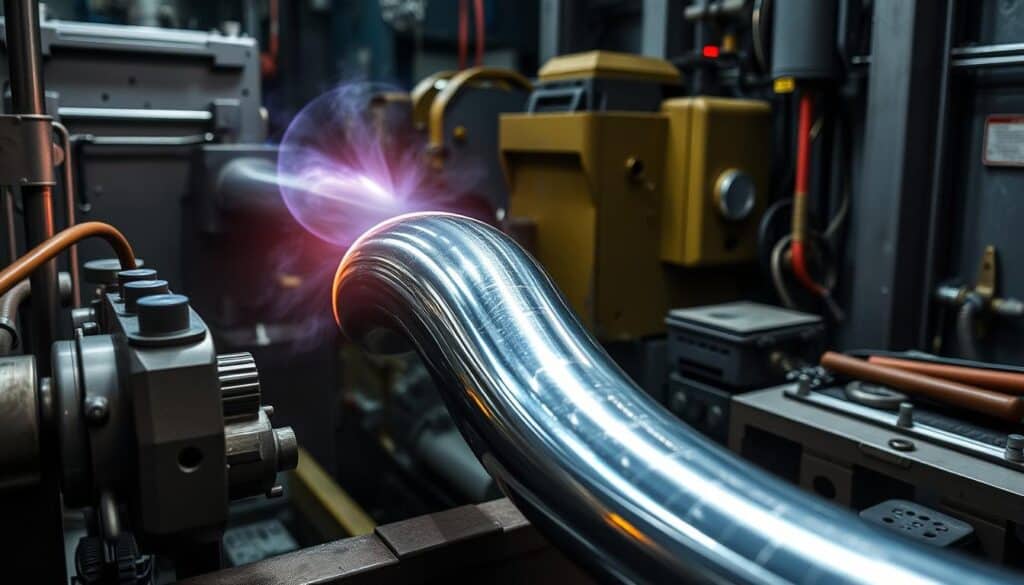
Bike makers also use tube hydroforming. They make high-quality bicycle frames that are strong yet light. This process ensures products meet exact size requirements and have fewer flaws.
Sheet Hydroforming
Sheet hydroforming is used to make complex shapes with great accuracy and surface quality. The aerospace industry uses it for parts that need precise shapes and strength. The car industry also uses it to make body panels and other parts.
This method is not just for cars and planes. It’s also used in making appliances. Aluminum, stainless steel, copper, and brass work well with this process. Items made with sheet hydroforming are strong and consistent, making it a top choice for critical uses.
| Hydroforming Technique | Applications | Key Benefits |
|---|---|---|
| Tube Hydroforming | Automotive (engine cradles, tubular frames), Bicycle frames | Higher strength-to-weight ratio, Cost-efficient, Precise fitment |
| Sheet Hydroforming | Aerospace (complex parts), Automotive (body panels), Appliance manufacturing | Superior surface quality, High dimensional accuracy, Enhanced structural integrity |
The rest of this article is reserved for members
To limit scraping bots (currently 40,000 hits per day!),
we had to restrict access to full articles and tools to registered members only.
to access all the rest.
FAQ
What is hydroforming?
Hydroforming is a way to shape metal using high-pressure fluid. It produces strong, complex parts accurately. It’s used in aerospace, automotive, healthcare, and defense industries.
What are the key benefits of hydroforming?
Hydroforming beats traditional methods by offering better structural strength. It makes more complex shapes and smoother surfaces. It also cuts down on tooling costs, boosts design flexibility, and uses materials more effectively.
What are the main types of hydroforming processes?
There are two key hydroforming methods: tube and sheet hydroforming. Tube hydroforming makes strong, light parts like tubes. Sheet hydroforming is great for complex shapes that need precise measurements and high-quality surfaces.
What materials can be used in hydroforming?
Hydroforming works with many metals like aluminum, brass, copper, stainless steel, and titanium. Each one has its own benefits for different uses.
How does hydroforming compare to traditional metal forming techniques like deep draw stamping and metal die casting?
Hydroforming gives better outcomes than stamping and casting. It needs fewer dies, which lowers costs. It also allows for more creative designs, better uses materials, and is cost-effective for smaller production batches.
External Links on Hydroforming and Metal Manufacturing
International Standards
(hover the link to see our description of the content)
Glossary of Terms Used
Finite Element Analysis (FEA): a numerical method for solving complex engineering problems by breaking down structures into smaller, simpler parts called elements, allowing for the analysis of stress, strain, and deformation under various conditions.
Metal Active Gas (welding) (MAG): a welding process that uses a continuously fed consumable electrode and a shielding gas mixture, typically containing carbon dioxide, to protect the weld pool from atmospheric contamination during the joining of ferrous and non-ferrous metals.
Metal Inert Gas (welding) (MIG): a welding process that uses a continuous solid wire electrode fed through a welding gun, creating an electric arc between the wire and the workpiece, melting both to form a weld pool, typically shielded by an inert gas to prevent contamination.