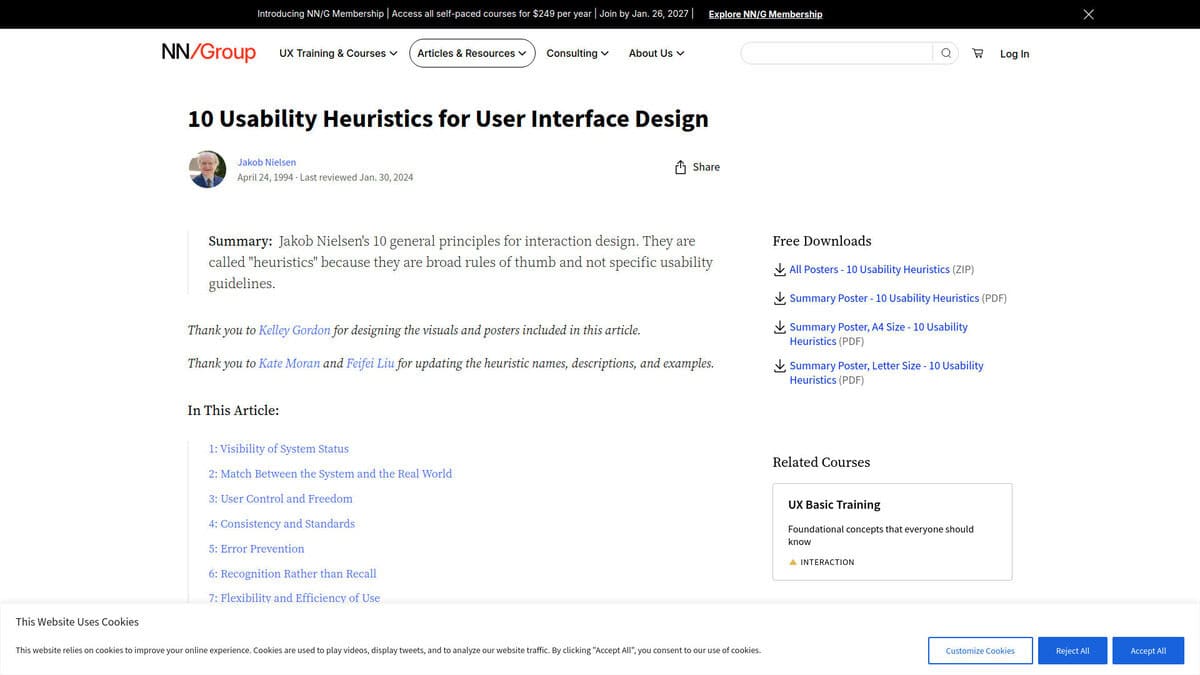
10 Usability Heuristics for UI Design compared with Interaction Design Foundation and Baymard Institute| 10 Usability Heuristics for UI Design (Nielsen Norman Group) | Interaction Design Foundation | Baymard Institute |
|---|
| Nature of the resource: A single free article by Jakob Nielsen, first published in 1994 and last reviewed in January 2024. Kate Moran and Feifei Liu updated the names, descriptions and examples. A 2020 update refined the wording without changing the ten heuristics. | Nature of the resource: A design education institution founded in 2002. It offers online courses, short master classes and a library of UX and UI material, so it is a learning platform and not a single checklist. | Nature of the resource: A research organisation that publishes ecommerce UX findings. Its material is organised as design guidelines and performance scores, not as a short list of general principles. |
| Scope and domain: General interface design, independent of platform or industry. The list runs from visibility of system status to help and documentation, and applies to software, websites and prototypes. | Scope and domain: Broad UX and UI design education. The site lists dozens of courses and many one-hour master classes, so coverage is wider than usability evaluation alone. | Scope and domain: Ecommerce and related sectors such as retail, subscriptions, travel and B2B. Topic areas include product pages, cart and checkout, on-site search and mobile. It is narrower than the ten heuristics but more specific. |
| Evidence and method: The heuristics are a checklist for heuristic evaluation, in which evaluators inspect an interface against recognised principles. | Evidence and method: Instruction comes from a faculty of design experts, delivered as video-based courses. | Evidence and method: The site describes its guidelines as distilled from a large body of usability testing, with benchmark scores for ecommerce sites. A published methodology page documents how the research is carried out. |
| Access and cost model: Free to read, with free summary and detailed heuristic posters. Some NN/g training courses are paid. Reuse requires crediting Jakob Nielsen and linking to the page. | Access and cost model: Membership-based learning, with company memberships for organisations and certificates for completed courses. The library is described as a free resource, but the share of freely available content is not stated. | Access and cost model: Freemium. Many research articles, a knowledge hub and design examples are free. Full access to the research catalogue needs a paid Premium subscription. A separate expert UX audit service is also offered. |