Seeing Theory compared with Khan Academy, Coursera and Brilliant| Seeing Theory | Khan Academy | Coursera | Brilliant |
|---|
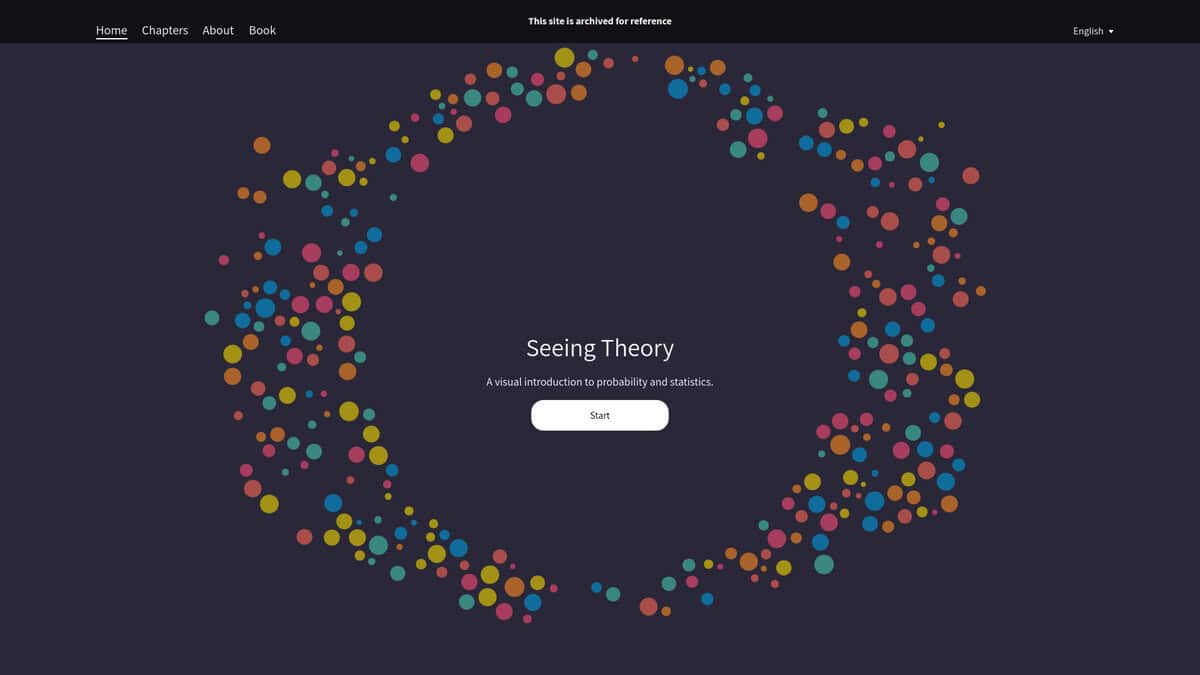
| Scope and subject matter: It covers one narrow field in six chapters: basic probability, compound probability, probability distributions, frequentist inference, Bayesian inference and regression analysis. | Scope and subject matter: It is a broad catalog of K-12 and early college courses in math, science, economics, computing, test preparation and other subjects. Statistics is one area among many. | Scope and subject matter: It offers MOOCs from partner universities across many fields, plus Specializations, Professional Certificates and degrees. Statistics courses are one part of a large catalog. | Scope and subject matter: Math is the deepest subject, with courses also in programming, data, AI and science. Math topics run from grade 4 foundations to college level. |
| Learning format: Concepts are taught through interactive visualizations of web-based simulations. It works as a visual complement to a textbook rather than as a graded course. | Learning format: Personalized courses help students master key concepts and fill learning gaps. The platform also offers AI tutoring through Khanmigo. | Learning format: Courses use pre-recorded video lectures, discussion forums, assignments and quizzes or exams, on a weekly schedule or at the learner's own pace. | Learning format: Learners solve hands-on problems with visual models and receive immediate feedback. A digital tutor called Koji guides learners who are stuck, within plan limits. |
| Credentials and assessment: The site itself offers no certificates. The authors are working on a textbook, and a draft PDF is available for download. | | Credentials and assessment: Course certificates require payment, while many courses can be audited for free by watching the videos. Financial aid exists for certificates, and degrees can be pursued through the platform. | |
| Cost model: Free for students, teachers and parents. Khan Academy is a nonprofit organization. | Cost model: Freemium: auditing is generally free, while certificates, subscriptions and degrees are paid. | Cost model: Freemium: a free tier with daily limits and a paid Premium subscription that adds Koji access and removes advertisements. |
| Status and origin: The site is archived for reference. It was created by Daniel Kunin while an undergraduate at Brown University. | Status and origin: Active nonprofit with apps on the Apple App Store and Google Play. | Status and origin: Active platform with a catalog of over 5,400 courses according to Class Central. | Status and origin: Active, available on the web, iOS and Android. |