LearnChemE compared with Khan Academy and Coursera| LearnChemE | Khan Academy | Coursera |
|---|
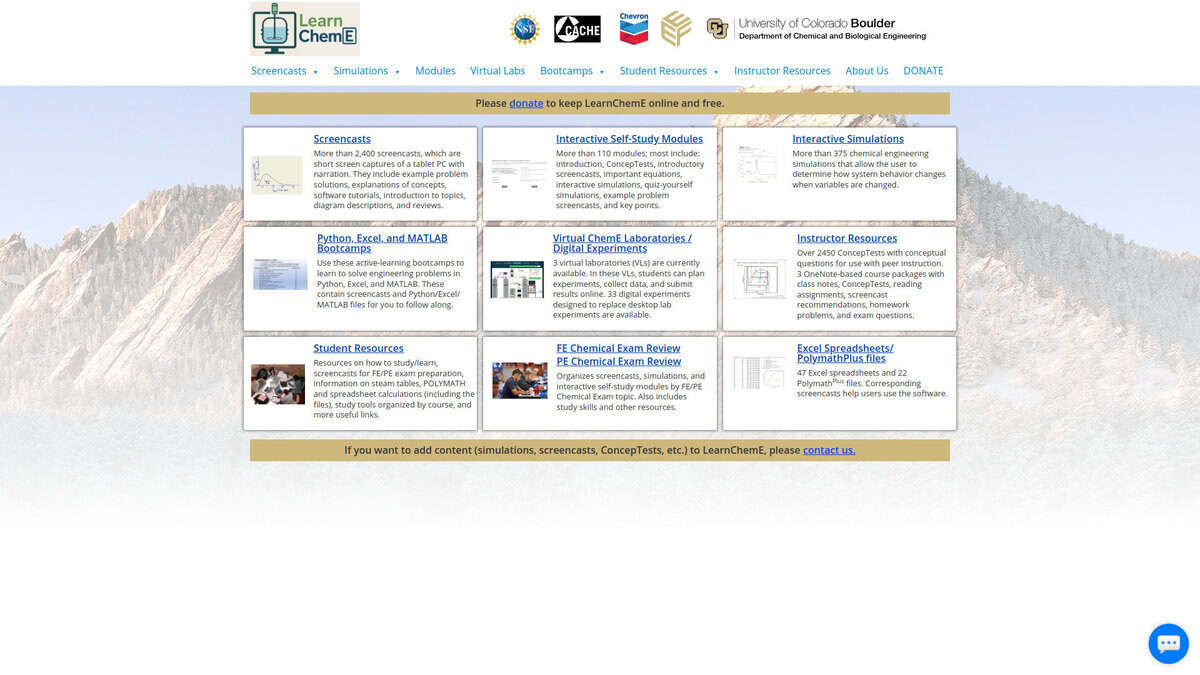
| Technical scope and level: The library is built for chemical and biological engineering, with screencasts for 14 courses and interactive simulations for 10 courses. | Technical scope and level: The science courses listed cover chemistry and physics at middle school, high school and Advanced Placement level. That list contains no engineering or college-level courses. | Technical scope and level: Courses, Specializations, Professional Certificates and degrees are offered across many subjects by universities and companies. |
| Learning formats: The site holds more than 1,700 screencasts, more than 200 interactive simulations, more than 55 self-study modules and more than 1,900 ConcepTests for instructors. It also offers two virtual lab experiments and three complete instructor course packages. | Learning formats: Learning is based on videos, articles, practice questions and lessons. | Learning formats: Offerings include courses, Specializations, Professional Certificates, degrees and tutorial-style Guided Projects. Most courses can be audited, which gives access to class instruction and most materials. |
| Cost model: It is a free online resource for chemical and biological engineering students and instructors, offered through a website and a YouTube channel. Support comes from the National Science Foundation, a university fund, industry sponsors and the host department. | Cost model: Learning is always free, and the organisation is a 501(c)3 non-profit funded by individual donations and grants. There are no ads or contracts. | Cost model: Auditing is free but excludes graded assessments and certificates. Certificates require a paid upgrade, Coursera Plus is a paid subscription, and financial aid exists for learners who cannot pay. |
| Origin and authorship: The platform was created by professors John Falconer, Janet deGrazia and Will Medlin of the University of Colorado Boulder, with contributions from more than 20 faculty. | Origin and authorship: The material is produced by the non-profit organisation itself and is not tied to a single university department. | Origin and authorship: Instruction comes from more than 300 universities and companies, including Johns Hopkins, Duke, Google and IBM. |