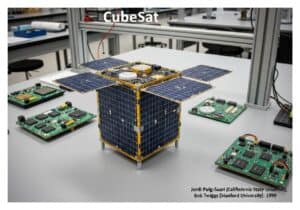
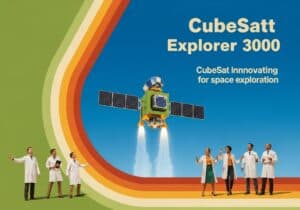
CubeSats are small, standardized satellites typically measuring 10x10x10 cm and weighing around 1.33 kg per unit, designed for various space missions. They emerged in the early 2000s as a cost-effective solution for universities, research institutions, and small companies to access space, enabling rapid development and deployment. Their modular design allows for scalability, making it easier to create larger systems by combining multiple units. Benefits include lower launch costs, shorter development timelines, and the ability to test new technologies in orbit. CubeSats have been used for Earth observation, scientific research, and technology demonstration, contributing to advancements in space exploration and data collection.
CubeSats made small satellites a university project. Their business cases are on satellite internet constellations, science missions on space exploration and astrophysics, and sensor payloads on MEMS. Group flying is on swarm robotics.
This is our latest selection of worldwide publications and patents in english on CubeSats, between many scientific online journals, classified and focused on Cubesat, 1U, 2U, NANOSATC-BR, 3U, RBF pin, nanosatellite, piggyback, deployment switch, rideshare, payload, ADCS, space exploration, 6U, P-POD, Poly-Picosatellite, Orbital Deployer, 12U, Picosat, NANOSAT, Deployer and QB50.
Humanoid-native predictive actuation validation using whole-body runtime state
Patent published on the 2026-11-05 in US under Ref US20260346448 by CARTWRIGHT DORIAN [US] (Cartwright Dorian [us])
Abstract: A humanoid robot intercepts a candidate humanoid action before actuator-command dispatch and obtains whole-body runtime state including body configuration and a support, contact, environment, object, human-relative, or actuator state. A predictive actuation validator predicts future physical consequences of executing the candidate action over an action-dependent prediction horizon and evaluates the consequences against humanoid-native criteria including stability, support contact, self-collision[...]
Our summary: A humanoid robot intercepts actions before actuator commands are dispatched, obtaining whole-body runtime state. A predictive actuation validator forecasts physical consequences of actions based on humanoid-native criteria. The validator can dynamically select evaluators to assess various consequence classes for a common action.
predictive actuation, humanoid robot, runtime state, validation
Patent
A method and system for deploying and collecting masses
Patent published on the 2026-11-05 in WO under Ref WO2026229781 by FLYZ LTD [IL] (Ben Shalom Itamar Moshe [il], Shafran Ron [il])
Abstract: A method and system for deploying a mass to a surface or collecting the mass from the surface, the system comprising: an aerial robot, having connected thereto: a carrier configured to hold the mass that a center of mass of the aerial robot remains substantially unchanged during flight; an advancement mechanism configured to advance the mass toward a distal end of the aerial robot, the advancement mechanism also configured to tilt the mass relative to a longitudinal axis of the aerial robot when[...]
Our summary: The system involves an aerial robot that deploys and collects a mass while maintaining its center of mass. It includes an advancement mechanism to position and tilt the mass before attachment. A processor controls the mechanism to ensure proper force application for secure attachment to the surface.
aerial robot, mass deployment, advancement mechanism, attachment system
Patent
Methods and apparatuses for adaptive concatenation in nr l2
Patent published on the 2026-11-05 in US under Ref US20260353172 by INTERDIGITAL PATENT HOLDINGS INC [US] (Hoang Tuong [ca], Alfarhan Faris [ca], Turtinen Samuli [fi], Wei Chia-hung [us], Freda Martino [ca], Martin Brian [gb], Kubota Keiichi [jp], Teyeb Oumer [ca], Periard Francois [ca], Adjakple Pascal [us], Pelletier Ghyslain [ca])
Abstract: A method may be implemented by a wireless transmit/receive unit (WTRU), and may include receiving configuration information, wherein the configuration information comprises one or more conditions associated with packet concatenating, and wherein the one or more conditions comprise a concatenation time window. A concatenated payload that comprises a plurality of protocol data units (PDUs) or a service data units (SDUs) may be generated based on the concatenation time window. One or more QoS param[...]
Our summary: The method involves a WTRU receiving configuration information for packet concatenation. A concatenated payload is generated based on a defined time window. QoS parameters are determined and used for sending the concatenated payload.
adaptive concatenation, WTRU, QoS parameters, protocol data units
Patent
harnessing photonic mass for advanced propulsion
Patent published on the 2026-11-05 in WO under Ref WO2026231163 by RIVAS SANZ RAUL EDUARDO [US] (Rivas-sanz Raul Eduardo [us])
Abstract: Building on the insight that photons possess a constant mass, this invention introduces an advanced spacecraft design that leverages the medium in which light travels – the "ether". Incorporating a unique combination of Bernoulli s principle and electromagnetic properties, the disc-shaped spacecraft utilizes funnel structures and a dual-charge system to channel the ether s flow. This mechanism results in both lift and thrust, suggesting potential speeds beyond that of light. The design facilit[...]
Our summary: This invention proposes a disc-shaped spacecraft that utilizes photonic mass and ether flow for propulsion. It combines Bernoulli s principle with electromagnetic properties to generate lift and thrust. The design suggests potential for speeds exceeding that of light, revolutionizing interstellar travel.
photonic mass, advanced propulsion, spacecraft design, ether flow
Patent
Indicating information in random access procedure
Patent published on the 2026-11-05 in US under Ref US20260353466 by INTERDIGITAL PATENT HOLDINGS INC [US] (Turtinen Samuli [fi], Alfarhan Faris [ca], Hoang Tuong [ca], Periard Francois [ca], Freda Martino [ca], Martin Brian [gb], Kubota Keiichi [jp], Pani Diana [ca], Pelletier Ghyslain [ca], Marinier Paul [ca], Wei Chia-hung [us])
Abstract: Systems, methods, and instrumentalities for indicating information in random access (RA) procedure(s) are disclosed herein. A wireless transmit/receive unit (WTRU) (e.g., a processor thereof) may receive, from a network, a configuration of one or more random access (RA) formats. A (e.g., each) RA format may be associated with a respective preamble and a respective payload. The WTRU may detect an RA trigger condition. The WTRU may select, based on one or more of the detected RA trigger condition [...]
Our summary: Systems and methods for indicating information in random access procedures are described. A wireless transmit/receive unit receives configuration details for various random access formats. The unit detects trigger conditions to select and transmit the appropriate preamble and payload.
random access, wireless transmit/receive unit, RA format, preamble
Patent
Hybrid nanoparticles for targeted delivery of senolytics for the treatment of osteoarthritis
Patent published on the 2026-11-05 in US under Ref US20260345491 by UNIV OF KENTUCKY RESEARCH FOUNDATION [US] (Annamalai Ramkumar Tiruvannamalai [us], Prajapati Sushant [us])
Abstract: [0000] A hybrid nanoparticle. The hybrid nanoparticle includes a synthetic lipid bilayer made of phosphatidylcholine, cholesterol, and a PEGylated phospholipid including a maleimide-functionalized PEG lipid and a biomembrane component derived from chondrocytes and incorporated into the synthetic lipid bilayer. The biomembrane component includes at least one SNARE protein configured to promote homotypic membrane fusion with chondrocytes and CD47 configured to inhibit phagocytic uptake. The hybrid[...]
Our summary: The hybrid nanoparticle consists of a synthetic lipid bilayer and a biomembrane component from chondrocytes. It is designed for targeted delivery of senolytics to treat osteoarthritis by promoting internalization into chondrocytes. The nanoparticle improves residence time in the joint compared to standard nanoparticles.
hybrid nanoparticles, targeted delivery, senolytics, osteoarthritis
Patent
Real-Time Axle-Load Sensing and AI-Enhanced Braking-Distance Prediction for Multi-Axle Heavy-Duty Trucks
Published on 2026-02-03 by Duk Sun Yun, Byung Chul Lim @MDPI
Abstract: Accurate braking-distance prediction for heavy-duty multi-axle trucks remains challenging due to the large gross vehicle weight, tandem-axle interactions, and strong transient load transfer during emergency braking. Recent studies on tire–road friction estimation, commercial-vehicle braking control (EBS/AEBS), and weigh-in-motion (WIM) sensing have highlighted that unmeasured vertical-load dynamics and time-varying friction are key sources of prediction uncertainty. To address thes[...]
Our summary: This study presents a framework for real-time axle-load sensing and AI-enhanced braking-distance prediction for heavy-duty trucks. It integrates dynamic load estimation with friction sensing and machine learning to improve prediction accuracy. The results show significant enhancements in braking-distance predictions compared to traditional methods, supporting advanced driver-assistance and safety management systems.
Axle-Load Sensing, Braking-Distance Prediction, Machine Learning, Heavy-Duty Trucks
Publication
Coverage Ratio–Based Evaluation of Antenna Omnidirectionality for a Pair of Microstrip Patch Antennas on a 6U CubeSat
Published on 2026-02-03 by Daisuke Nakayama, Kei Sano, Rin Sato, Tohlu Matsushima, Yuki Fukumoto @MDPI
Abstract: CubeSat missions increasingly rely on microwave-band communication systems, whose antennas often exhibit directional radiation patterns. As a result, multiple antennas are commonly used to improve coverage; however, a quantitative method to evaluate their performance across all spacecraft attitudes has been lacking. This paper introduces the Coverage Ratio of CubeSat Attitude (CRCA), a metric that quantifies the proportion of orientations for which the antenna gain exceeds a required threshold. [...]
Our summary: This paper presents the Coverage Ratio of CubeSat Attitude (CRCA) metric to evaluate antenna performance across spacecraft orientations. It demonstrates the CRCA using the S-band command antenna system of the 6U CubeSat VERTECS. The study compares antenna configurations and shows the effectiveness of the proposed metric in assessing communication performance under varying attitudes.
Coverage Ratio, Antenna Omnidirectionality, CubeSat, Microwave Communication
Publication