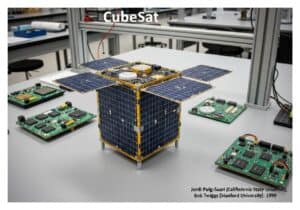

Os CubeSats são pequenos satélites padronizados, geralmente medindo 10x10x10 cm e pesando cerca de 1,33 kg por unidade, projetados para diversas missões espaciais. Surgiram no início dos anos 2000 como uma solução de baixo custo para universidades, instituições de pesquisa e pequenas empresas acessarem o espaço, permitindo desenvolvimento e implantação rápidos. Seu design modular permite escalabilidade, facilitando a criação de sistemas maiores pela combinação de múltiplas unidades. Os benefícios incluem custos de lançamento mais baixos, prazos de desenvolvimento mais curtos e a capacidade de testar novas tecnologias em órbita. Os CubeSats têm sido usados para observação da Terra, pesquisa científica e demonstração de tecnologia, contribuindo para avanços na exploração espacial e na coleta de dados.
Os CubeSats transformaram pequenos satélites em um projeto universitário. Seus estudos de caso estão em constelações de internet via satélitemissões científicas em exploração espacial e astrofísicae cargas úteis de sensores em MEMSO voo em grupo está em andamento. robótica de enxame.
Esta é a nossa mais recente seleção de publicações e patentes mundiais em inglês sobre CubeSats, entre diversos periódicos científicos online, classificadas e focadas em Cubesat, 1U, 2U, NANOSATC-BR, 3U, pino RBF, nanossatélite, piggyback, interruptor de implantação, compartilhamento de carga, carga útil, ADCS, exploração espacial, 6U, P-POD, Poly-Picosatellite, Orbital Deployer, 12U, Picosat, NANOSAT, Deployer e QB50.
Method for Variance-Based Jitter Analysis and Measurement in Multi-Level PAM Eye Diagrams Using Finite Mixture Models
Patent published on the 2026-11-19 in US under Ref US20260367124 by WU DONGHONG [US] (Wu Donghong [us])
Abstract: A method is disclosed for variance-based jitter analysis and measurement in high-speed serial communication systems using multi-level Pulse Amplitude Modulation (PAM-n) eye diagrams. The invention redefines jitter as statistical variance, extending analysis beyond the time domain into the amplitude domain. The method includes editing the PAM-n eye diagram into a one-unit interval (1UI) pattern, selecting level groups, and acquiring a horizontal lane histogram to establish a reference mean and st[...]
Our summary: The method provides variance-based jitter analysis in multi-level PAM eye diagrams. It employs Gaussian Mixture Models to decompose jitter components. This approach enhances measurement precision in high-speed serial communication systems.
Jitter Analysis, PAM Eye Diagrams, Finite Mixture Models, Gaussian Mixture Model
Patent
Robot device that remains on the surface of ice
Patent published on the 2026-11-19 in WO under Ref WO2026236859 by UNIV DE MAGALLANES [CL] (Rada Giacaman Camilo Andrés [cl])
Abstract: An autonomous robot device, which is capable of remaining on top of ice and which operates under critical environmental conditions, such as ice build-up, snowfall, rain and freezing rain, in order to operate effectively and keep itself and its instruments safe and operational, said device comprising: a moving platform and a central shaft supporting the moving platform; the upper section of the central shaft has a toothed covering or sleeve designed to remove ice from the central shaft when it mo[...]
Our summary: The device is an autonomous robot designed to operate on ice under harsh conditions. It features a moving platform and a central shaft with an ice-removing mechanism. Equipped with solar panels and various sensors, it captures and transmits critical data while maintaining operational safety.
autonomous robot, ice management, environmental sensors, solar power
Patent
Methods, systems and devices for providing low latency communications for unmanned aerial vehicles (uavs) over terrestrial 5g networks
Patent published on the 2026-11-19 in US under Ref US20260371321 by AT & T IP I LP [US] (Vivanco Daniel [us], Jia Yupeng [us])
Abstract: Aspects of the subject disclosure may include, for example, receiving unmanned aerial vehicle (UAV) data traffic comprising command and control (C2) data traffic and payload data traffic, configuring a first cell of a first base station for a mini-slot transmission scheme, and identifying a second cell of a second base station that is configured for a regular slot transmission scheme. Further embodiments include transmitting the C2 data traffic to the first base station, the first base station t[...]
Our summary: This document discusses methods and systems for low latency communication for UAVs over 5G networks. It details the transmission of command and control data and payload data using different slot transmission schemes. The first base station uses a mini-slot scheme for C2 data, while the second base station uses a regular slot scheme for payload data.
UAV, 5G, low latency, communication
Patent
First-person view (fpv) drone carrier uav
Patent published on the 2026-11-19 in WO under Ref WO2026240743 by STEPURA OLEKSANDR [UA] (Stepura Oleksandr [ua])
Abstract: The invention relates to a field of unmanned aerial vehicles (UAVs) that act as carriers for other UAVs that imply remote control of the UAV based on a first- person view, i.e., FPV drones. The FPV drone carrier UAV comprises a self-powered payload platform that is equipped with a flight control tool and an FPV drone fixation mechanism. The carrier UAV is equipped with a real-time video signal relay device that is arranged on the payload platform and comprises a system for receiving an analog si[...]
Our summary: The invention describes a first-person view (FPV) drone carrier UAV designed to transport other UAVs. It features a self-powered platform with a flight control tool and a video signal relay system. This system enhances the operational range of FPV systems by utilizing real-time video transmission capabilities.
FPV drones, UAV carrier, video signal relay, flight control
Patent
System and method for interfacing applications with blockchain networks
Patent published on the 2026-11-19 in US under Ref US20260370500 by R SQUARED LABS LLC [US] (Rosenthal Robert [us])
Abstract: The present invention provides systems and methods for interfacing a host software application with a blockchain network to conduct a blockchain transaction initiated through the host application, which includes binding a user s application identity with a user s blockchain account. Action data representing a user action triggered in the host application during an authenticated session and including authorization data for the user s access to the application is generated and received. The system[...]
Our summary: This invention enables host applications to interface with blockchain networks for transactions. It binds user identities to blockchain accounts and converts action data into compatible payloads. The system facilitates transaction execution through a sponsor wallet service and provides response data to the host application.
blockchain, transaction, application interface, payload data
Patent
Combining downlink control information (dci) for accurate payload decoding
Patent published on the 2026-11-19 in WO under Ref WO2026240921 by QUALCOMM INC [US] (Uziel Lior [us], Berger Peer [us], Oved Tal [us])
Abstract: This disclosure provides methods, components, devices and systems for combining downlink control information (DCI) for accurate payload decoding. A user equipment (UE) may receive control signaling that indicates a set of resources to receive a first DCI message and a retransmission of the first DCI message, along with mapping information that indicates a second set of bit fields included within the retransmission that are unchanged relative to a first set of bit fields included within the first[...]
Our summary: This disclosure presents methods for combining downlink control information (DCI) to enhance payload decoding. User equipment (UE) receives control signaling indicating resources for a first DCI message and its retransmission. The UE decodes the DCI payload by integrating log-likelihood ratios from both the original and retransmitted messages.
downlink control information, payload decoding, user equipment, log-likelihood ratios
Patent
Real-Time Axle-Load Sensing and AI-Enhanced Braking-Distance Prediction for Multi-Axle Heavy-Duty Trucks
Published on 2026-02-03 by Duk Sun Yun, Byung Chul Lim @MDPI
Abstract: Accurate braking-distance prediction for heavy-duty multi-axle trucks remains challenging due to the large gross vehicle weight, tandem-axle interactions, and strong transient load transfer during emergency braking. Recent studies on tire–road friction estimation, commercial-vehicle braking control (EBS/AEBS), and weigh-in-motion (WIM) sensing have highlighted that unmeasured vertical-load dynamics and time-varying friction are key sources of prediction uncertainty. To address thes[...]
Our summary: This study presents a framework for real-time axle-load sensing and AI-enhanced braking-distance prediction for heavy-duty trucks. It integrates dynamic load estimation with friction sensing and machine learning to improve prediction accuracy. The results show significant enhancements in braking-distance predictions compared to traditional methods, supporting advanced driver-assistance and safety management systems.
Axle-Load Sensing, Braking-Distance Prediction, Machine Learning, Heavy-Duty Trucks
Publication
Coverage Ratio–Based Evaluation of Antenna Omnidirectionality for a Pair of Microstrip Patch Antennas on a 6U CubeSat
Published on 2026-02-03 by Daisuke Nakayama, Kei Sano, Rin Sato, Tohlu Matsushima, Yuki Fukumoto @MDPI
Abstract: CubeSat missions increasingly rely on microwave-band communication systems, whose antennas often exhibit directional radiation patterns. As a result, multiple antennas are commonly used to improve coverage; however, a quantitative method to evaluate their performance across all spacecraft attitudes has been lacking. This paper introduces the Coverage Ratio of CubeSat Attitude (CRCA), a metric that quantifies the proportion of orientations for which the antenna gain exceeds a required threshold. [...]
Our summary: This paper presents the Coverage Ratio of CubeSat Attitude (CRCA) metric to evaluate antenna performance across spacecraft orientations. It demonstrates the CRCA using the S-band command antenna system of the 6U CubeSat VERTECS. The study compares antenna configurations and shows the effectiveness of the proposed metric in assessing communication performance under varying attitudes.
Coverage Ratio, Antenna Omnidirectionality, CubeSat, Microwave Communication
Publication