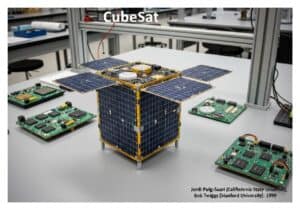
CubeSats are small, standardized satellites typically measuring 10x10x10 cm and weighing around 1.33 kg per unit, designed for various space missions. They emerged in the early 2000s as a cost-effective solution for universities, research institutions, and small companies to access space, enabling rapid development and deployment. Their modular design allows for scalability, making it easier to create larger systems by combining multiple units. Benefits include lower launch costs, shorter development timelines, and the ability to test new technologies in orbit. CubeSats have been used for Earth observation, scientific research, and technology demonstration, contributing to advancements in exploration spatiale et la collecte de données.
Voici notre dernière sélection de publications et brevets mondiaux en anglais sur les CubeSats, parmi de nombreuses revues scientifiques en ligne, classées et axées sur Cubesat, 1U, 2U, NANOSATC-BR, 3U, RBF pin, nanosatellite, piggyback, commutateur de déploiement, rideshare, charge utile, ADCS, exploration spatiale, 6U, P-POD, Poly-Picosatellite, Orbital Deployer, 12U, Picosat, NANOSAT, Deployer et QB50.
Transfection of cells on three-dimensional cell constructs with surface-capped protein nanoparticles
Patent published on the 2026-06-11 in WO under Ref WO2026122687 by THE REGENTS OF THE UNIV OF MICHIGAN [US] (Xhyliu Fjorela [us], Mun Seongjun [us], Lahann Joerg [us])
Abstract: A method of manipulating cell genetics includes transferring a genetic payload from at least one non-viral nanoparticle capable of penetrating tissue to at least one cell growing and supported on a three-dimensional construct by contacting the nanoparticle with the at least one cell. The transferring occurs without disassociating or breaking up the three-dimensional construct. Also provided is a genetic cell manipulation system, including a three-dimensional cell construct configured to support [...]
Our summary: This method enables the transfection of cells using non-viral nanoparticles within three-dimensional cell constructs. The nanoparticles, designed with a water-soluble protein core and a positively-charged surface, deliver genetic payloads effectively. The process maintains the integrity of the three-dimensional construct during cell manipulation.
Transfection, Nanoparticles, Three-dimensional constructs, Genetic manipulation
Patent
Collective contextual intelligence for enhanced vulnerability assessment and penetration testing
Patent published on the 2026-06-11 in US under Ref US20260161801 by VASUDEVAN PRATHAPACHANDRAN (Abdulmajeed Rejah Rehim Angadithodiyil [in], Vasudevan Prathapachandran)
Abstract: A specially-configured computing system executes a computer-implemented method to improve automated vulnerability-assessment and penetration-testing technology. The system receives heterogeneous security-related data streams including static-analysis results, threat-intelligence feeds, SBOM records, network-telemetry feeds, and cloud-infrastructure information for a protected computing environment. A contextually-adaptive-test-case-selection engine comprising a Bayesian-network model constructs [...]
Our summary: The system enhances vulnerability assessment and penetration testing by utilizing heterogeneous security data streams. It employs a contextually-adaptive test-case selection engine and an exploit-simulation engine to autonomously execute tailored attack sequences. The system also includes a re-validation module to verify results and continuously updates records with new findings.
vulnerability assessment, penetration testing, contextual intelligence, exploit simulation
Patent
Linker for antibody-drug conjugates and antibody-drug conjugates comprising the linker
Patent published on the 2026-06-11 in WO under Ref WO2026122978 by THE US SECRETARY DEPARTMENT OF HEALTH AND HUMAN SERVICES [US] (Schnermann Martin J [us], Matikonda Siddharth [us], Klapper Lily Marie [us], Brognard John [us], Li Xiaoyi [us])
Abstract: Disclosed herein are linkers suitable for use in antibody-drug conjugates (ADCs), and ADCs comprising the linkers. The ADCs may be suitable for treating or preventing cancer, such as head and neck squamous cell carcinomas (HNSCCs), glioma, breast cancer, colorectal cancer, prostate cancer, squamous cell carcinoma, ovarian cancer, endometrial cancer and/or lung cancer. Such ADCs comprise an antibody that targets the cancer, such as an EGFR-targeting antibody, and a drug suitable for treating the [...]
Our summary: The content discusses linkers for antibody-drug conjugates (ADCs) used in cancer treatment. It highlights ADCs targeting various cancers with specific antibodies and drugs. Methods for making and using these ADCs are also disclosed.
Linker, antibody-drug conjugates, cancer treatment, mTOR inhibitor
Patent
Mitigating sample-interleaving distortion through decorrelated waveform averaging
Patent published on the 2026-06-11 in WO under Ref WO2026123015 by LAWRENCE LIVERMORE NAT SECURITY LLC [US] (Buckley Brandon Walter [us])
Abstract: Methods and systems for optimally detuning the ratio of analog-to-digital (ADC) sample rate and trigger rate during waveform averaging to minimize the deleterious effects from sample interleaving are described. In some examples, the optimal detuning factor is based on the number of ADC cores used and the limited tuning resolution of the clock rates. An example method includes providing, by a clock generation circuit, an analog-to-digital (ADC) clock to a bank of ADCs, and adjusting at least one [...]
Our summary: The content discusses methods to mitigate sample-interleaving distortion through decorrelated waveform averaging. It describes optimizing the ratio of ADC sample rate and trigger rate to minimize distortion effects. The method involves adjusting clock parameters to ensure the frequencies are relatively prime.
sample-interleaving, waveform averaging, ADC clock, optimal detuning
Patent
Lineage-loci engineered cell therapy and related methods of producing and using same
Patent published on the 2026-06-11 in WO under Ref WO2026123001 by UMOJA BIOPHARMA INC [US] (O'hara Samantha [us], Romanov Artem [us], Koning Ryan [us], Vereide David T [us], Yingst Ashley M [us], Jarrell Dillon [us])
Abstract: Provided herein are genetically engineered cells containing a payload in a lineage specific locus and related methods and uses thereof in cell therapy. In some embodiments, the cells are genetically engineered with a CAR, such that expression of the CAR is delayed until the cell is differentiated to a lineage. In some embodiments, the genetically modified cells can be selected for using a selection cassette. Also provided are cell compositions containing the engineered cells, and related methods[...]
Our summary: This content discusses lineage-loci engineered cell therapy and methods for producing genetically engineered cells. It highlights the use of CARs that are expressed upon cell differentiation. Additionally, it covers cell compositions, selection methods, and applications in cancer immunotherapy.
cell therapy, genetically engineered cells, CAR, lineage-specific locus
Patent
System and method for picking industrial infrastructure from dynamically sized stacks
Patent published on the 2026-06-11 in US under Ref US20260159366 by SEEGRID CORP [US] (Spletzer John [us], Jensen Austin [us], Hoang Tru [us], Kelly Sean P [us])
Abstract: [0000] A robotic vehicle, such as an autonomous mobile robot (AMR), is provided, comprising a chassis; a navigation system configured to navigate the AMR to stacked infrastructures; at least one sensor including a payload presence sensor configured to perform a vertical scan of the stacked infrastructures; and at least one processor. The at least one processor is configured to estimate a height of the stacked infrastructures using data generated by the payload presence sensor and estimate a heig[...]
Our summary: The system describes a robotic vehicle designed to navigate and interact with stacked infrastructures. It utilizes a navigation system and sensors to perform vertical scans. The processor estimates the heights of both the stacked infrastructures and target infrastructures for efficient operation.
robotic vehicle, autonomous mobile robot, navigation system, payload presence sensor
Patent
yet another quantum quantizer design space exploration of quantum gate sets using novelty search
Published on 2026-04-09 by Aritra Sarkar, Akash Kundu, Matthew Steinberg, Sibasish Mishra, Sebastiaan Fauquenot, Tamal Acharya, Jaros?aw A Miszczak and Sebastian Feld @IOP SCIENCE
Abstract: The standard model of quantum computation is based on quantum circuits, where the number and quality of the quantum gates composing the circuit influence the runtime and fidelity of the computation. The fidelity of the decomposition of quantum algorithms, represented as unitary matrices, to bounded depth quantum circuits depends strongly on the set of gates available for the decomposition routine. To investigate this dependence, we explore the design space of discrete quantum gate sets and prese[...]
Our summary: This study explores the design space of quantum gate sets using a software tool called YAQQ. It evaluates gate sets based on circuit depth, process fidelity, and novelty. The findings highlight optimized gate sets for quantum algorithms and practical applications in error correction and instruction set design.
quantum gates, novelty search, circuit decomposition, quantum fidelity
Publication
Real-Time Axle-Load Sensing and AI-Enhanced Braking-Distance Prediction for Multi-Axle Heavy-Duty Trucks
Published on 2026-02-03 by Duk Sun Yun, Byung Chul Lim @MDPI
Abstract: Accurate braking-distance prediction for heavy-duty multi-axle trucks remains challenging due to the large gross vehicle weight, tandem-axle interactions, and strong transient load transfer during emergency braking. Recent studies on tire–road friction estimation, commercial-vehicle braking control (EBS/AEBS), and weigh-in-motion (WIM) sensing have highlighted that unmeasured vertical-load dynamics and time-varying friction are key sources of prediction uncertainty. To address thes[...]
Our summary: This study presents a framework for real-time axle-load sensing and AI-enhanced braking-distance prediction for heavy-duty trucks. It integrates dynamic load estimation with friction sensing and machine learning to improve prediction accuracy. The results show significant enhancements in braking-distance predictions compared to traditional methods, supporting advanced driver-assistance and safety management systems.
Axle-Load Sensing, Braking-Distance Prediction, Machine Learning, Heavy-Duty Trucks
Publication