Product Design, Manufacturing & Innovation Resources
Home » CE Marking

CE Marking

1993-07-22
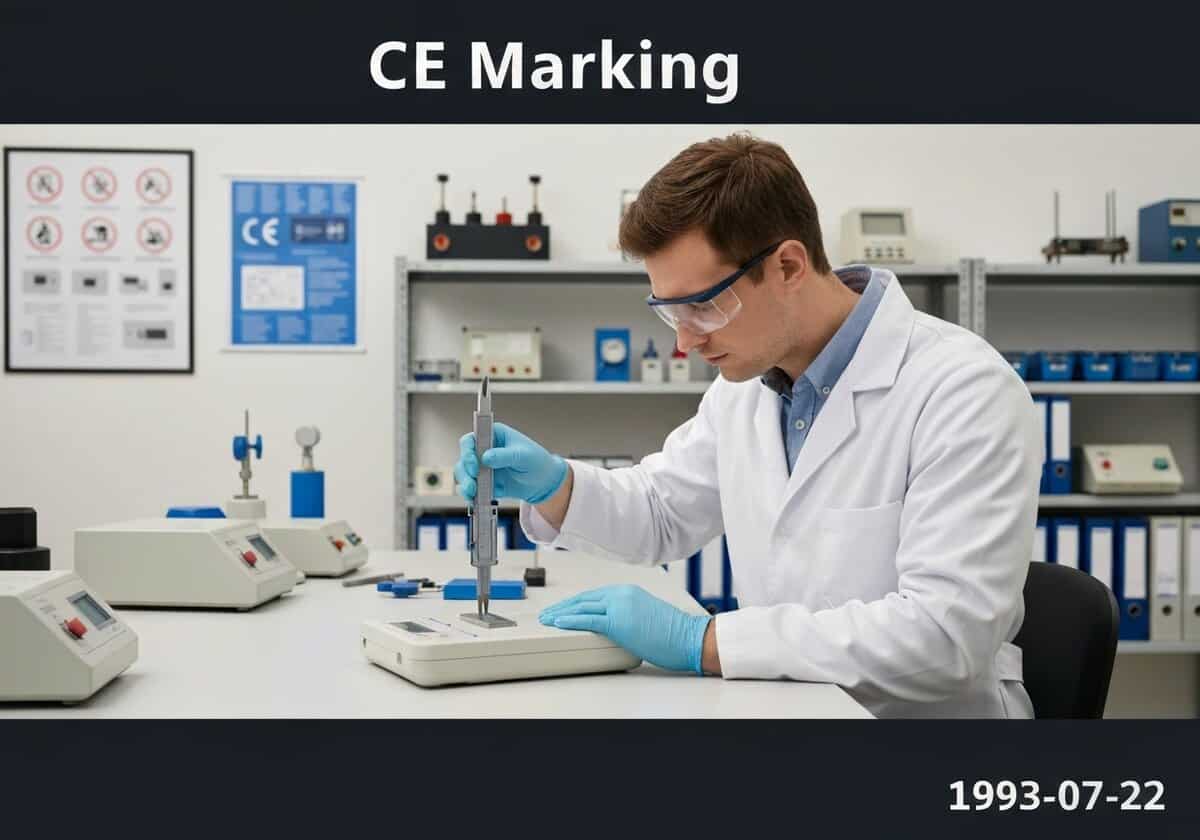
Quality control laboratory with technician inspecting product for CE marking compliance.

(generated image for illustration only)

The CE marking, an abbreviation of “Conformité Européenne” (French for “European Conformity”), is a mandatory certification mark for certain products sold within the European Economic Area (EEA). It signifies that the manufacturer has verified the product meets EU safety, health, and environmental protection requirements. It is not a quality mark but a declaration of conformity with relevant legislation. CE is among the manufacturing terms and acronyms that every exporter meets, along with RoHS and REACH.


The CE marking is a key indicator of a product’s compliance with EU legislation and enables the free movement of products within the European market. By affixing the CE marking on a product, a manufacturer is declaring, on their sole responsibility, conformity with all of the legal requirements to achieve CE marking. The manufacturer is thus ensuring validity for that product to be sold throughout the European Economic Area (EEA), which consists of the 27 member states of the EU and European Free Trade Association countries Iceland, Liechtenstein, and Norway. This also applies to products made in third countries which are sold in the EEA.

It is crucial to understand that the CE marking does not indicate that a product was made in the EEA, but merely that it has been assessed before being placed on the market. It signifies that the manufacturer has verified that the product complies with all relevant essential requirements (e.g., safety, health, environmental protection) of the applicable directive(s). The mark is not a mark of origin, nor is it a quality certification for consumers. It is primarily a tool for market surveillance authorities of the member states, providing them with a presumption of conformity that allows products to circulate freely. The responsibility for ensuring compliance and affixing the mark lies entirely with the manufacturer or their authorized representative within the EU.

UNESCO Nomenclature: 3326
– Production engineering

Type

Abstract System

Disruption

Substantial

Usage

Widespread Use

Precursors

  • various national safety and technical standards in european countries (e.g., tüv in germany, bsi kitemark in the uk)
  • the treaty of rome (1957) which established the goal of a common market
  • the ‘new approach to technical harmonisation and standards’ resolution of 1985

Applications

  • facilitates free movement of goods within the european single market
  • enables market surveillance by public authorities
  • provides consumers with a baseline assurance of product safety
  • harmonizes technical legislation across member states

Patents:

NA

Potential Innovations Ideas

  • a digital ce marking system using qr codes to link directly to the product’s declaration of conformity and technical file
  • integration of ce marking data into a blockchain ledger for immutable traceability of product compliance throughout the supply chain
  • smart ce labels that change color or display a warning if a product’s operational parameters exceed safety limits
  • an augmented reality application for customs officials to scan a product and instantly see its ce compliance status and relevant directives
  • a unified global conformity mark (g-mark) based on the ce principles, adopted by multiple international trade blocs
  • ce marking for software and ai algorithms, certifying their compliance with ethical and safety standards
  • consumer-facing apps that explain the specific eu directives a product’s ce mark complies with
  • ce marking for recycled materials, certifying their purity and safety for reuse in new products
  • a tiered ce marking system (e.g., ce+, ce-eco) to indicate compliance with standards beyond the essential requirements, such as sustainability or cybersecurity
  • automated factory systems that refuse to package a product until its ce conformity data is successfully logged
Related to: CE marking, conformité européenne, eea, product safety, eu directive, european economic area, manufacturer declaration, market access, regulatory compliance, single market.

Historical Context

CE Marking

1990
1992
1992
1993-07-22
1996
1998
1999
1990
1991
1992
1993
1994
1997
1998
1999-05-01

(if date is unknown or not relevant, e.g. "fluid mechanics", a rounded estimation of its notable emergence is provided)

10th year anniversary

Full size images and downloads are only available, 100% free, for registered members.

> Login <