
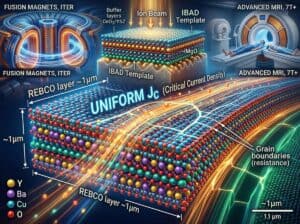
High-temperature superconductors conduct without DC resistance at temperatures far above those of conventional metallic superconductors, with critical temperatures near 90 K in REBCO. Commercial conductors are mainly REBCO coated conductor tapes and BSCCO wires. Critical current density, critical field and strain tolerance define their usefulness. Applications include fusion magnets, MRI and NMR systems, wind generators, electric aircraft motors and power cables.
Manufacturing and protection are the hard parts. Long-length tape production by ion beam assisted deposition and chemical routes must hold uniform critical current. Cost per kiloampere-meter limits market growth. Magnet designers handle quench detection, no-insulation winding, screening currents and joint resistance, because these coils store large energy in small volumes. Hydride, iron-based and nickelate superconductors extend the research frontier. The publications and patents indexed below cover conductors, magnets, cables, fault current limiters, cryogenic integration and new superconducting materials.
HTS wires carry current with no resistance at temperatures liquid nitrogen can reach. Cooling is on cryogenics, the physics on condensed matter physics. Big users are fusion magnets and particle accelerators. Grid cables link to smart grids.
This is our latest selection of worldwide publications and patents in english on High-Temperature Superconductors (HTS), between many scientific online journals, classified and focused on high-temperature superconductor, REBCO, YBCO, BSCCO, coated conductor, superconducting tape, HTS magnet, critical current density, superconducting cable, fault current limiter, superconducting magnetic energy storage, no-insulation coil, quench protection, flux pinning, iron-based superconductor, hydride superconductor, nickelate superconductor, cuprate, superconducting motor and superconducting joint.
A reduced diameter cryostat component and superconducting cable assembly employing same
Patent published on the 2026-11-04 in EP under Ref EP4835919 by SUPERNODE LTD [IE] (Acin Marcos [ie], Carlisle Andrew [ie], Stringer Peter [ie], O Donovan Daniel [ie])
Abstract: [0001] The present invention provides a cryostat component comprising an elongate cylindrical tubular sidewall formed from fibre reinforced thermoplastic and having an inner diameter of less than 50mm; wherein the fibre reinforcement is optimised to provide the cryostat component with a coefficient of thermal expansion in an axial direction of +/- 15ppm/°C, in addition to a superconducting cable assembly comprising one or more of the cryostat components, in particular for use as a former for on[...]
Our summary: The invention features a cryostat component with a cylindrical sidewall made from fibre reinforced thermoplastic. It has an inner diameter of less than 50mm and a thermal expansion coefficient of +/- 15ppm/°C. The component is designed to serve as a former for superconductors in a cable assembly.
cryostat, superconducting cable, fibre reinforced thermoplastic, thermal expansion
Patent
Critical photoinduced reflectivity relaxation dynamics in single-layer Bi-based cuprates near the pseudogap end point
Published on 2026-09-02 by T Shimizu, R Tobise, T Kurosawa, S Tsuchiya, M Oda, Y Toda, V V Kabanov, D Mihailovic and T Mertelj @IOP SCIENCE
Abstract: A comprehensive study of photoinduced transient reflectivity dynamics in heavily overdoped single-layer cuprate (Bi,Pb) Sr CuO (Pb-Bi-2201) across the end points of the pseudogap (PG) and superconducting phases was conducted using optical ultrafast time-resolved pump-probe spectroscopy. In the Pb-Bi-2201 near the proposed PG end-point doping (PGED), the transient reflectivity dynamics above resemble the PG response observed in the optimally doped La-Bi-2201. With decreasing temperature, however,[...]
Our summary: This study investigates the transient reflectivity dynamics in single-layer Bi-based cuprates near the pseudogap end point. It reveals a power-law divergence in relaxation time consistent with quantum critical behavior as temperature decreases. The findings show similarities in dynamics between heavily overdoped Pb-Bi-2201 and optimally doped La-Bi-2201.
photoinduced reflectivity, cuprates, pseudogap, ultrafast spectroscopy
Publication
Grooved, nested-cylinder, layer-wound superconducting magnets and related construction techniques
Patent published on the 2026-07-09 in WO under Ref WO2026147855 by MASSACHUSETTS INST OF TECHNOLOGY [US] (Mouratidis Theodore [us], Labombard Brian [us], Austin Samuel [us])
Abstract: Described is a no-insulation superconducting magnet design that utilizes high temperature superconducting tapes arranged in a layer-wound configuration. The design is compact, modular and utilizes a fabrication methodology that scales well for commercialization. Embodiments described herein may find use in a wide variety of applications including, but not limited to solenoidal magnets in general, including devices operating at very high magnetic field strength and also in plasma thrusters for [...]
Our summary: The content discusses a no-insulation superconducting magnet design using high temperature superconducting tapes. It emphasizes a compact and modular design suitable for commercialization. Applications include solenoidal magnets and plasma thrusters for spacecraft propulsion.
superconducting magnets, high temperature superconductors, layer-wound configuration, plasma thrusters
Patent
Modelling, Optimisation, and Construction of a High-Temperature Superconducting Maglev Demonstrator
Published on 2026-01-16 by Chenxuan Zhang, Qian Dong, Hongye Zhang, Markus Mueller @MDPI
Abstract: To achieve global carbon-neutrality goals, magnetic levitation (maglev) technologies offer a promising pathway toward sustainable, energy-efficient transportation systems. In this study, a comprehensive methodology was developed to analyse and optimise the levitation performance of high-temperature superconducting (HTS) maglev systems. Several permanent magnet guideway (PMG) configurations were compared, and an optimised PMG Halbach array design was identified that enhances flux concentration an[...]
Our summary: This study develops a methodology to optimise the levitation performance of high-temperature superconducting maglev systems. An optimised PMG Halbach array design enhances flux concentration and improves levitation performance. The 3D finite element model accurately predicts levitation forces, confirming the model s reliability for HTS maglev systems.
Superconductivity, Maglev, Finite Element Analysis, Optimisation
Publication