Product Design, Manufacturing & Innovation Resources
집 » Superconductivity

Superconductivity

1911-04-08
  • Heike Kamerlingh Onnes
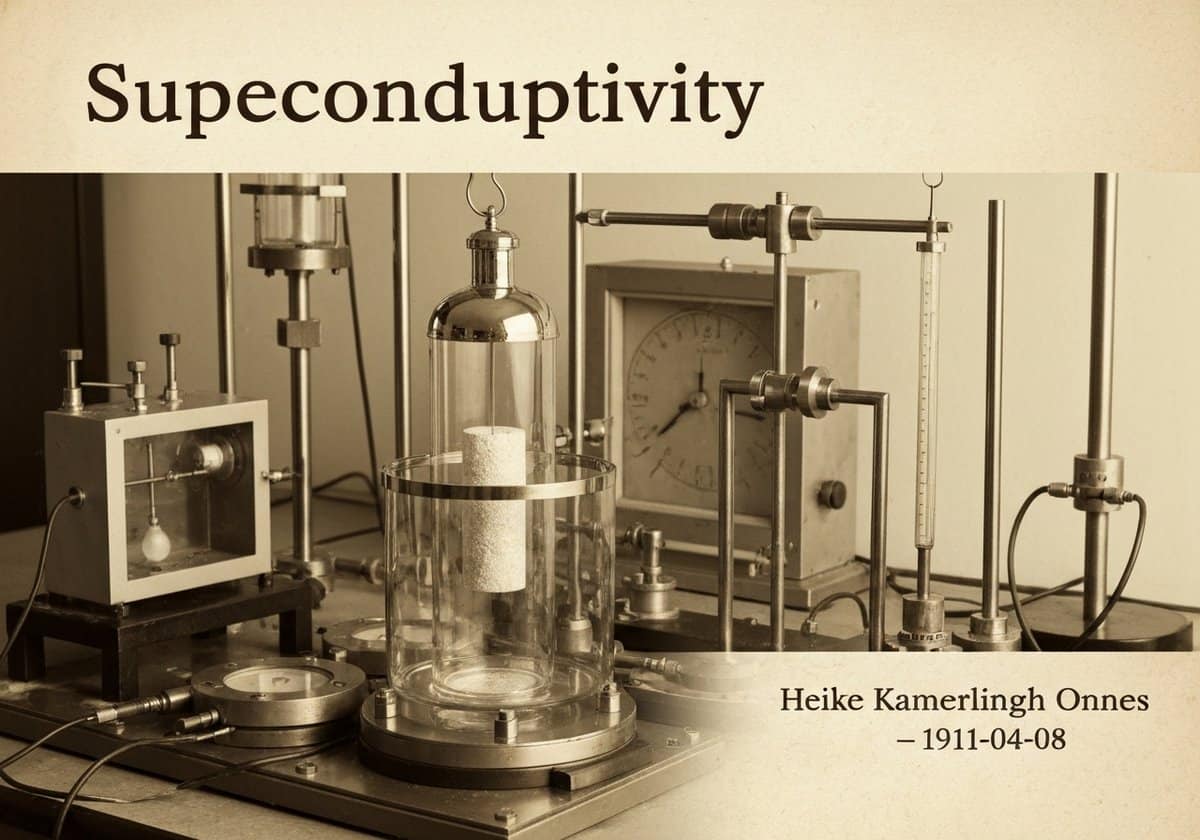
극저온 실험실 장치를 이용하여 고체 수은의 초전도 현상을 시연하는 모습.

(설명을 위한 생성된 이미지입니다)

1911년, 하이케 카메를링 오네스는 고체 수은의 저항을 연구하던 중 초전도 현상을 발견했습니다. 극저온 temperatures. He observed that the electrical resistance of mercury abruptly dropped to zero at a 임계 온도 ([latex]T_c[/latex]) of 4.2 K. This phenomenon, termed superconductivity, represents a state of matter with exactly zero electrical resistance and expulsion of magnetic fields.

The discovery was a direct consequence of Onnes’s pioneering work in low-temperature physics, specifically his successful liquefaction of helium in 1908. This achievement opened up a new temperature regime for experimental investigation, down to about 1 K. Onnes was initially investigating how the electrical resistance of pure metals behaved at these extremely low temperatures. Prevailing theories suggested that resistance would either level off to a constant value or increase again as electron motion ceased. However, when his team cooled a sample of solid mercury, they observed a sudden, complete disappearance of resistance at 4.2 K. Onnes initially suspected a short circuit but soon confirmed the phenomenon was real and intrinsic to the material. He called this new state “supraconductivity” (later superconductivity). This discovery was revolutionary because classical physics could not explain how electrons could move through a material lattice without any energy loss. It marked the birth of a new field of physics and demonstrated the existence of macroscopic quantum phenomena, where quantum effects become visible on a large scale. The zero-resistance state implies that a current induced in a superconducting loop could persist indefinitely without a power source, a concept later verified in persistent current experiments.

The implications were profound, suggesting possibilities for lossless energy transmission and the creation of extremely powerful magnets. However, the extremely low temperatures required (liquid helium temperatures) made practical applications challenging for many decades. The discovery spurred a global research effort to find materials with higher critical temperatures and to develop a theoretical understanding of the underlying mechanism, a puzzle that would remain unsolved for nearly 50 years until the advent of the BCS theory.

UNESCO Nomenclature: 2211
고체물리학

유형

물리적 속성

분열

혁명가

용법

널리 사용됨

전구체

  • 헬륨의 액화 (1908)
  • development of 극저온 공학
  • 드루드 전기 전도 모델
  • 저온에서의 전기 저항에 대한 연구

응용 프로그램

  • magnetic resonance imaging (mri)
  • 입자 가속기
  • 자기부상열차
  • 초전도 양자 간섭 장치(SQUID)
  • 전력 송전선로

특허:

NA

잠재적 혁신 아이디어

  • room-temperature superconducting computer processors
  • personal maglev transportation pods
  • city-scale 초전도 자기 에너지 저장 (중소기업)
  • superconducting shielding for spacecraft against cosmic radiation
  • lossless global electricity grid
  • portable, high-field mri scanners for ambulances
  • quantum computing based on stable, high-tc superconducting qubits
  • superconducting artificial muscles for robotics
  • electromagnetic launch systems for space exploration
  • fusion reactors with more compact and efficient magnetic confinement
관련 주제: 초전도, 하이케 카메를링 오네스, 임계 온도, 제로 저항, 수은, 극저온학, 저온 물리학, 상전이 응축 물질양자역학.

역사적 맥락

Superconductivity

1907
1909
1910
1911-04-08
1913
1915
1916
1904
1907
1909
1910
1912
1915
1915-11
1916

(날짜를 알 수 없거나 관련이 없는 경우, 예를 들어 "유체역학"의 경우, 주목할 만한 등장 시기를 대략적으로 추정하여 제공합니다.)

10년차 기념일

고화질 이미지 및 다운로드는 등록된 회원에게만 100% 무료로 제공됩니다.

> 로그인 <